
When framing an AI solution for a business initiative, what is the primary reason teams define key performance indicators (KPIs)?
Select an answer to reveal the explanation.
Short Explanation and Infographic
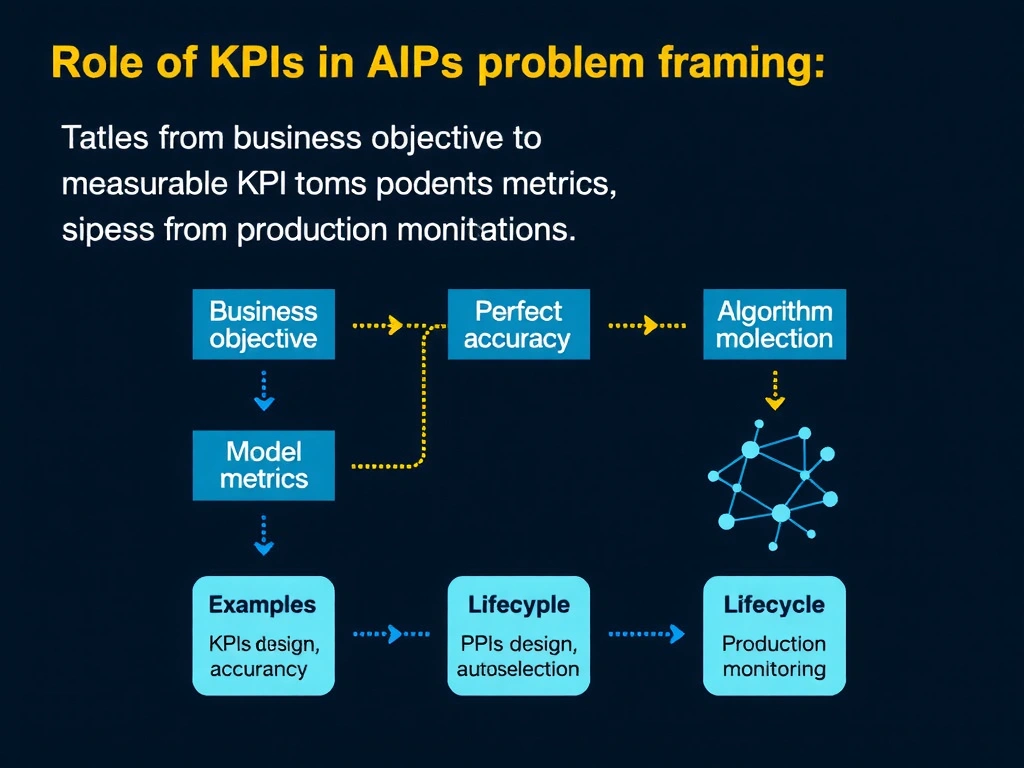
Here's the deal: KPIs aren't academic decoration—they're how you prove the AI actually moved the business needle. Think of it like this: your boss walks in and asks, "Did the fraud model save us money this quarter?" You need numbers tied to the goal—loss prevented, false-alert rate, review cost—not just "the F1 looked pretty." Pay close attention here, because teams get stuck optimizing leaderboard metrics that never map to what leadership cares about. KPIs connect model behavior to the objective: reduce churn, speed support, cut scrap. Perfect accuracy? Nice fantasy. Auto-picking the algorithm? Different job. Define KPIs early, track them honestly, and you'll know when to ship, iterate, or kill the project. Got it? Sweet. Land that takeaway: measure success against the business goal.
Full explanation below image
Full Explanation
Key performance indicators (KPIs) are quantitative measures that express whether an AI initiative is succeeding relative to a business objective. In problem analysis and solution design, defining KPIs is the bridge between a vague aspiration—such as "improve customer retention" or "reduce operational risk"—and operational targets that product, data science, and engineering teams can optimize and report against. Typical KPIs may include conversion lift, cost per successful prediction, mean time to resolution, fraud dollars avoided, or service-level adherence, often accompanied by constraints such as latency budgets, fairness thresholds, or maximum false-positive rates that protect users and operations.
The correct answer captures this purpose: KPIs measure how well the model and surrounding system progress toward the stated business goal. They guide problem framing (what to predict, when to intervene), data collection priorities, evaluation design, and go/no-go decisions at launch and in production monitoring. Technical metrics such as accuracy, AUC, or RMSE remain important, but they are intermediate signals; without linkage to business KPIs, a model can look strong offline and still fail to create value online.
The distractor that demands 100% accuracy confuses an ideal mathematical outcome with a practical success criterion. Most real systems tolerate controlled error when the net business impact is positive, and insisting on perfection can delay deployment indefinitely. The idea that KPIs exist to make the problem more complex is incorrect; well-chosen KPIs reduce ambiguity by stating what "good" means. Finally, KPIs do not by themselves select the best algorithm. Algorithm and architecture choices depend on data modality, volume, latency, interpretability needs, and infrastructure; KPIs evaluate whether the chosen approach delivers value once trained, validated, and integrated.
Best practice is to define KPIs with stakeholders early, ensure they are measurable with available instrumentation, set baselines and targets, and monitor both leading technical indicators and lagging business outcomes after deployment. Document ownership, review cadence, and thresholds for rollback or retraining. When KPI definitions drift from actual product decisions, teams optimize the wrong objective—one of the most common failure modes in applied AI. Clear KPIs therefore remain a foundational element of analyzing and solving AI problems responsibly and effectively in production settings across industries and organizational maturity levels.