
A product team wants to train, package, and deploy machine learning models without owning servers, patching GPU drivers, or wiring custom training clusters. Which capability is the main reason they would choose a managed ML platform (PaaS) such as Azure Machine Learning or Amazon SageMaker?
Select an answer to reveal the explanation.
Short Explanation and Infographic
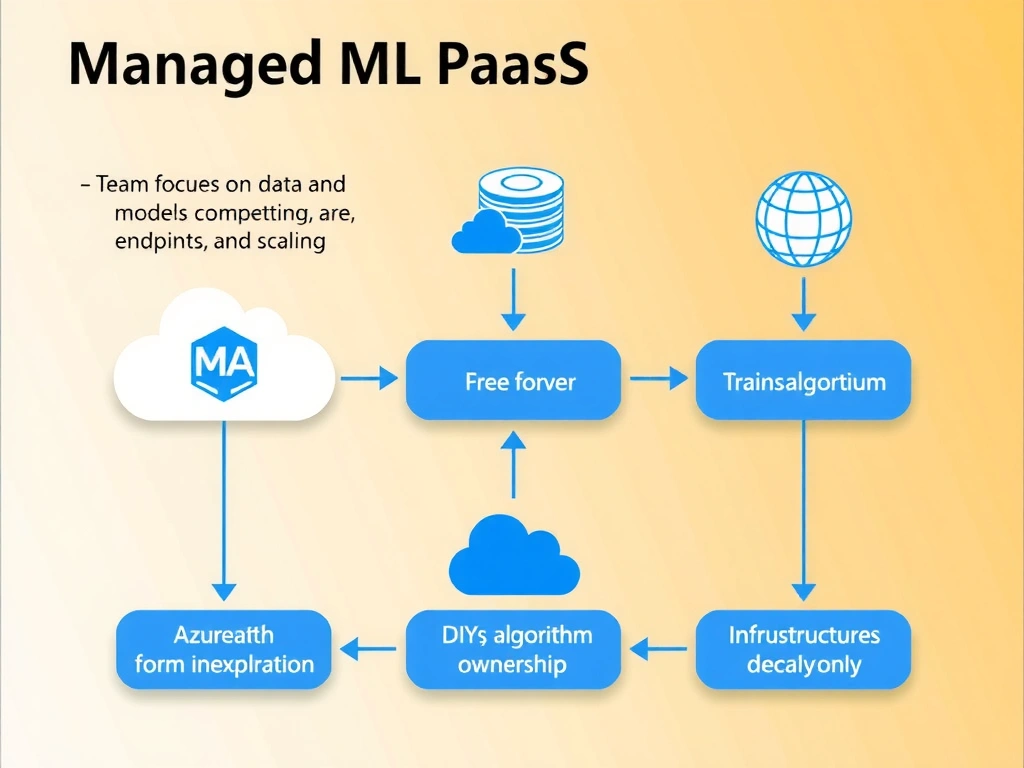
Here's the deal: managed ML platforms exist so you stop babysitting machines. Think of it like this — instead of building the kitchen, buying the ovens, and fixing the plumbing, you walk into a ready commercial kitchen and cook. Azure ML, SageMaker, and friends spin up compute, wire storage, handle scaling, and give you pipelines so your crew can train, tune, and ship models. Pay close attention: the exam trap is confusing "platform convenience" with "always free," "one algorithm only," or "laptop only." None of those are the point. If your boss walks in Friday and says "we need experiments running this weekend, no server tickets," PaaS is how you answer. Remember: infrastructure off your plate, focus on the model. Got it? Sweet. Keep that trade-off cold for the test.
Full explanation below image
Full Explanation
Platform-as-a-service offerings for machine learning provide managed environments for experimentation, training, packaging, and deployment. Their central value proposition is operational abstraction: the provider handles virtual machines or containers, driver and runtime updates, job scheduling, autoscaling, and many monitoring integrations. That separation lets data scientists and ML engineers invest time in feature design, model selection, evaluation, and product integration rather than in cluster setup and day-two operations.
In practice, a team using such a platform can submit training jobs, track experiments, register models, and promote endpoints through platform APIs and UIs without standing up Kubernetes clusters or custom GPU fleets from scratch. Elastic compute means large jobs can request more resources temporarily, then release them. Shared workspaces, dataset versioning, and pipeline tools further reduce friction across collaborators. The business outcome is faster iteration cycles and fewer specialists required solely for infrastructure toil.
The incorrect options reflect common misconceptions. Claiming the platform supports only one algorithm misrepresents commercial ML PaaS products, which generally support multiple frameworks (for example, scikit-learn, PyTorch, TensorFlow) and built-in plus custom estimators. Asserting perpetual free use confuses marketing credits or free tiers with the real pricing model; production workloads incur charges for compute, storage, networking, and managed features. Restricting the platform to local-only execution inverts the purpose of cloud PaaS, which is remote, elastic, multi-tenant infrastructure with optional local tooling only as a development convenience.
Choosing PaaS is still a trade-off. Organizations gain speed and reduced ops burden but accept vendor-specific interfaces, billing complexity, and potential lock-in. Security, data residency, and cost governance remain the customer's responsibility even when servers are managed. Best practice is to define clear experiment tracking, environment versioning, and promotion gates on top of the platform so automation does not become uncontrolled spend. For exam purposes, map "PaaS benefit" to "infrastructure managed for you, focus on model development," and reject answers that invent artificial limits on algorithms, cost, or locality.