
At the start of an applied AI initiative, what does defining the business problem primarily involve?
Select an answer to reveal the explanation.
Short Explanation and Infographic
Okay, let's start where real projects start—not with code, with the "why." Business problem definition means: what decision are we trying to improve, for whom, and is AI even the right tool? Think of it like this: you wouldn't pour a foundation before you know if you're building a house or a bridge. Boss walks in: "We need AI on this by Friday." Slow down—what fails today, what does success look like in dollars or risk, and would a simple report beat a neural net? Exam trap: diving into data cleaning, model code, or production deploy as if those are the problem step. They're later. Land it: understand the problem and whether AI fits—then build. You've done the right thing by putting the business first. Let's keep rolling.
Full explanation below image
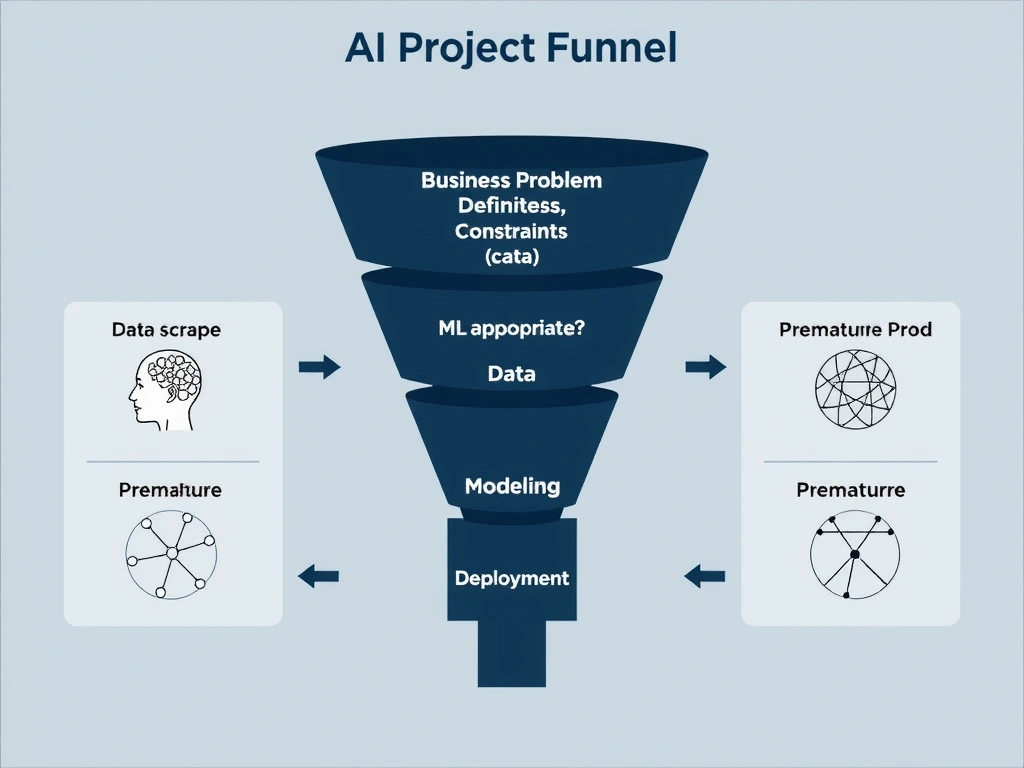
Full Explanation
Successful AI projects begin with problem framing, not with algorithms. Defining the business problem means understanding the operational or strategic question stakeholders care about: which decision will change, which users or processes are affected, what constraints exist (latency, cost, regulation, explainability), and how success will be measured in business terms as well as technical metrics. Part of this step is feasibility: determining whether machine learning is warranted versus rules, analytics dashboards, process redesign, or buying an existing capability. Teams also sketch data availability at a high level, risks such as bias or privacy, and whether a predictive, generative, ranking, or optimization framing matches the need.
Only after this framing do organizations wisely invest in large-scale data collection, labeling, feature pipelines, model development, and deployment. Skipping problem definition leads to models that optimize vanity metrics, solve the wrong task, or never integrate into a decision workflow. Clear problem statements also guide label design, evaluation protocols, human-in-the-loop requirements, and go/no-go criteria for production.
The correct answer captures the essence of this stage: understand the specific problem to be solved and determine whether AI is a suitable approach. That clarity anchors every later engineering choice.
Distractors pull later lifecycle activities into the first step. Collecting and cleaning data is crucial, but without a problem definition teams often gather irrelevant fields, miss critical labels, or over-clean noise that actually signals the phenomenon of interest. Writing model code early feels productive yet frequently produces impressive demos that do not move a KPI. Deploying to production first inverts risk management and can create operational, ethical, and reliability failures before value is proven.
Best practices include writing a short problem brief with stakeholders, defining baseline non-ML performance, stating success metrics and constraints, assessing data and skill readiness, and deciding explicitly whether to proceed with ML. Memory aid: problem first, data second, model third, deploy last—never reverse the order on exam day or in the real world.