
In AI systems, what is a knowledge graph?
Select an answer to reveal the explanation.
Short Explanation and Infographic
Think of a knowledge graph like a smart map of facts: nodes are things—people, products, cities—and edges are relationships—"works_at," "located_in," "bought." It's structured knowledge you can query and link, not a neural net, not a loss curve, not a photo bucket. Pretty cool for search, recommendations, and grounding LLM answers. Exam trap: seeing "graph" and answering "plot" or "neural network." When your boss wants "how is supplier X connected to part Y?" you're in knowledge-graph territory. Pay close attention: entities plus relationships. Land the takeaway—structured interconnected facts, not weights or JPEGs. You've got this.
Full explanation below image
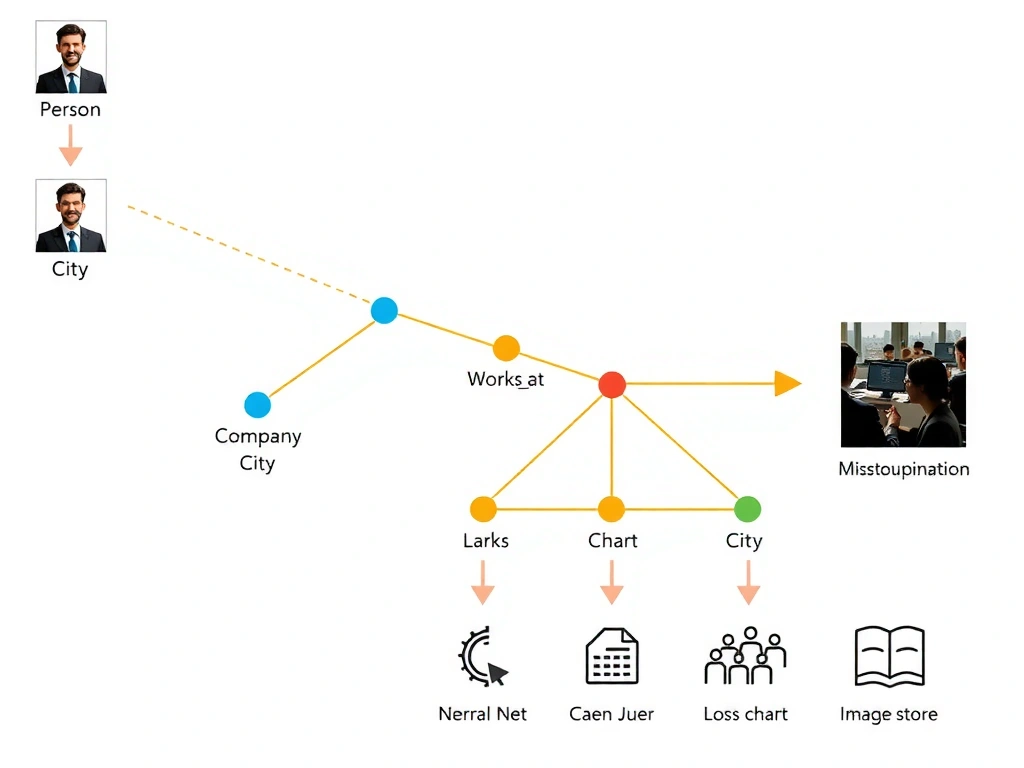
Full Explanation
A knowledge graph is a structured representation of domain knowledge in which entities are modeled as nodes and relationships as edges, often with types, properties, and provenance. Classic examples connect people to organizations, products to categories, drugs to side effects, or locations to administrative hierarchies. Because the representation is explicit and relational, systems can traverse paths, support structured queries, perform entity linking, and provide interpretable context for downstream AI applications such as semantic search, recommendation, fraud detection, and retrieval-augmented generation.
It is important not to confuse knowledge graphs with other "graph" or storage ideas. A neural network is a computational model of weighted transformations; even when its connectivity is drawn as a graph, that architecture is not a knowledge graph of real-world facts. Charts that plot model performance over training epochs are visualizations for experiment analysis, not encodings of domain entities and relations. Databases or object stores optimized for images hold binary media for computer-vision pipelines; without an entity–relationship knowledge layer, they are not knowledge graphs.
In practice, knowledge graphs may be stored in graph databases or as RDF triple stores, populated via information extraction (including NER and relation extraction), curated by experts, or hybridized with embeddings for similarity search. Design concerns include ontology design, identity resolution, conflict handling, and freshness. Relative to pure vector memory, knowledge graphs offer stronger symbolic structure and explainable links; relative to unstructured text, they offer queryable precision. For exam purposes, define a knowledge graph as a network of interconnected entities and relationships representing knowledge—not as a neural architecture, metric plot, or image repository. When exam language mentions entities, relationships, and structured facts, choose knowledge graph over neural nets, charts, or media stores.