
What is the primary objective of prompt engineering when working with large language models?
Select an answer to reveal the explanation.
Short Explanation and Infographic
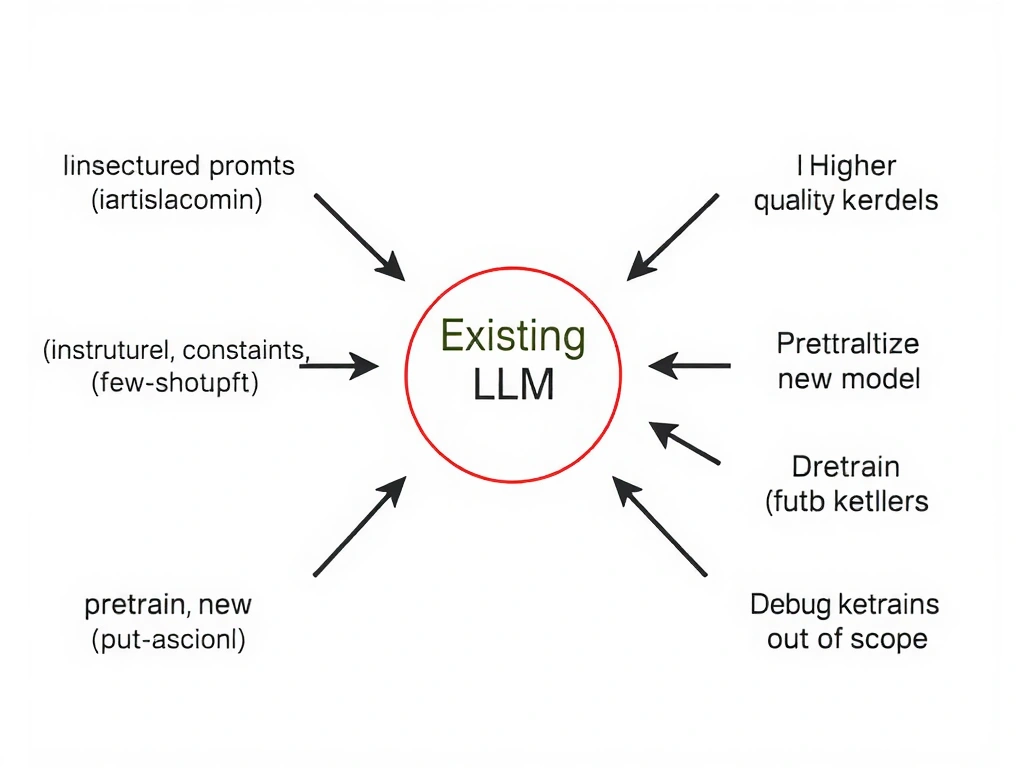
Prompt engineering is about talking to the model you've already got so it gives you better answers—clearer instructions, formats, constraints, maybe a few examples. You're not building a new LLM in your garage, not patching CUDA, and not mounting a full retrain just to rephrase a request. Think of it like briefing a brilliant contractor: better brief, better deliverable. Exam trap: equating prompts with pretraining. If quality is weak, first tighten the prompt, add structure, or few-shot demos before you burn a training budget. Boss wants cleaner outputs by Friday? Prompt engineering is your fast lever. Land it: improve existing-model outputs through smarter inputs.
Full explanation below image
Full Explanation
Prompt engineering is the practice of designing, testing, and refining the natural-language (and sometimes multimodal) inputs that steer a pretrained large language model toward useful behavior. Because modern LLMs are general-purpose sequence predictors with instruction-following abilities, the wording of a task, the presence of constraints, the requested output schema, system messages, and optional few-shot demonstrations can dramatically change correctness, style, safety, and consistency—without updating model weights.
The main goal, therefore, is to improve the quality and reliability of answers from an existing model: reduce ambiguity, enforce formats (JSON, bullet lists, rubrics), supply necessary context, and encode success criteria. Advanced patterns include chain-of-thought style scaffolding where appropriate, role instructions, retrieval-augmented context, tool-calling schemas, and evaluation harnesses that score prompt variants systematically.
Activities that are not prompt engineering include training a new LLM from scratch, which requires enormous compute and data; debugging the model's internal implementation or accelerator kernels; and assembling datasets for full end-to-end weight retraining. Those efforts may complement prompting in a broader ML program, but they are separate disciplines. Teams often escalate: start with prompt design, then consider fine-tuning or RAG when prompts alone cannot meet quality, latency, or domain depth targets.
For exams, associate prompt engineering with inference-time control of pretrained models, not with pretraining or kernel debugging. A compact memory aid is "same model, smarter ask." Measuring success means offline rubrics, human preference checks, and online metrics—not merely longer prompts. When a question asks for the main goal of prompt engineering, the correct idea is elevating output quality from an already available LLM through carefully designed prompts and interaction strategies.