
To help a car-recognition model generalize, engineers expand the training set by creating additional views of each vehicle under varied angles and lighting. What is this practice an example of?
Select an answer to reveal the explanation.
Short Explanation and Infographic
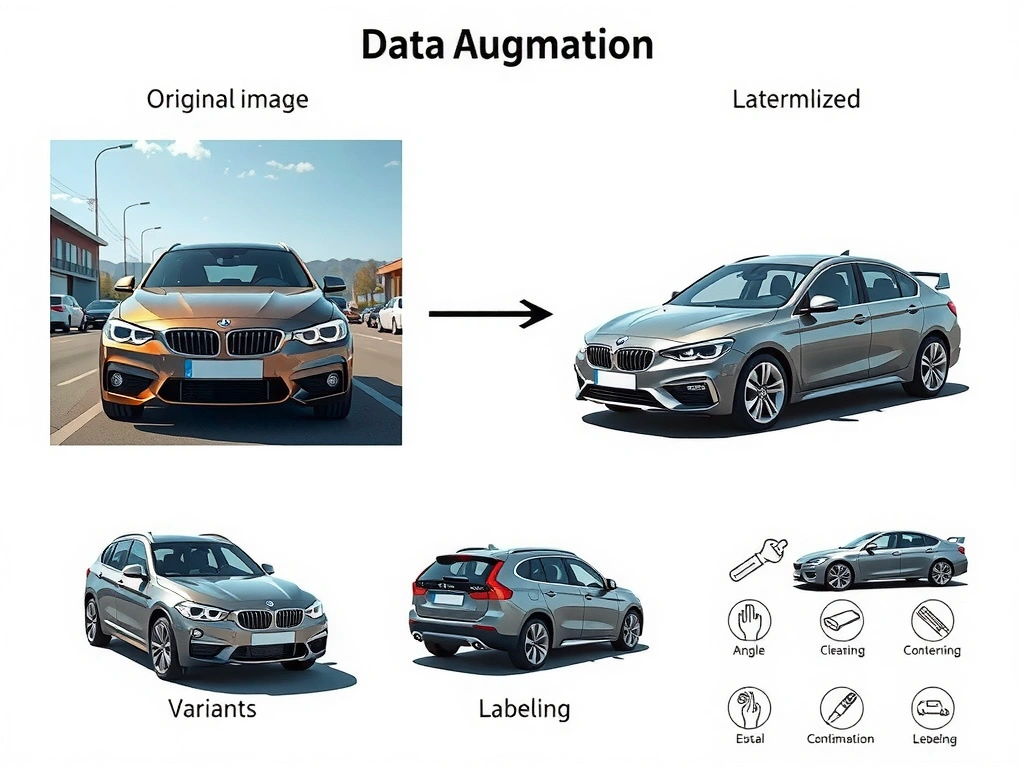
Your training set is thin, so you spin new training images—tilt the car, darken the scene, change the camera angle—and keep the same label. That's data augmentation. Think of it like practicing free throws from different spots on the court so game day doesn't surprise you. Exam trap: normalization is scaling numbers, cleaning is fixing junk data, labeling is writing the answers on samples. Augmentation is about more varied inputs. Pay close attention—vision exams love this distinction. You've done the right thing learning it cold.
Full explanation below image
Full Explanation
Data augmentation increases the effective size and diversity of a training set by applying label-preserving transformations to existing examples. In computer vision for vehicle recognition, common augmentations include geometric changes (rotation, cropping, flipping where appropriate), photometric changes (brightness, contrast, color jitter), and simulated viewpoint or lighting variation. The goal is improved generalization: the model sees conditions closer to real deployment without collecting and annotating every possible photo from scratch. When engineers deliberately expand the kit with additional angles and illumination variants of cars, they are performing data augmentation, whether those views are captured carefully or synthesized by transforms in the training pipeline.
Data normalization is a different preprocessing idea. It standardizes scales—for example subtracting channel means and dividing by standard deviations—so optimization is better conditioned and features share comparable ranges. Normalization does not create new angled or relit car images and therefore cannot explain the scenario. Data cleaning focuses on correcting errors: removing corrupt files, fixing misaligned metadata, or filtering duplicates and outliers. Cleaning improves quality but is not the name for deliberately synthesizing diversity. Data labeling is the assignment of supervisory targets such as car make, model, or type. Augmented images typically inherit the original label; the act of labeling is not synonymous with augmentation even though labels must remain correct after transforms.
Effective practice pairs augmentation with validation that reflects true deployment conditions, avoids unrealistic transforms that break label semantics (for example a horizontal flip that invalidates text or directional signals), monitors train–validation gaps, and may use advanced methods such as MixUp, CutMix, or learned augmentation policies. For the exam, map "more varied training views from existing images" to data augmentation every time. Memory aid: augment means invent plausible variety; normalize means rescale; clean means fix; label means annotate. That four-way split resolves most distractors in preprocessing and dataset questions for vision models and keeps your answer aligned with the training-diversity intent of the stem.