
In modern NLP pipelines, what primary role do word embeddings play?
Select an answer to reveal the explanation.
Short Explanation and Infographic
Check this out. Models don't "read" English the way you do—they need numbers. Word embeddings turn each word into a dense vector so that similar meanings sit near each other. Think of it like a city map of language: "king" and "queen" live in the same neighborhood; "banana" is across town. That's the whole point—semantic meaning in a form models can math on. Exam trap: don't confuse embeddings with stop-word removal, term counting, or making text pretty for humans. Those are different jobs. When the question asks what embeddings are for, answer: numeric semantic representations. Got it? Sweet.
Full explanation below image
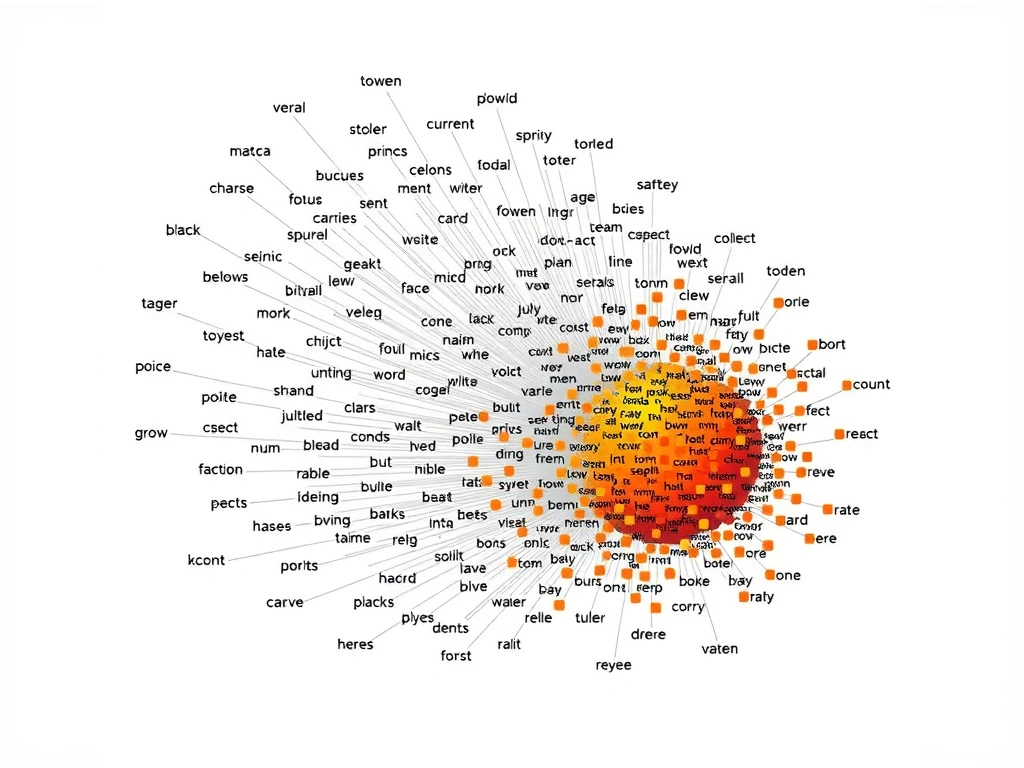
Full Explanation
Word embeddings are continuous, usually low-to-moderate dimensional vector representations of tokens. Training objectives such as skip-gram, CBOW, or contextual objectives in modern language models encourage vectors of words that appear in similar contexts—or that share related meanings—to lie close together under a similarity metric. Downstream classifiers, sequence taggers, and neural networks then consume these vectors as input features. The main purpose is therefore to capture semantic (and often syntactic) information in a numerical form that learning algorithms can process effectively, overcoming the sparsity and lack of similarity structure in one-hot encodings. Without such a mapping, models treat vocabulary items as unrelated atomic IDs even when humans know they are related.
Embeddings are not a stop-word filter. Removing high-frequency function words is a separate preprocessing choice that may or may not accompany embedding-based pipelines. They are also not term-frequency counters; classic bag-of-words or TF-IDF explicitly measure how often tokens occur, whereas embedding training learns distributed features that generalize across vocabulary items and support similarity, analogy-style geometry, and transfer into neural layers. Finally, embeddings are not intended to convert text into a more readable format for people; their audience is the model, not the end user reading a pretty-printed string.
Static embeddings assign one vector per word type, while contextual embeddings (for example from transformers) produce vectors that depend on surrounding words, handling polysemy more gracefully. Either way, the educational core remains dense semantic geometry for machine learning. Memory aid: one-hot is a name tag with no neighbors; an embedding is a GPS coordinate in meaning-space. Exam questions often contrast embeddings with count-based representations—pick the option about semantic numeric encoding. In practice, choose embedding models aligned with your domain, monitor out-of-vocabulary handling, and remember that quality of the training corpus shapes which similarities the space encodes. That purpose statement is what separates embeddings from cleanup or counting steps.