
An engineer must classify photos of rare bird species but has only a modest labeled set. Why is transfer learning especially attractive for this computer-vision task?
Select an answer to reveal the explanation.
Short Explanation and Infographic
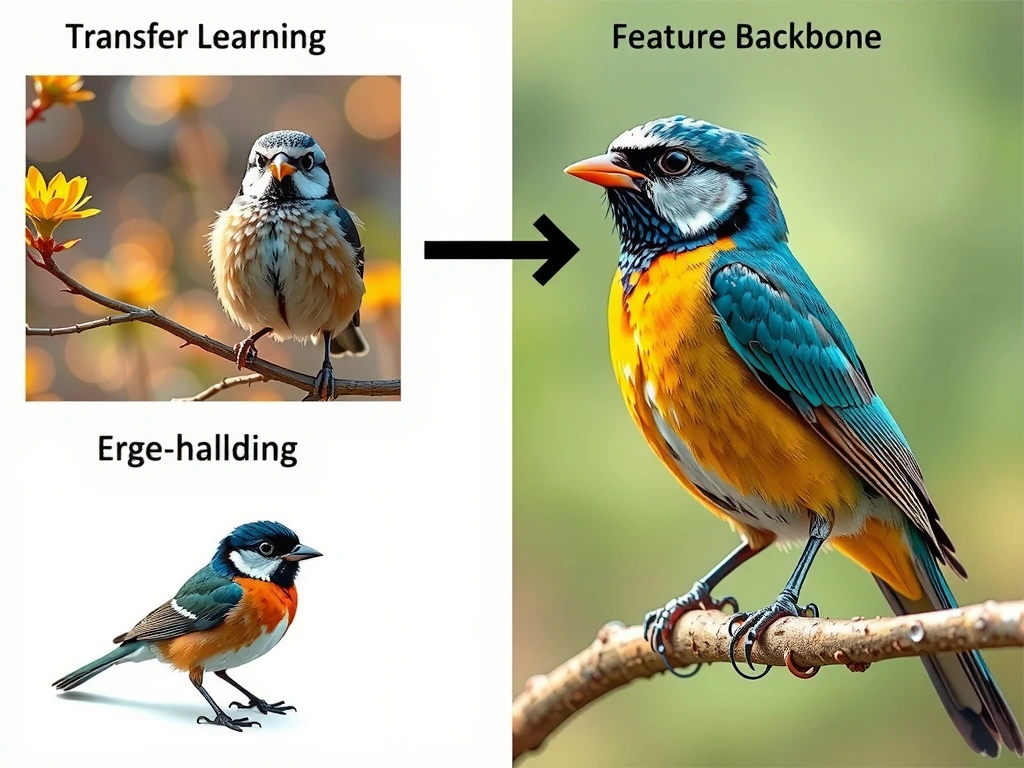
Here's the deal. You've got a handful of labeled warblers and your boss wants a solid classifier by Friday. Training a deep net from scratch on that tiny set is rough. Transfer learning says: start from a network that already studied millions of everyday images—edges, feathers-ish textures, shapes—then fine-tune on your birds. Think of it like hiring someone who already finished general vision school instead of teaching vision from zero. Exam trap: transfer is not a magic anti-overfit spell, and it doesn't make models explainable. And it definitely doesn't demand a giant bird dataset first—that's the opposite. Reuse general features, save labels. That's the win. Stick with me—you'll see this pattern everywhere in CV.
Full explanation below image
Full Explanation
Transfer learning in computer vision typically begins with a convolutional or vision-transformer backbone trained on a large, diverse image collection such as ImageNet-scale data. Early layers learn generic visual primitives—edges, color transitions, textures—while deeper layers capture more abstract patterns. When the target task is recognizing bird species from limited labeled photographs, those pretrained representations provide a strong starting point. The practitioner freezes or gently updates early layers and adapts later layers (or a new classifier head) on the bird data. The major practical advantage is that high-quality specialty labels become far less critical in quantity because much of the visual feature hierarchy has already been learned elsewhere.
This advantage should not be overstated into absolute guarantees. Pretraining does not ensure the fine-tuned model cannot overfit; small target sets still need regularization, data augmentation, careful learning rates, and validation monitoring. Nor does transfer learning automatically yield interpretable predictions; deep features remain distributed and often opaque without extra explanation tools. Finally, the claim that transfer only works when a huge bird-specific labeled corpus already exists inverts the use case: abundant in-domain labels would reduce the need for transfer in the first place.
Best practice includes matching pretraining domain as well as possible, using appropriate fine-tuning schedules, and evaluating on held-out species or conditions that reflect deployment. Few-shot and metric-learning variants extend the same idea when labels are extremely scarce. For exam purposes, associate transfer learning with "reuse general visual knowledge to cut specialty data needs," especially in image classification scenarios like wildlife, medical imaging, or industrial inspection. The core principle is knowledge reuse across related visual distributions, not magic immunity to overfitting or automatic explainability.