
A team adapts a large pre-trained vision network to a new specialized recognition task by adding a small task-specific head. Why is it common to freeze the early backbone layers and update only the newly attached layers during the first training stage?
Select an answer to reveal the explanation.
Short Explanation and Infographic
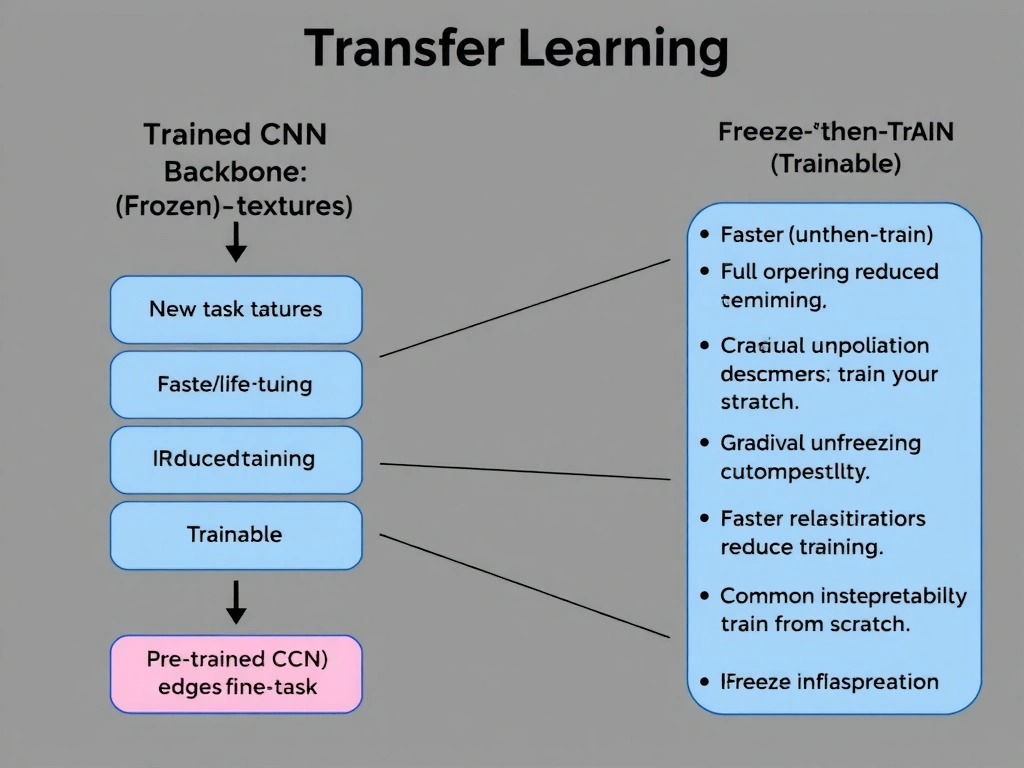
Okay, let's dive in. You've got a pre-trained vision model that's already seen millions of images—edges, corners, textures, the works. Your boss walks in and says, "Specialize this for our widgets by Friday." Do you retrain the whole stack? Usually no. You freeze those early layers so the network keeps the general visual building blocks it already paid for, and you only train the new head (and maybe later unfreeze a bit). Training goes faster, needs less data, and you dodge catastrophic forgetting of those reusable features. Exam trap: people pick "more interpretable" or "learn everything from scratch"—neither is the point. Think of it like this: don't rebuild the foundation every time you remodel the kitchen. Land it: freeze early = speed + keep general features. Got it? Sweet.
Full explanation below image
Full Explanation
Transfer learning for computer vision commonly starts from a backbone trained on a large, diverse corpus. Lower layers tend to capture generic visual primitives—oriented edges, color gradients, simple textures—while deeper layers become increasingly task- and dataset-specific. When the target problem has limited labeled data or is a specialization of the pre-training domain, practitioners often freeze the early backbone and train only a newly attached classification or detection head. Gradient updates then concentrate on the task-specific parameters, which shortens wall-clock training time, reduces the risk of overwriting useful general features (a form of catastrophic forgetting), and stabilizes optimization when the fine-tuning set is small.
The correct option captures both operational benefits: faster training and preservation of general low-level features. A typical recipe is freeze-backbone training of the head, optional gradual unfreezing of upper blocks with a small learning rate, and careful monitoring of validation metrics to decide how much of the stack to open. Domain shift, class imbalance, and resolution differences still matter; freezing is a strong default, not a universal law. Data augmentation, regularization, and appropriate loss design remain necessary.
Distractors confuse freeze strategies with unrelated goals. Freezing does not automatically make internal representations interpretable for compliance or debugging; saliency maps, concept activation methods, or simpler models address interpretability. Forcing the network to reinvent all filters from random initialization abandons transfer learning and usually demands far more data and compute. Layer freezing also does not transform a supervised fine-tuning job into unsupervised clustering; labels (or another supervised signal) still drive the head’s objective. A useful memory aid is “reuse the foundation, retrain the finish”: early layers are the foundation of visual representation, while the finish is the task head. On exams, associate freeze-early fine-tuning with efficiency and retention of general features, not with interpretability, full reinitialization, or a change of learning paradigm.