
In MLOps, what is the key objective of model monitoring?
Select an answer to reveal the explanation.
Short Explanation and Infographic
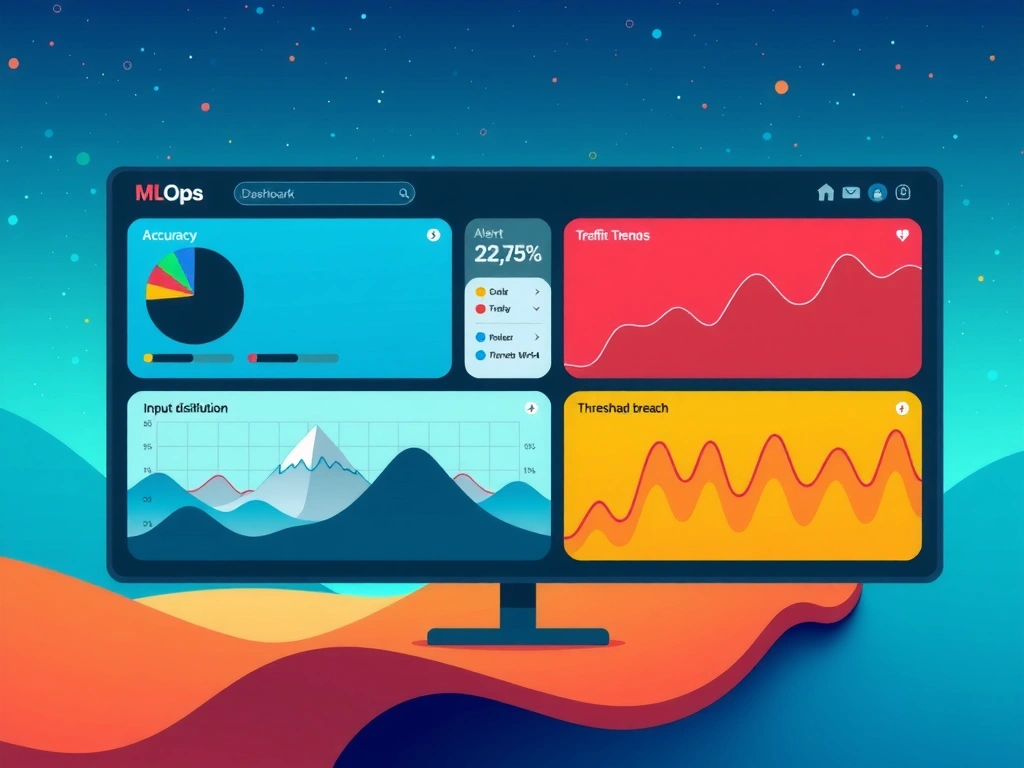
Model monitoring is your smoke alarm for production ML. You're watching whether the model still performs and whether the inputs still look like what it was trained on. When accuracy slides or feature distributions wander, you get alerted—then you decide to investigate, retrain, or roll back. Boss walks in: "Is the model still good?" Monitoring is how you answer with evidence, not vibes. Exam trap: monitoring isn't mainly "collect new data," isn't hyperparameter search, and isn't "always retrain on something new no matter what." Those are neighboring activities. Key objective: detect degradation and data-distribution change, and alert. Land that, and the MLOps monitoring questions get easy. You've done the right thing locking this in.
Full explanation below image
Full Explanation
Model monitoring in MLOps is the continuous observation of deployed models and their data context to ensure they remain fit for purpose. The key objective is to detect—and promptly alert on—degradations in predictive performance and meaningful shifts in the distribution of inputs (and sometimes outputs). Without monitoring, teams may discover failures only after business harm: wrong decisions at scale, customer complaints, or silent concept drift.
A practical monitoring stack tracks offline-comparable metrics when ground truth becomes available, online proxy metrics when labels lag, data quality checks (missingness, schema violations), population stability or drift statistics on features, prediction confidence distributions, and service health (latency, error rates, throughput). Alert policies route issues to on-call owners with runbooks for diagnosis. Monitoring thus connects observability to action: investigate pipeline bugs, retrain with fresher data, recalibrate thresholds, or roll back to a prior model version.
Collecting new data can be a beneficial side effect of production logging, but data collection alone is not the definition of monitoring. Hyperparameter optimization is an experimental training concern used to improve candidate models before or during retraining cycles. Continuous forced retraining on new data regardless of signals is wasteful and risky; mature systems retrain when triggered by schedules, performance drops, or drift—not because monitoring exists to retrain endlessly.
Best practices include establishing launch baselines, monitoring both global and sliced metrics (segments that matter for fairness or critical customers), avoiding training-serving skew, and tying alerts to decision criteria. For exam purposes, equate model monitoring with detecting and alerting on performance degradation and input distribution changes in production—the operational feedback loop that keeps ML systems trustworthy after deployment.