
Which statement best describes an artificial neural network (ANN)?
Select an answer to reveal the explanation.
Short Explanation and Infographic
Okay, let's dive in. When people say artificial neural network, they're not talking about magic—they're talking about a brain-inspired graph of little compute units. Think of it like a team of coworkers: each person takes in signals, does a simple calculation, and passes a message along. Stack enough of those connections and you get patterns that solve real problems. Here's the exam trap: don't confuse the architecture (ANN) with a learning style (supervised vs unsupervised) or with old-school expert systems that use if-then rules. An ANN can be trained many ways, but what defines it is interconnected neurons with learnable weights. Boss walks in and says "build me a network"—they're expecting layers of units, not a giant spreadsheet of symbolic rules. Got it? Sweet. Remember: structure first—interconnected nodes inspired by biology.
Full explanation below image
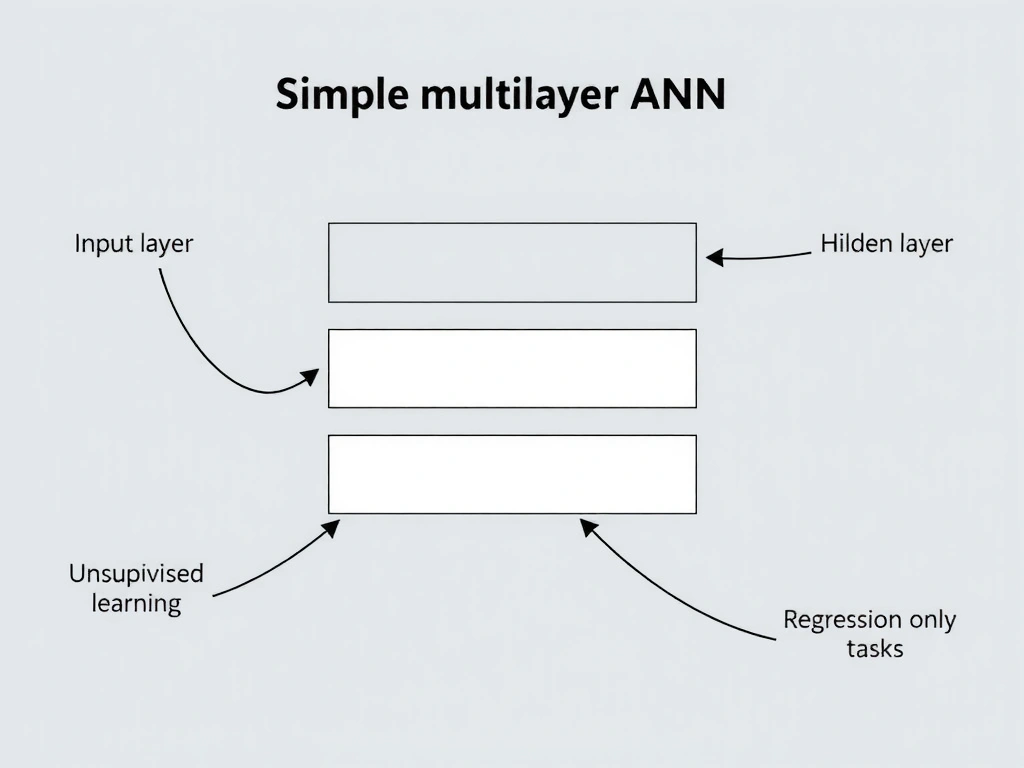
Full Explanation
An artificial neural network (ANN) is a computational model whose design is loosely inspired by biological nervous systems. Units commonly called neurons receive weighted inputs, combine them (often with a bias term), apply a nonlinear activation function, and pass the result forward. When many such units are organized into layers and connected according to a chosen topology—fully connected stacks, convolutional graphs, recurrent loops, or attention-based blocks—the network can approximate complex input–output mappings. Learning typically adjusts the connection weights by optimizing a loss with gradient-based methods such as backpropagation and stochastic gradient descent. This structural definition is what the correct option captures: interconnected computational nodes organized to process information in a brain-inspired way.
The distractor that equates an ANN with unsupervised learning confuses model class with training paradigm. Unsupervised learning refers to the absence of target labels (clustering, density estimation, some representation learning). The same ANN architecture might be trained with labels (supervised classification), without labels (autoencoders), or with rewards (deep reinforcement learning). Architecture and supervision signal are orthogonal choices.
Calling an ANN merely a statistical model that predicts a continuous variable collapses neural networks into univariate regression. While ANNs can perform regression, they are equally standard for multi-class classification, sequence transduction, image segmentation, ranking, and generative modeling. The defining trait is the compositional graph of parameterized nonlinear units, not a single task type.
Equating ANNs with rule-based symbolic systems confuses connectionist and symbolic AI. Expert systems encode domain knowledge as explicit logical rules and inference engines. Classical ANNs instead store knowledge primarily in distributed numerical weights learned from data. Hybrid neuro-symbolic systems exist, but the core ANN concept remains the interconnected neuron model rather than hand-authored symbolic reasoning.
For practice and exams, anchor the definition in three ideas: (1) units with activations, (2) weighted interconnections, and (3) layered composition that enables hierarchical feature learning. That framing cleanly separates ANNs from clustering-only definitions, regression-only definitions, and symbolic rule engines, and it generalizes from shallow multilayer perceptrons to modern deep architectures.