
Your product team needs a system that reads a provided passage and answers natural-language questions about that passage. Which architecture family is the strongest default choice for this reading-comprehension style task?
Select an answer to reveal the explanation.
Short Explanation and Infographic
Okay, let's dive in. Boss walks in: "We need answers from this document, not vibes." For passage + question, you want a model that can look at every token in relation to every other token—transformers do that with attention. BERT-style encoders (and QA fine-tunes) are built for this. An old-school RNN can read left-to-right, but long passages make it painful. A GAN is for generating realistic samples, not grounded reading. A CNN is your image buddy with local filters—not the first pick for document QA. Exam trap: don't grab "sequence model" just because text is sequential—pick the transformer. Land it: passage QA → transformer.
Full explanation below image
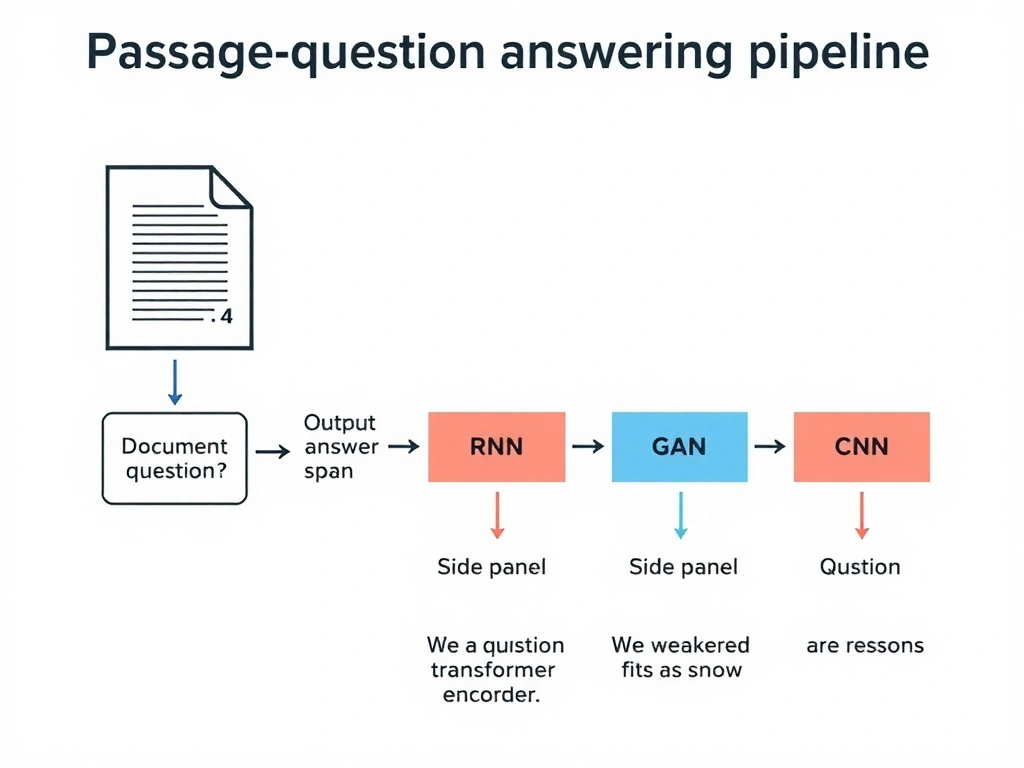
Full Explanation
Question answering grounded in a supplied passage is a classic natural language understanding problem: the model must align the question with relevant spans or content in the context, handle paraphrase, coreference, and often return either an extracted span or a generated answer constrained by that context. Transformer architectures—especially encoder models like BERT and their descendants, as well as encoder–decoder or decoder-only systems fine-tuned for QA—use self-attention (and cross-attention where applicable) so that distant tokens can interact directly in a single layer. That property is ideal when the answer depends on a sentence far from the question wording or on multi-sentence reasoning within the passage, which is common in enterprise document QA.
Recurrent networks process tokens sequentially and maintain a hidden state. They historically powered language modeling and early sequence tasks, but long documents expose vanishing gradients, limited effective context, and poor parallel training efficiency on modern hardware. For a production reading-comprehension product today, a pure RNN is rarely the most appropriate primary architecture. Generative adversarial networks pit a generator against a discriminator to produce realistic samples; their training dynamics and objective do not map cleanly onto supervised or extractive QA over text passages. Convolutional networks apply local receptive fields that excel at vision and some short n-gram patterns, but they are not the default for modeling full question–passage interactions at document scale.
In practice, teams often fine-tune a pretrained transformer on SQuAD-style or domain-specific QA data, use retrieval-augmented pipelines when corpora are large, and evaluate with exact match / F1, ROUGE for abstractive answers, or human faithfulness metrics that check whether answers are supported by the passage. Latency, context-window limits, and citation of source spans matter for user trust. Memory aid: "passage + question → attention over both → transformer." When exam items contrast RNNs, GANs, CNNs, and transformers for text QA, choose the transformer-based approach.