
Which statement best describes a defining trait of a Long Short-Term Memory (LSTM) network?
Select an answer to reveal the explanation.
Short Explanation and Infographic
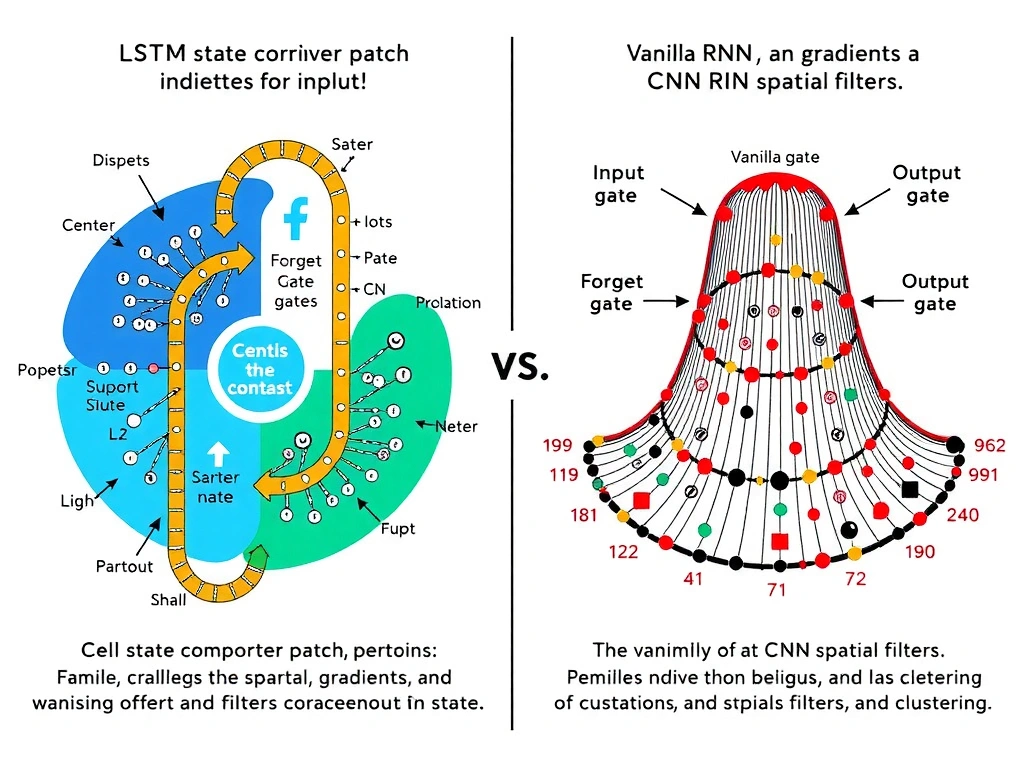
Okay, let's dive in. Vanilla RNNs try to remember the past, but over long sequences the gradient often fades to nothing—classic vanishing gradient pain. LSTMs were built for that mess. Think of the cell state like a conveyor belt with gates: forget what you don't need, write what matters, and decide what to output. Pay close attention—exam traps love swapping LSTM for CNN or calling it unsupervised clustering. Not the same universe. If your boss says “we need sentiment over a 500-token review,” you reach for gated recurrence (or transformers later), not a plain feedforward net. Got it? Sweet. Remember: LSTM = gated RNN for long-range memory, not vision-only CNNs and not clustering.
Full explanation below image
Full Explanation
Long Short-Term Memory networks extend recurrent neural networks with a carefully designed memory cell and gating mechanism. A typical LSTM unit includes a forget gate, an input gate, and an output gate, each implemented as a sigmoid (or related) nonlinearity that modulates how much information is discarded, written, or exposed. The additive update path into the cell state allows gradients to flow across many time steps more reliably than a vanilla RNN’s repeated multiplication of the same transition Jacobian, which is a primary reason LSTMs mitigate vanishing gradients on long sequences. Without those gates, repeated nonlinear transforms tend to shrink gradients toward zero, so early tokens stop influencing later predictions during training.
That architectural intent is the key characteristic tested here: LSTM is a gated recurrent design aimed at long-range temporal dependencies in sequential data—language, speech frames, sensor streams, and similar ordered signals. Training is usually supervised (or self-supervised) with backpropagation through time; the network is not, by definition, a clustering algorithm, nor is it a convolutional image backbone. In production NLP and time-series systems, practitioners still encounter LSTMs in streaming inference, smaller edge deployments, and hybrid pipelines that combine convolutional front ends with recurrent temporal modeling.
Distractors mix up model families learners often conflate. A simple feedforward network for linear regression has no recurrent state and no sequence memory, so it cannot maintain an evolving hidden representation across tokens. Convolutional networks excel at local spatial patterns via shared filters; they do not replace gated recurrence for order-sensitive modeling, though CNN–LSTM stacks exist for video. Unsupervised clustering groups points without the sequential gating story of LSTMs and does not implement forget or input gates at all.
Modern practice often prefers transformers for many NLP tasks because self-attention captures long-range links without step-by-step recurrence, but LSTMs remain foundational exam content and still appear when latency, memory, or online updates favor a compact recurrent cell. Related gated units such as GRUs simplify the gate set while pursuing a similar goal. Memory aids: “gates control the conveyor belt of memory,” and “LSTM is an RNN upgrade, not a CNN or k-means.” When a question emphasizes overcoming vanishing gradients via controlled information flow, LSTM (or GRU) is the architecture family to select.