
What is generalization in machine learning?
Select an answer to reveal the explanation.
Short Explanation and Infographic
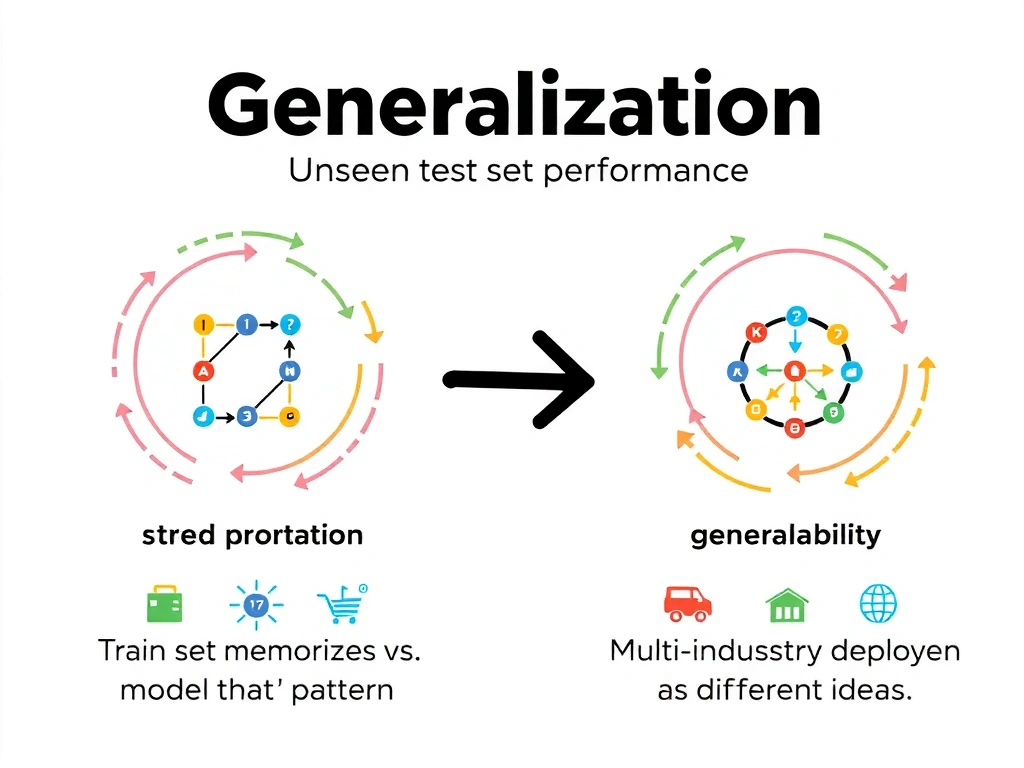
Here's the deal: generalization is whether your model still works when the data is new. Training accuracy is practice; the test set is game day. Think of a student who memorizes flashcards but can't answer rephrased questions—that model didn't generalize. Exam trap: mixing this up with interpretability ("can humans explain it?") or with "works in every industry." Different ideas. If train looks great and fresh data looks ugly, generalization failed—often overfitting. You want the model to learn the pattern, not the homework answer key. Takeaway: unseen data performance is the point of the whole exercise.
Full explanation below image
Full Explanation
Generalization is the capacity of a learned model to produce accurate predictions on inputs it has not trained on, assuming those inputs come from a distribution related to the training process, commonly idealized as independent draws from the same population. Supervised learning algorithms minimize training loss, but the true objective is low expected risk on future data. Holdout validation, cross-validation, and final test sets estimate generalization error. Gaps between training and validation performance are primary evidence of overfitting and poor generalization. Memorizing the training set without capturing transferable structure fails this goal even if training accuracy is perfect.
Factors that influence generalization include model capacity, regularization, dataset size and quality, distribution shift, and early stopping. Techniques such as weight decay, dropout, data augmentation, and ensembling are often motivated as ways to improve generalization rather than merely reduce training loss. In modern deep learning, empirical generalization remains an active research topic, but the operational definition for practitioners and exams stays clear: success on unseen data under the intended task distribution. When the production distribution drifts, measured generalization on an old test set can overstate real-world skill, so monitoring after deployment matters as well.
Distractors conflate neighboring concepts. Cross-domain commercial deployment into every industry is about product portability and transfer across tasks, not the core statistical meaning of generalization to new samples of the same problem. Sparse feature usage may help simplicity or speed but is neither necessary nor sufficient as a definition of generalization. Interpretability concerns human understanding of model behavior and can exist with or without strong predictive transfer to new cases.
When evaluating systems, report metrics on untouched test data, avoid leaking test examples into training or tuning, monitor production performance for drift, and treat training metrics as incomplete. For certification questions, map language about performing correctly on new, unseen data after training directly to generalization. That single idea connects overfitting, validation strategy, regularization choices, and honest model selection in both classic machine learning and deep learning workflows.