
A trading analytics team needs a model to forecast the next-day closing price of equities as a numeric value. What type of machine learning problem is this?
Select an answer to reveal the explanation.
Short Explanation and Infographic
Stock price as a number tomorrow? That's regression — continuous target. If they only asked up or down, you could argue classification, but the stem wants the price itself. Clustering would group similar tickers without predicting tomorrow's close. Dimensionality reduction just packs features tighter. Here's the trap: finance folks say predict the market and students jump to classification out of habit from churn questions. Always ask: is the label a category or a quantity? Quantity means regression. Real world, prices are noisy and non-stationary — hard problem — but the exam still wants the problem type right. Land regression and you're good.
Full explanation below image
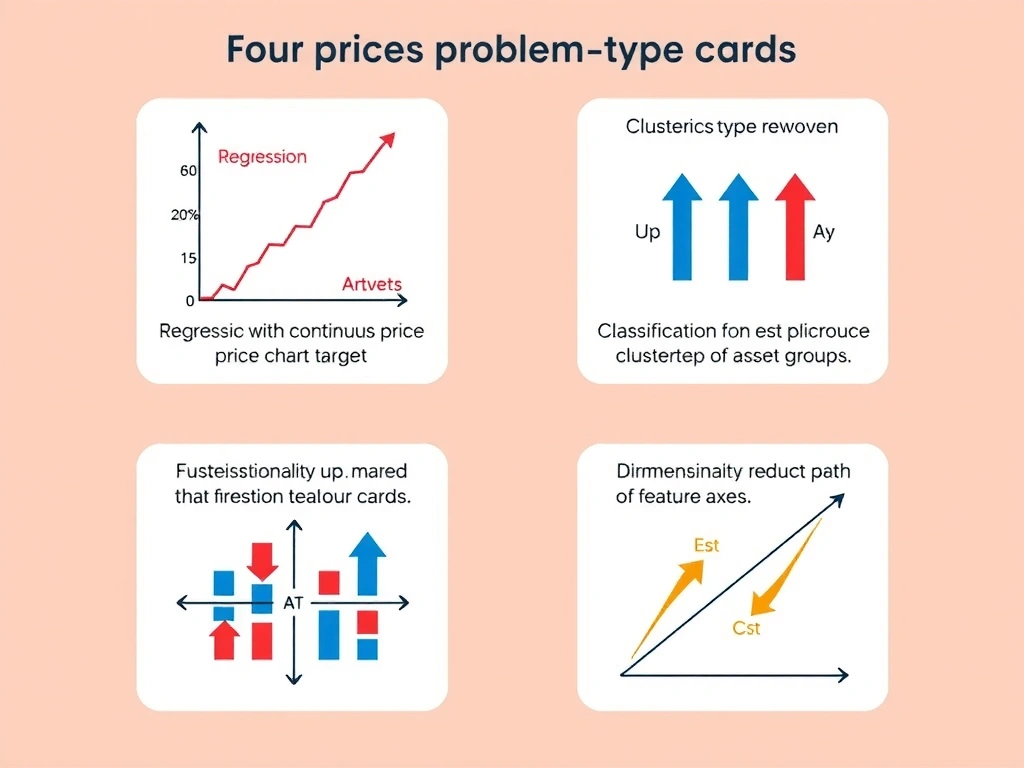
Full Explanation
Forecasting a next-day closing price as a real-valued quantity is a supervised regression problem. The model is trained on historical features such as past prices, volumes, technical indicators, and alternative data, with a continuous label equal to the observed future price or a related numeric transform. Evaluation uses metrics such as MAE, RMSE, or MAPE rather than classification accuracy.
Classification would apply if the target were discrete, for example predicting whether the price will rise or fall, or assigning volatility regimes. Many trading systems do use classification for directional bets, but that is a different problem statement than predicting the price level. Clustering discovers groups of securities or days with similar behavior without directly outputting a supervised price forecast. Dimensionality reduction may help engineer features or visualize markets but is not the primary learning task when the goal is numeric price prediction.
Domain caveats such as non-stationarity, low signal-to-noise, and leakage from improper scaling or shuffling of time series matter in practice and in advanced questions, yet foundational exams focus on correctly typing the problem. Use the target test: continuous numeric label means regression; categorical label means classification; no label and find groups means clustering; compress features means dimensionality reduction. Applying that rubric to predict stock prices as numbers selects regression cleanly and avoids mixing it up with the churn-style classification stems that often appear nearby on the same exam.
If a question instead asks only for direction of movement, reclassify it as classification; if it asks for natural groups of assets without labels, reclassify it as clustering. The stem here specifies a numeric closing price, so regression is the correct problem type. Keep the target-variable test front and center whenever problem-type questions appear back to back.