
A subscription business wants a model that predicts whether each customer will cancel service in the next 30 days. What type of machine learning problem is this?
Select an answer to reveal the explanation.
Short Explanation and Infographic
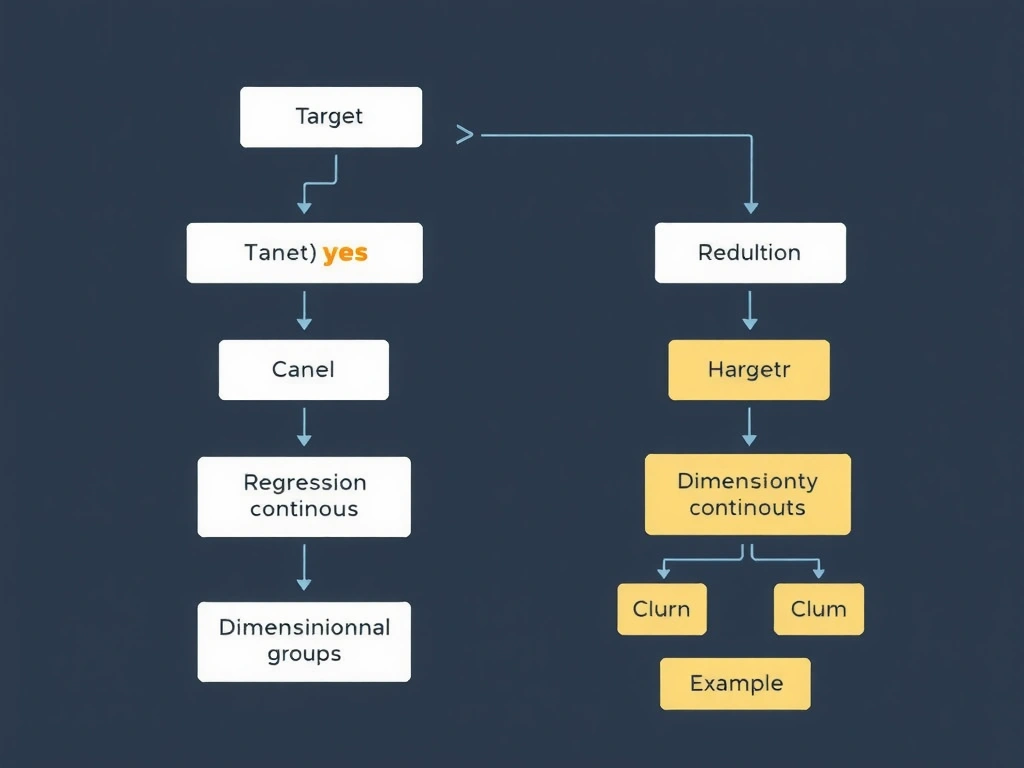
Will they churn or not? That's a category — classification. You're predicting a label, not a dollar amount or a free-form segment. Regression would be how many months until they leave or what will their spend be. Clustering groups similar customers without a churn label. Dimensionality reduction just shrinks features for other models. Pay attention: product managers say predict churn and sometimes mean a probability — still classification territory, often with a probabilistic classifier. Exam trap is grabbing regression because predict sounds numeric. If the answer is a class, pick classification. Simple as that — and it shows up constantly.
Full explanation below image
Full Explanation
Predicting customer churn framed as whether a customer will cancel within a fixed window is a supervised classification problem. Historical rows carry a binary or multi-class label derived from observed cancellations, and the model learns a mapping from behavioral, demographic, and account features to that label. Outputs may be hard class decisions or calibrated probabilities used for ranking retention outreach—still within the classification family.
Regression would apply if the target were continuous, such as expected lifetime value, days until cancellation, or a numeric risk score defined without class boundaries—but the stem's yes-or-no cancellation outcome is categorical. Clustering groups customers by similarity without requiring churn labels; it may support segmentation strategy but does not directly answer the labeled prediction task described. Dimensionality reduction methods such as PCA or autoencoders transform the feature space and can be a preprocessing step, yet they are not the problem type for forecasting churn outcomes.
In production, churn models emphasize class imbalance handling, proper time-aware splits, and business metrics such as precision at k or lift alongside accuracy. For exam taxonomy questions, map the nature of the target variable first: discrete labels mean classification; continuous values mean regression; unlabeled structure discovery means clustering; feature compression means dimensionality reduction. That decision tree resolves churn, fraud, spam, and similar business stems quickly and accurately.
Even when stakeholders ask for a churn score, the underlying supervised problem is still classification or ranking from class probabilities, not regression, unless the labeled target itself is a continuous quantity. Always read whether the outcome is cancel-or-not versus a numeric amount before selecting the problem type. On the exam, will they leave yes or no is classification every time.