
When is k-fold cross-validation the most appropriate choice during model development?
Select an answer to reveal the explanation.
Short Explanation and Infographic
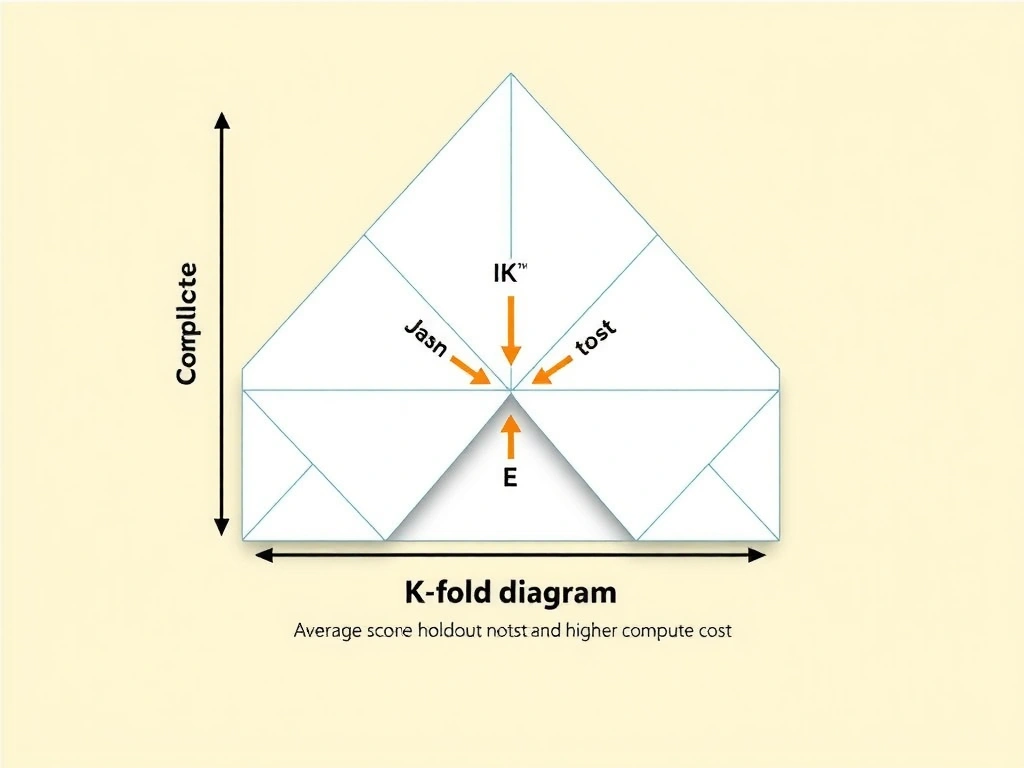
Check this out—k-fold is how you stop lying to yourself with one lucky test split. You carve data into k chunks, train on all but one, validate on the held chunk, rotate, then average. Better read on unseen performance, especially when data is limited. Trap: thinking k-fold speeds up huge-data training—nope, it usually costs more compute. It also is not your missing-value fixer or a magic feature picker. Boss wants a number she can trust before launch? That's when cross-validation earns its keep. Use stratified folds for classification when classes skew. Remember: reliable generalization estimate—that's the why.
Full explanation below image
Full Explanation
K-fold cross-validation partitions the dataset into k disjoint folds of roughly equal size for repeated evaluation. For each iteration, one fold serves as the validation set while the model trains on the remaining folds. Scores are then aggregated, commonly as a mean and sometimes with a variance or standard deviation, across the k rounds of training and validation. Because every observation appears in exactly one validation fold, the procedure uses data more efficiently than a single fixed split and yields a more stable estimate of out-of-sample performance. That stability is especially valuable on small or medium datasets where a one-shot holdout can be noisy and overly optimistic or pessimistic by pure chance alone.
K-fold is not primarily a speed optimization for large-scale training jobs. Training roughly k models increases computational cost, so teams with extremely large datasets often prefer simpler holdouts, progressive validation, or lightly subsampled cross-validation when wall-clock time dominates the schedule. Cross-validation also does not replace missing-data strategies in the feature pipeline. Imputation, if needed, must be fitted carefully inside each training fold to avoid leakage from validation rows into training statistics that would inflate scores. While cross-validation scores can inform feature selection or hyperparameter search workflows, those are surrounding activities. The defining purpose of k-fold remains honest performance estimation on data treated as unseen during each training phase of the loop.
Best practices include stratification for classification so each fold preserves class rates, grouped folds when samples are not independent such as multiple rows per patient or user, time-aware splits for temporal data that must not leak the future, and nested cross-validation when tuning and evaluating together to avoid selection bias. Report the metric distribution across folds, not only the mean headline number. After model selection, some teams retrain on all available data for deployment while still quoting the cross-validation estimate as the generalization snapshot shared with stakeholders. Exam focus is clear. Pick k-fold when the goal is a more reliable estimate of performance on unseen data, not when the vignette emphasizes raw training speed, missing-value imputation as the main task, or pure feature hunting without careful evaluation discipline.