
How do the concepts of strong AI and weak AI primarily differ?
Select an answer to reveal the explanation.
Short Explanation and Infographic
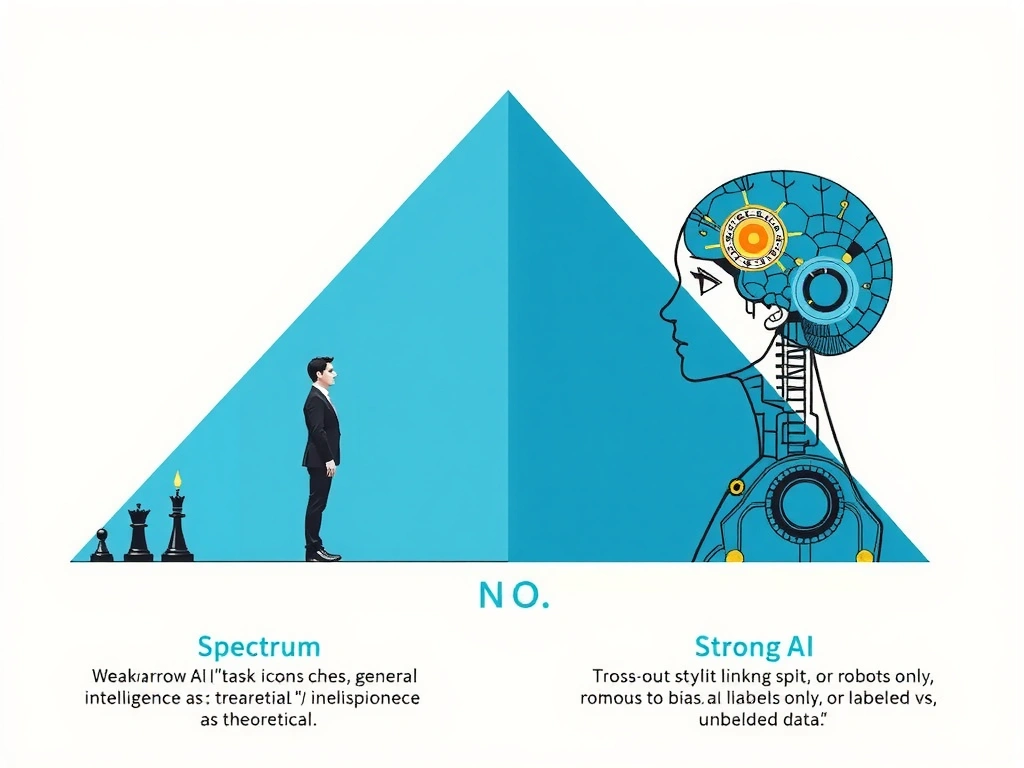
Let's clear this one up, because the terms sound dramatic. Weak AI—also called narrow AI—is everything you actually use: spam filters, recommenders, chatbots that do a job well in a box. Strong AI is the sci-fi end of the spectrum: a machine with real, general mind-like understanding, not just task performance. Think of it like this: a calculator is brilliant at arithmetic; that doesn't mean it "understands" math the way a person does. Exam trap: tying strong/weak to bias, robots vs software, or supervised vs unsupervised. Nope—those are different axes. When the test asks for the main difference, scope of intelligence (general/conscious vs specialized) is the answer. Stick with that and you're solid.
Full explanation below image
Full Explanation
In AI discourse, weak AI (narrow AI) describes systems engineered to perform particular tasks—classification, generation within limits, control in a domain—without claiming human-level general cognition. Virtually all production systems today fall here: vision models, speech recognizers, ranking engines, and large language models used as tools. Strong AI historically refers to the stronger claim that a machine could possess genuine understanding, mind-like states, or full general intelligence comparable to humans (closely related to discussions of AGI and consciousness). Strong AI remains largely theoretical as an achieved system; it is a research and philosophy target rather than a shipping product category.
The distinction is about breadth and nature of intelligence, not morality of bias, physical form factor, or labeling of training data. Weak systems can encode severe bias. Strong AI is not defined as robots only; embodiment is independent—software can be discussed as strong or weak, and robots can run narrow AI. Supervised and unsupervised learning describe how models are trained, not whether the system is strong or weak. Mixing those axes is a common exam trap.
Related terms include artificial general intelligence and artificial superintelligence, which extend the spectrum beyond narrow tools. Product teams should specify task boundaries and evaluation suites rather than marketing every specialist system as general intelligence. Philosophically, debates about machine consciousness are distinct from measuring task competence.
Underlying principle: strong versus weak classifies scope of intelligence claims, not hardware, bias level, or learning regime. Best practice uses precise terms—narrow or weak for specialists, AGI-style language only when breadth is actually claimed—and evaluates systems on defined tasks. Memory aid: weak means good at a job; strong means hypothetically good at being a mind. Exam questions almost always reward that conceptual split.