
For which class of problems are recurrent neural networks (RNNs) primarily designed?
Select an answer to reveal the explanation.
Short Explanation and Infographic
Here's the deal: an RNN is built for stuff that happens in order. Think of it like this—you're reading a sentence one word at a time, and what you just read changes how you interpret the next word. Same idea for stock prices or sensor ticks over time. The network keeps a little memory (hidden state) as it steps through the sequence. Hopefully you picked time series and NLP-style sequence work—that's the main use case. Exam trap: people mash "neural net" with "reinforcement learning" or slap RNNs on image recognition like they're CNNs. Nope. Clustering? Totally different job. When the data is a sequence and order matters, RNNs (and their modern cousins) are in their element. Got it? Sweet.
Full explanation below image
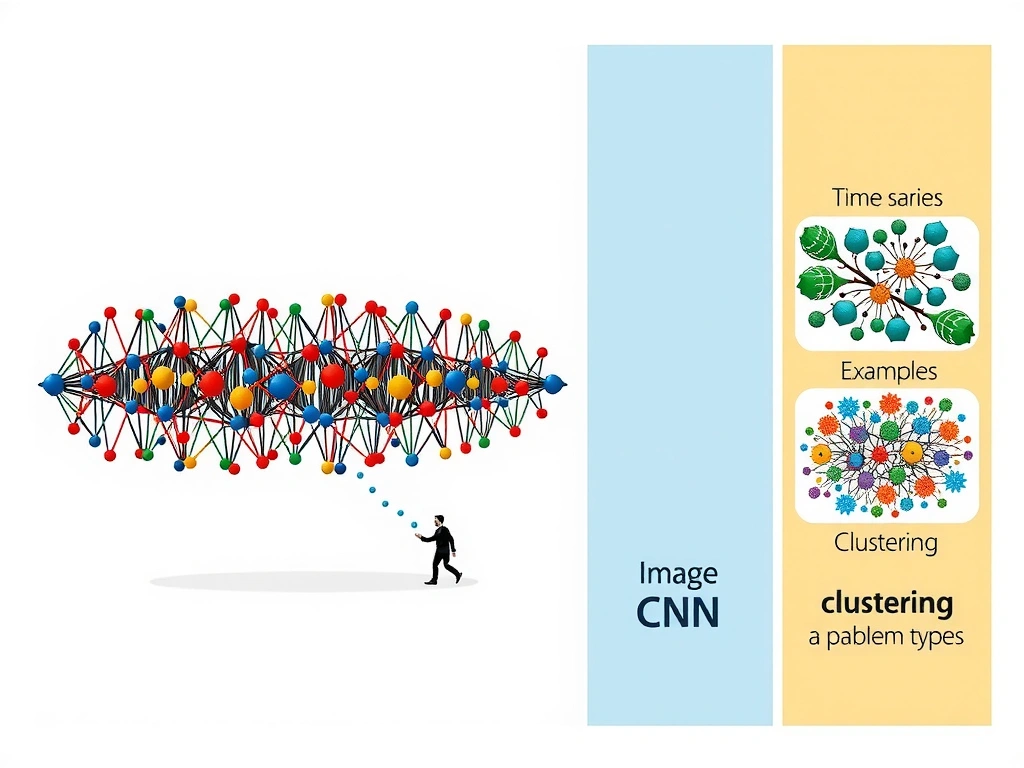
Full Explanation
Recurrent neural networks process inputs as a sequence of steps, updating a hidden state that carries information from earlier positions to later ones. That inductive bias makes them a natural fit for ordered data: time-series forecasting (demand, sensor streams, financial series), speech, and classical natural language tasks such as language modeling, sequence tagging, and machine translation architectures that historically used encoder–decoder RNNs. The key idea is temporal or sequential dependency—position t depends on context from previous positions.
Reinforcement learning is a learning paradigm based on agents, environments, and rewards. RNNs can appear inside policy or value networks, but the main use case of an RNN is not “do RL.” Image recognition relies on spatial locality and hierarchical filters; convolutional neural networks and increasingly transformers dominate that space. Unsupervised clustering groups observations by similarity without sequential recurrence as the defining mechanism. Each distractor names a real area of AI that simply is not what RNNs were primarily designed for.
In practice, LSTMs and GRUs improved vanilla RNNs on long dependencies, and transformers now lead many sequence benchmarks—but exam questions still expect the conceptual pairing: recurrence with sequential or time-ordered data. Vanishing gradients over long sequences are a known limitation that motivated those later architectures.
Underlying principle: architecture should match the structure of dependencies in the data. Best practice is to use sequence models when order matters, and to consider transformers or temporal convolutions when long-range context or parallelism dominates requirements. Memory aid: CNN for grids, RNN historically for chains, transformers for attention over sequences. If the problem is “what comes next in this ordered stream,” RNNs are the classic answer.