
During model development, a team holds out a portion of labeled examples that is neither used to fit parameters nor reserved for the final report. What is the primary role of that held-out validation set?
Select an answer to reveal the explanation.
Short Explanation and Infographic
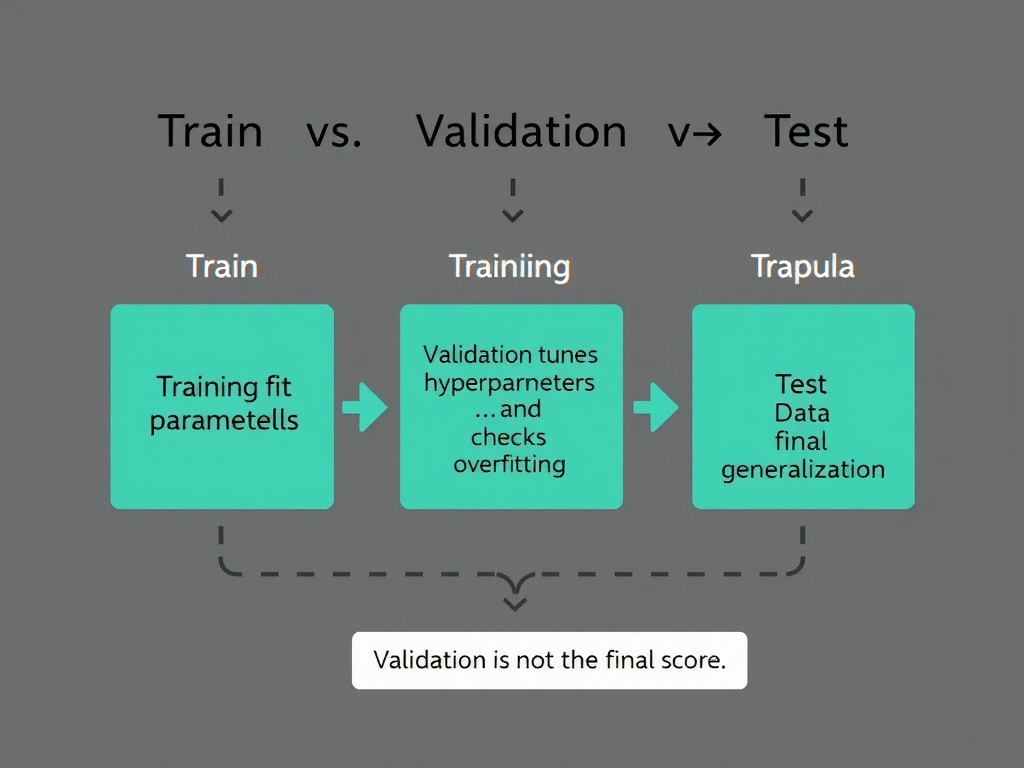
Okay, let's dive in. Think of training like practicing free throws, validation like scrimmages where you tweak your form, and the test set like game day. You don't use scrimmage results as your official season stats—and you sure don't practice on the game film. Here's the deal: the validation set is where you adjust hyperparameters and pick the model that looks healthiest without baking those decisions into the final score. Exam trap? People swap validation and test all the time. Remember: train fits weights, validate guides design, test is the honest report. Got it? Sweet. When your boss asks how you chose the learning rate, you point at validation—not the test set.
Full explanation below image
Full Explanation
In supervised machine learning, labeled data is typically partitioned so that different stages of development remain statistically independent. The training set is used to update parameters (weights and biases) through optimization. The validation set is consulted during development to compare configurations, tune hyperparameters (for example learning rate, regularization coefficient, number of layers, early-stopping patience), and detect overfitting when training metrics improve while validation metrics worsen. The test set is used only after those choices are locked, yielding an estimate of generalization that has not influenced model selection.
The correct answer captures that middle role: the validation set supports hyperparameter tuning and model selection while helping avoid overfitting to the training data. Treating it as a place to fit parameters confuses it with training. Treating it as the final performance number confuses it with testing; if validation is used repeatedly for selection, reported validation scores become optimistically biased. Archiving production predictions addresses monitoring and audit, not the classic data-split purpose of validation.
A practical memory aid is the three-question checklist: Where do gradients run? Training. Where do design decisions get scored? Validation. Where do we publish the final number? Test. Cross-validation is a related technique that rotates the validation fold when data is scarce, but the conceptual purpose remains the same—honest intermediate evaluation without burning the final held-out set. Best practice also includes keeping preprocessing fit statistics (means, vocabularies) estimated only on training folds and applied to validation and test, so leakage does not silently inflate results. In practice, document the decision criteria you used so teammates can reproduce the evaluation. Prefer metrics and checks that match the business risk, not vanity scores. When reviewing distractors on an exam item, name the misconception each option encodes: wrong learning paradigm, wrong evaluation stage, or a metric that optimizes the wrong objective. A reliable memory aid is to restate the concept in one sentence, then ask which option alone matches that definition without adding unrelated goals. Finally, connect the idea to a production workflow step—data prep, training, validation, or monitoring—so the correct answer stays grounded in how systems are actually built and governed.