
Improving fit on the training sample can hurt performance on unseen examples if the model becomes too brittle. What does the bias–variance tradeoff describe?
Select an answer to reveal the explanation.
Short Explanation and Infographic
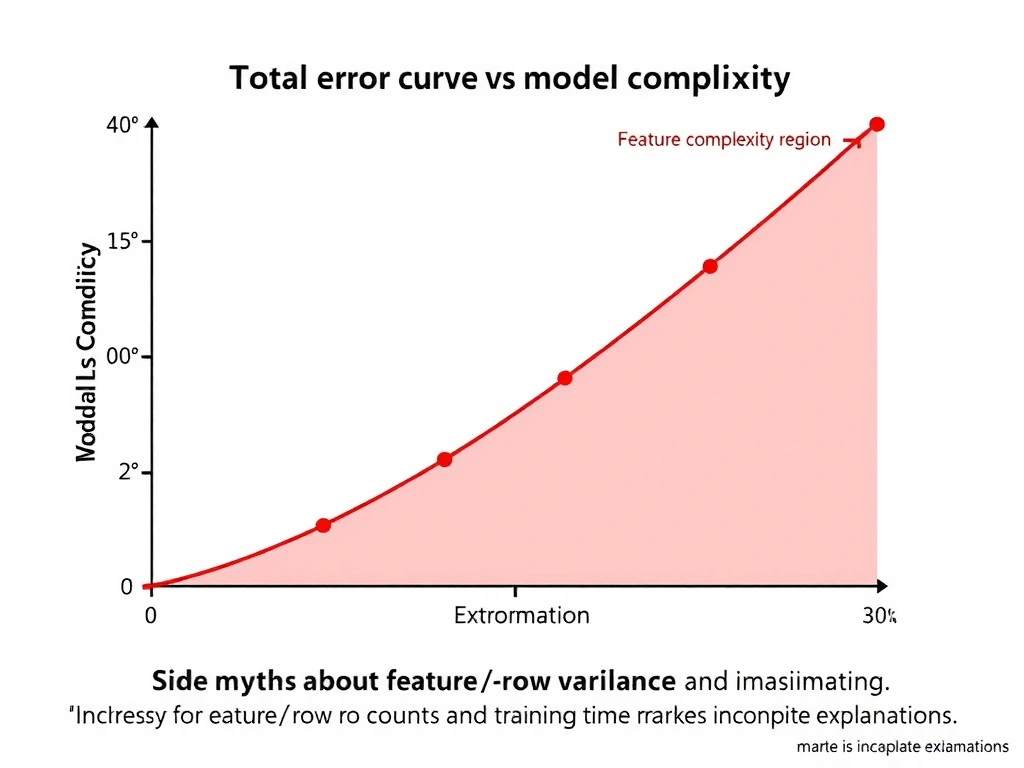
Here's the deal—and this pairs with the bias/variance definitions. Make the model super flexible and you can hug every training point (low bias), but it may freak out on new data (high variance). Clamp it down too hard and you're stable but systematically off (high bias, low variance). That's the bias–variance tradeoff: fit the training set vs generalize. Think of a tailored suit so exact it only fits today's measurements after lunch—not very useful tomorrow. Exam trap: “features vs samples,” “big data vs small data,” or “complexity vs training minutes.” Related pressures, wrong definition. Boss wants lower test error? You're managing that tradeoff with regularization, model choice, and more data—not just grinding more epochs. Land it: training fit ↔ generalization tension.
Full explanation below image
Full Explanation
The bias–variance tradeoff is a central idea in machine learning model selection. As hypothesis class flexibility increases, models can represent more complex functions, typically reducing bias but increasing variance: predictions depend more on the particular training sample. Simpler models do the reverse. Total expected error reflects both components (plus noise), so the best practical model is rarely the most complex one that minimizes training loss; it is the one that minimizes error on unseen data.
Engineers navigate the tradeoff with capacity control (architecture size, tree depth), regularization (L2/L1, dropout, early stopping), ensemble methods, and more representative data. Cross-validation estimates generalization while tuning these choices. Learning curves reveal whether collecting data or simplifying/complexifying the model is the better next step. The tradeoff also clarifies why perfect training accuracy can coexist with poor production performance.
Incorrect options capture incomplete intuitions. Balancing number of features against number of examples influences whether a flexible model can be estimated reliably, but that ratio is not itself the definition of the tradeoff. Framing the issue as only large versus small datasets misses model-capacity and regularization levers. Equating the tradeoff with training-time budgets confuses statistical generalization with computational cost—important operationally, but different. Underlying principle: increasing flexibility often lowers bias while raising variance, so the best model balances both for unseen data. Best practice uses validation-driven capacity control and more data when variance dominates. Memory aid: tradeoff means how hard I fit the training set versus how stable I am on new data. When a stem mentions the relationship between fitting training data and generalizing, the bias–variance tradeoff is the intended concept.