
A BI platform turns sales tables, KPI fields, and template facts into fluent narrative summaries for executives. Which NLP capability is primarily at work?
Select an answer to reveal the explanation.
Short Explanation and Infographic
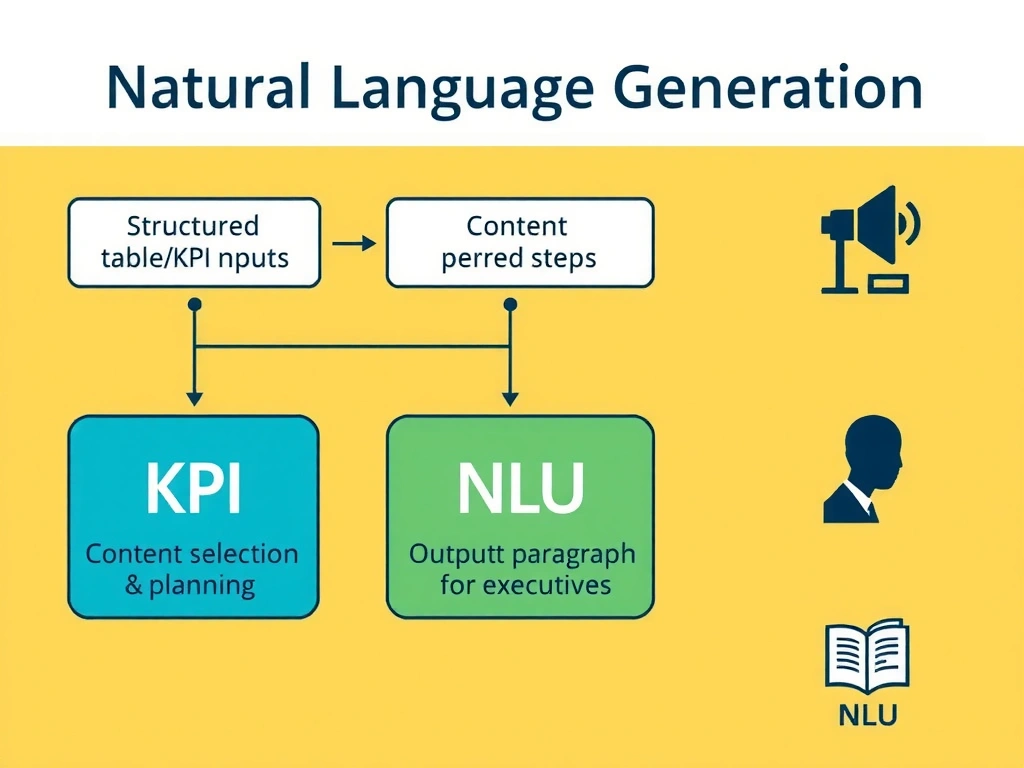
Let's keep this simple. You've got rows and columns — revenue, region, week-over-week change — and the system spits out: "West region sales jumped 12%..." That's NLG: data in, readable prose out. Think of it like a sports ticker that turns box scores into a recap paragraph. Exam trap: don't grab translation (language A to B), NLU (understanding what the human said), or speech-to-text. Those are cousins in the NLP family, different jobs. If the input is structured data and the output is narrative English, you're in NLG territory. Trust me on this — that's the distinction they love to test.
Full explanation below image
Full Explanation
Natural language generation (NLG) is the branch of NLP concerned with producing fluent, coherent text from non-linguistic or structured representations—databases, knowledge graphs, templates, intermediate meaning representations, or model hidden states. Classic NLG pipelines include content selection, planning, and surface realization; modern neural systems often generate end-to-end conditioned on structured or multimodal inputs. The defining information flow is structure or meaning in, human-readable language out.
In the business-intelligence scenario, tabular KPIs and facts are the source representation, and the executive summary is the generated language. That maps directly to NLG. Report automation, weather narratives from sensor readings, and sports recaps from statistics are textbook NLG applications. Quality criteria include factual faithfulness to the source numbers, readability, and appropriate emphasis for the audience—not merely fluent prose.
Machine translation transforms existing text from one natural language into another; both sides are linguistic strings, so it does not primarily verbalize tables. NLU focuses on interpreting human language (intent, entities, semantics)—the reverse information flow of generation. ASR converts speech signals into text and does not address structured-data storytelling. Each distractor is a real NLP capability, but none matches “KPIs and template facts become fluent narrative.”
Underlying principle: identify the input and output modalities. Structured data to prose is NLG; speech to text is ASR; text meaning extraction is NLU; language-to-language is MT. Best practice for BI narratives is to ground generation in verified metrics, constrain hallucinations, and review templates or model outputs for numerical accuracy. Memory aid: NLU equals understand language in; NLG equals produce language out; MT equals language-to-language; ASR equals speech-to-text. When structured data becomes a paragraph, choose NLG. In generative AI ecosystems, large language models often implement NLG, but the exam concept remains the task definition, not a specific architecture.