
The city clerk's portal waits for a DNA Center wireless-health REST response before rendering. On the sequence diagram, which notation best shows that blocking synchronous call?
Select an answer to reveal the explanation.
Short Explanation
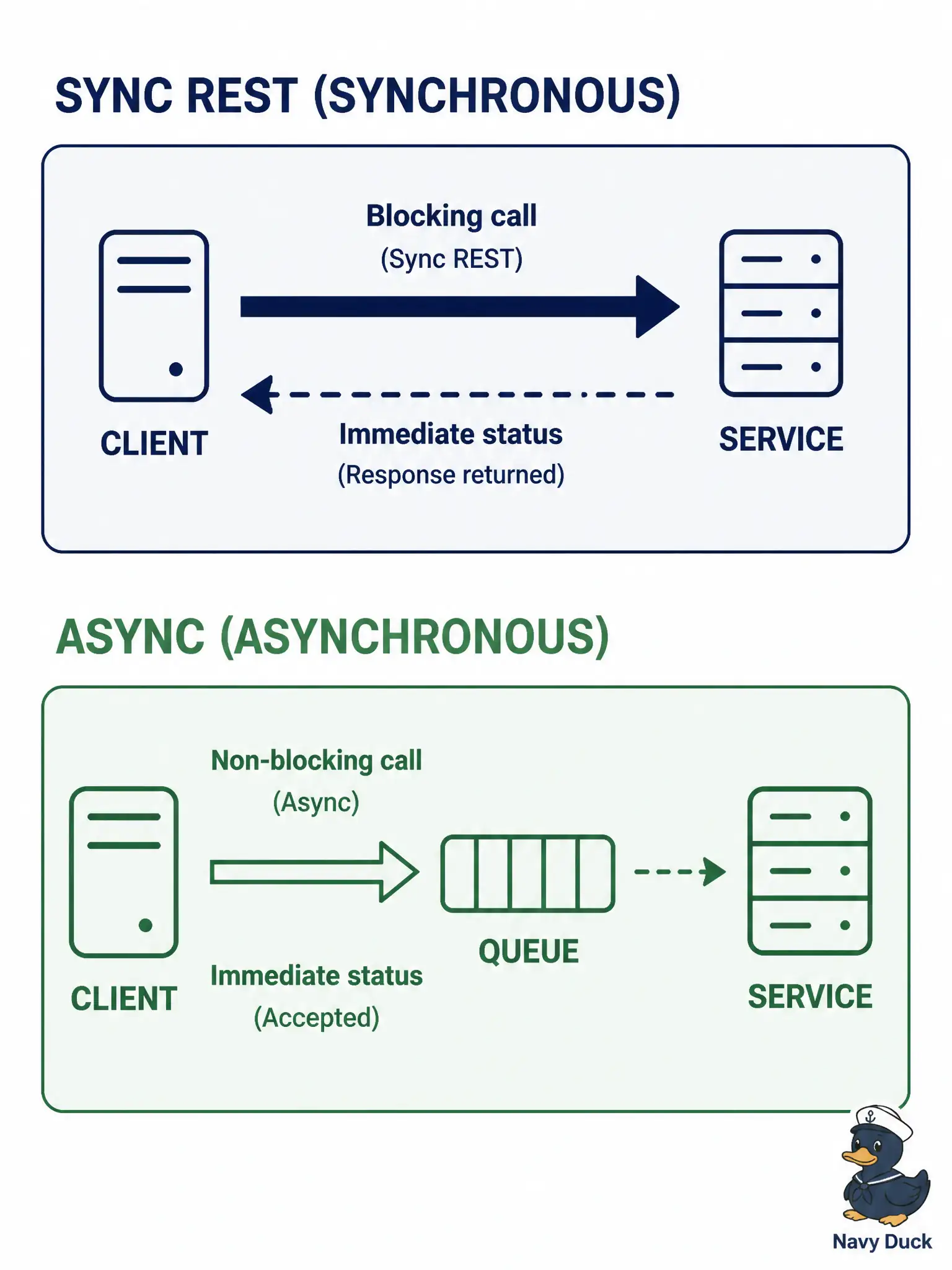
A synchronous REST wait looks like a solid ask and a dashed answer coming back with status or body. An open arrow into a queue with no return is a different, asynchronous conversation.
Full Explanation
A blocking synchronous REST wait is drawn as a filled (solid) request arrow to the API participant and a dashed return carrying status or body back to the caller. That notation shows the city clerk’s portal lifeline remains in the call until DNA Center wireless-health responds—exactly the synchronous dependency in the stem.
An open arrow into a message queue with no immediate return dashed line denotes asynchronous fire-and-forget or queueing, not a portal that blocks on the REST response before rendering. A cloud icon with no lifelines erases participants and falsely implies REST is always non-blocking. A self-message loop only on the UI lifeline with no API participant omits the DNA Center hop entirely and cannot show the synchronous request/return pair.
Exam caveat: some tools draw synchronous calls with a filled arrowhead and async with an open arrowhead—learn your notation, but the return dashed line is the usual cue that the caller waited. Operational check: when reviewing the diagram, confirm every blocking REST dependency has both the outbound call and the return; if the portal must render without waiting, the diagram (and code) should show async handling instead. In municipal portals that block on wireless-health JSON before paint, missing the dashed return on the diagram often correlates with code that never awaits the response—catch that mismatch in review. Keep the DNA Center participant visible even when using a gateway proxy lifeline in front of it, so the synchronous contract remains obvious to operators reading the design.