
A civic design review asks for a sequence diagram of enabling a library-branch SSID through the city's back-end and the Meraki Dashboard API. What must the diagram show to satisfy that request?
Select an answer to reveal the explanation.
Short Explanation
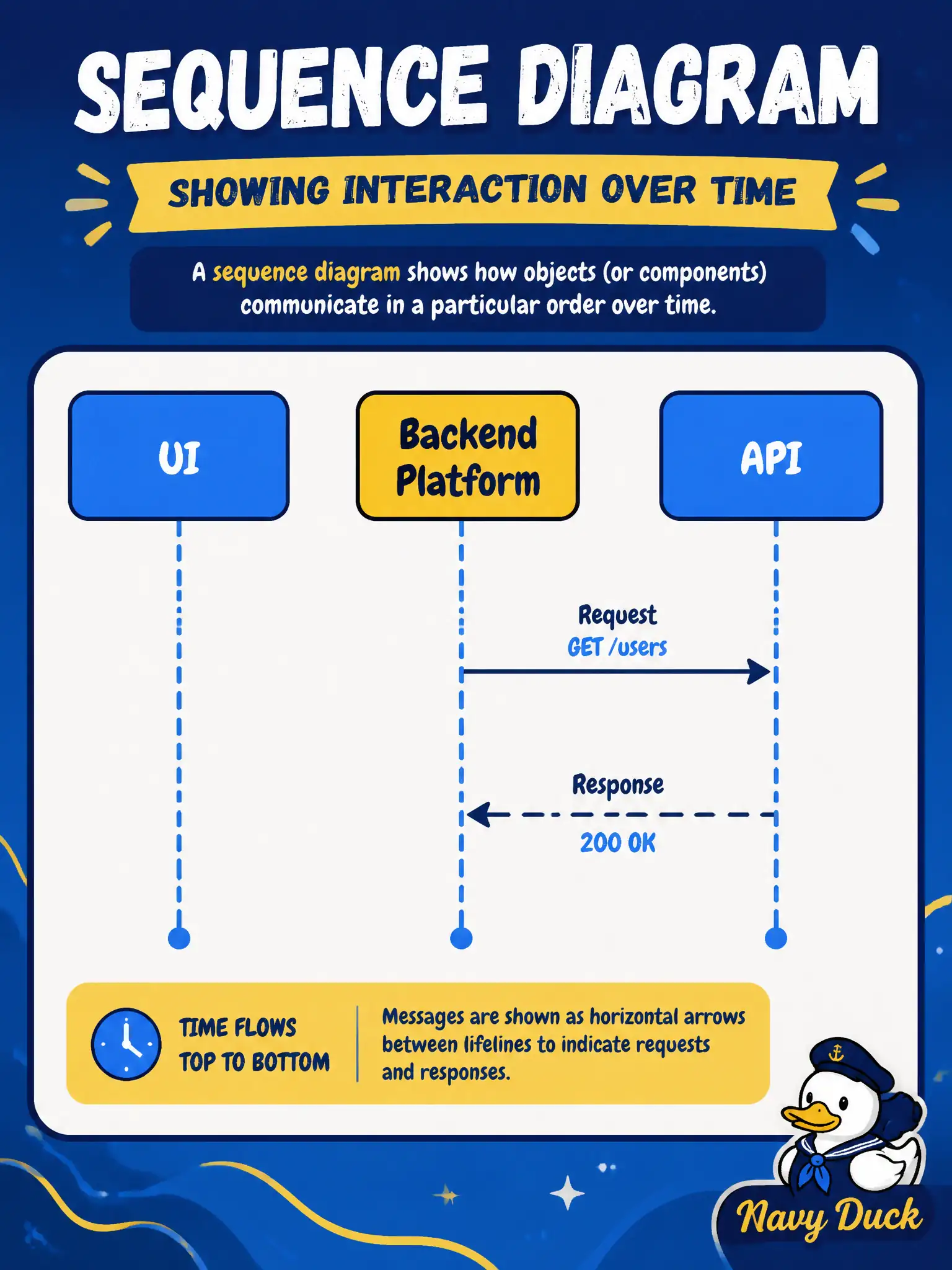
A sequence diagram is a conversation script: who speaks to whom, in order. Give the user or UI, the back-end, and the Meraki API their own lifelines, then label the API call and its reply.
Full Explanation
A sequence diagram for enabling a library-branch SSID through the city’s back-end and the Meraki Dashboard API must show interaction order among distinct participants. Separate lifelines for the UI or user, the back-end service, and the platform API, with labeled request and response arrows, make the conversation explicit: who initiates, who calls Meraki, and what returns. That is what a design review means by “sequence”—ordered messages across roles, not a topology sketch.
A Layer-2 campus cartoon with switches and VLAN clouds shows connectivity topology, not the ordered API conversation for SSID enablement. Dumping OpenAPI YAML of every Meraki endpoint lists contracts without actor order or timing of this particular flow. Collapsing the back-end and Meraki API into one swimlane hides the boundary the review asked to see and cannot show the Dashboard API hop distinctly.
Exam caveat: sequence diagrams can omit internal private methods, but they must not merge independent systems into one lifeline when the review question is about the platform API boundary. Operational check: walk the diagram against a real enable-SSID call—confirm UI→back-end→Meraki request/response arrows match the city’s helper logs before approving the design.