
Five containers are labeled microservices, yet they share one database and must always ship on the same release train because any schema change breaks all five. What have the architects actually built?
Select an answer to reveal the explanation.
Short Explanation
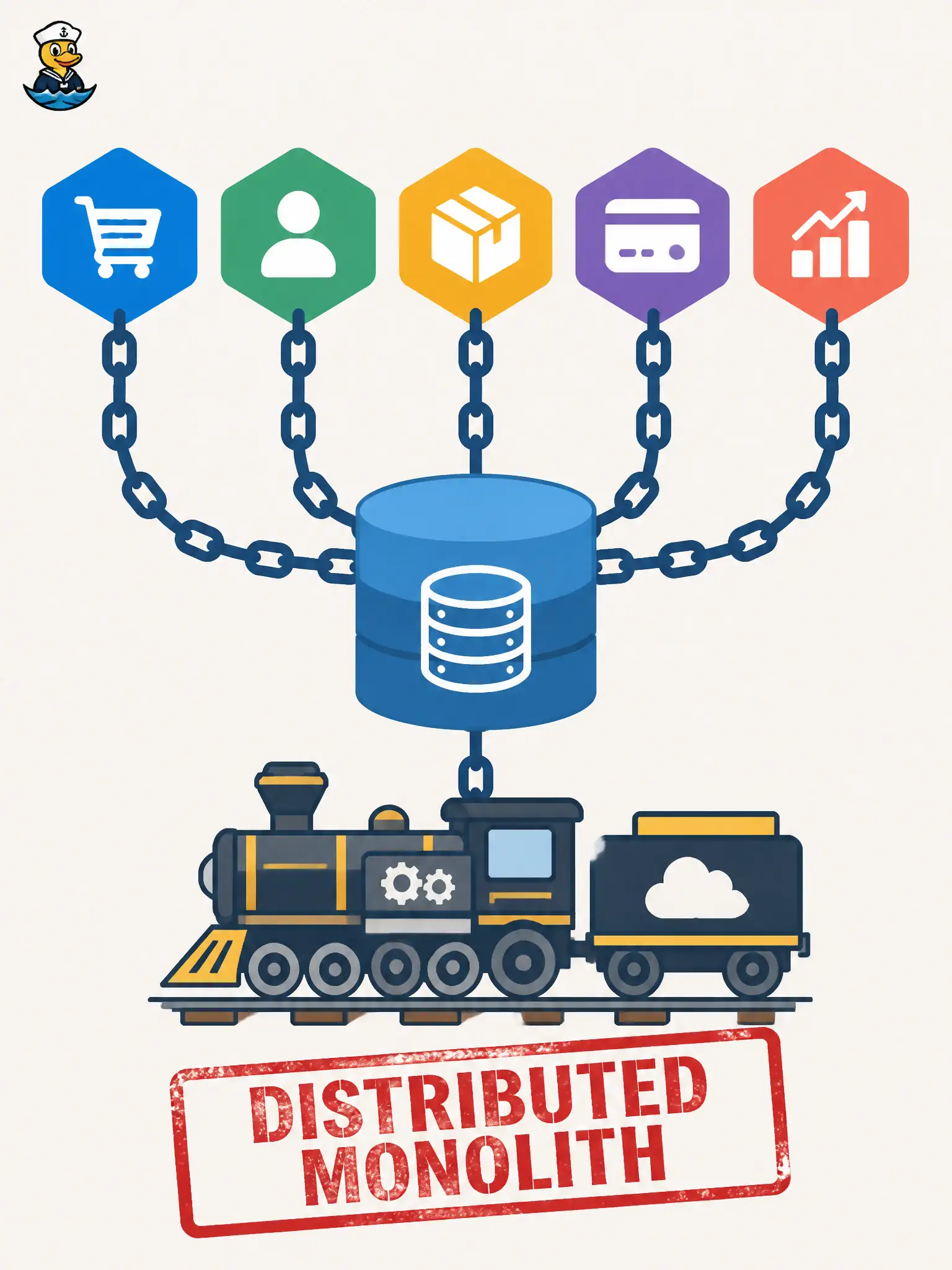
Five trailers locked to one hitch still move as one truck. Shared database and lockstep releases mean you have a distributed monolith, not independent microservices. The slide title does not override the coupling.
Full Explanation
Architects have actually built a distributed monolith: microservices in name only without independent deployability. Five containers that share one database and must always ship on the same release train because any schema change breaks all five remain coupled at the data and release layers. Five trailers locked to one hitch still move as one truck. Container labels and slide titles do not override shared-schema and lockstep-release coupling.
Calling it a pure event-driven system because containers are used confuses packaging with interaction style; shared databases and lockstep releases are not evidence of event-driven decoupling. Calling it a justified fine-grained microservices architecture with decentralized data contradicts the single shared database and inseparable release train. Calling it an official columnar analytics platform misreads an application-structure failure as a storage-engine choice.
Exam caveat: splitting processes without splitting data ownership is the classic path to a distributed monolith—independence requires both deploy and data boundaries. Operational check: attempt to release one container with a schema-compatible change while others stay put; if a shared-schema migration still forces all five to move together, document the architecture as a distributed monolith and plan either true data decentralization or an intentional modular monolith.