
DNA Center (Catalyst Center) emits a network event that must reach a ticket opener, a ChatOps Webex notifier, and a metrics recorder. The producer must not wait on or know those consumers. Which pattern fits?
Select an answer to reveal the explanation.
Short Explanation
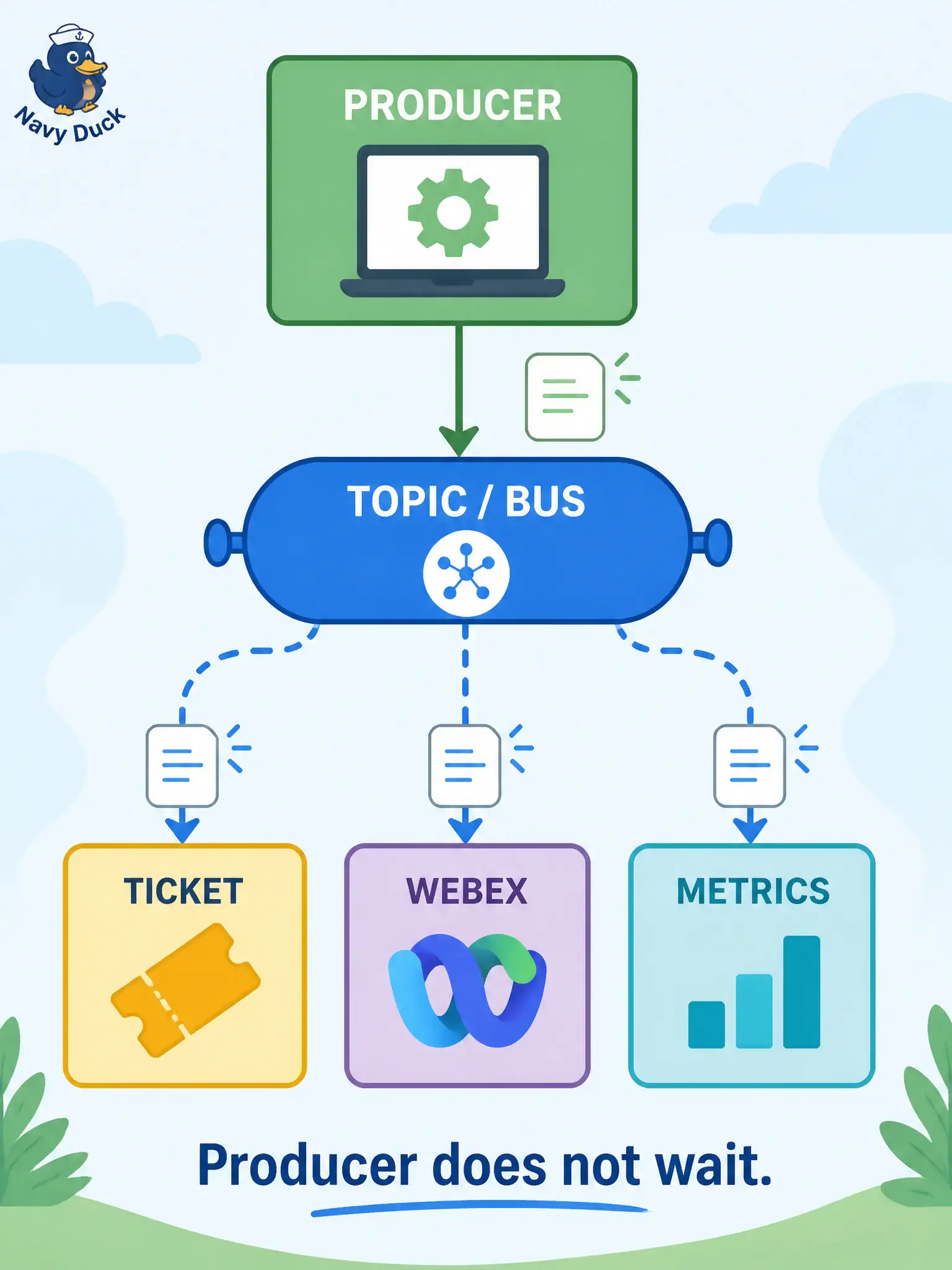
A town crier rings the bell once; listeners decide what to do—he does not run each errand himself. Event-driven publish/subscribe gives that fan-out and decoupling. Synchronous REST chains make the producer wait on every consumer.
Full Explanation
An event-driven design where the producer publishes once and subscribers consume independently fits a Catalyst Center (DNA Center) network event that must reach a ticket opener, a ChatOps Webex notifier, and a metrics recorder without the producer waiting on or knowing those consumers. A town crier rings the bell once; listeners decide what to do. Publish/subscribe gives fan-out and decoupling so adding or slowing a consumer does not block the producer’s emit path.
A synchronous REST chain where Catalyst Center calls each consumer in order and blocks forces the producer to wait on every consumer and to know their endpoints—the opposite of the requirement. A monolith that embeds ticket, Webex, and metrics code in one Catalyst Center process couples release and failure domains into the producer. A shared relational table that consumers poll only during business hours introduces lag, polling load, and business-hours blind spots instead of independent near-real-time consumption.
Exam caveat: event-driven still needs durable delivery, schema contracts, and idempotent consumers—fire-and-forget without those guarantees creates silent gaps. Operational check: publish a test network event in a lab bus or queue, confirm ticket, Webex, and metrics subscribers each process it without the producer calling them, then stop one subscriber and verify the producer still completes publish while that subscriber’s backlog is visible.