
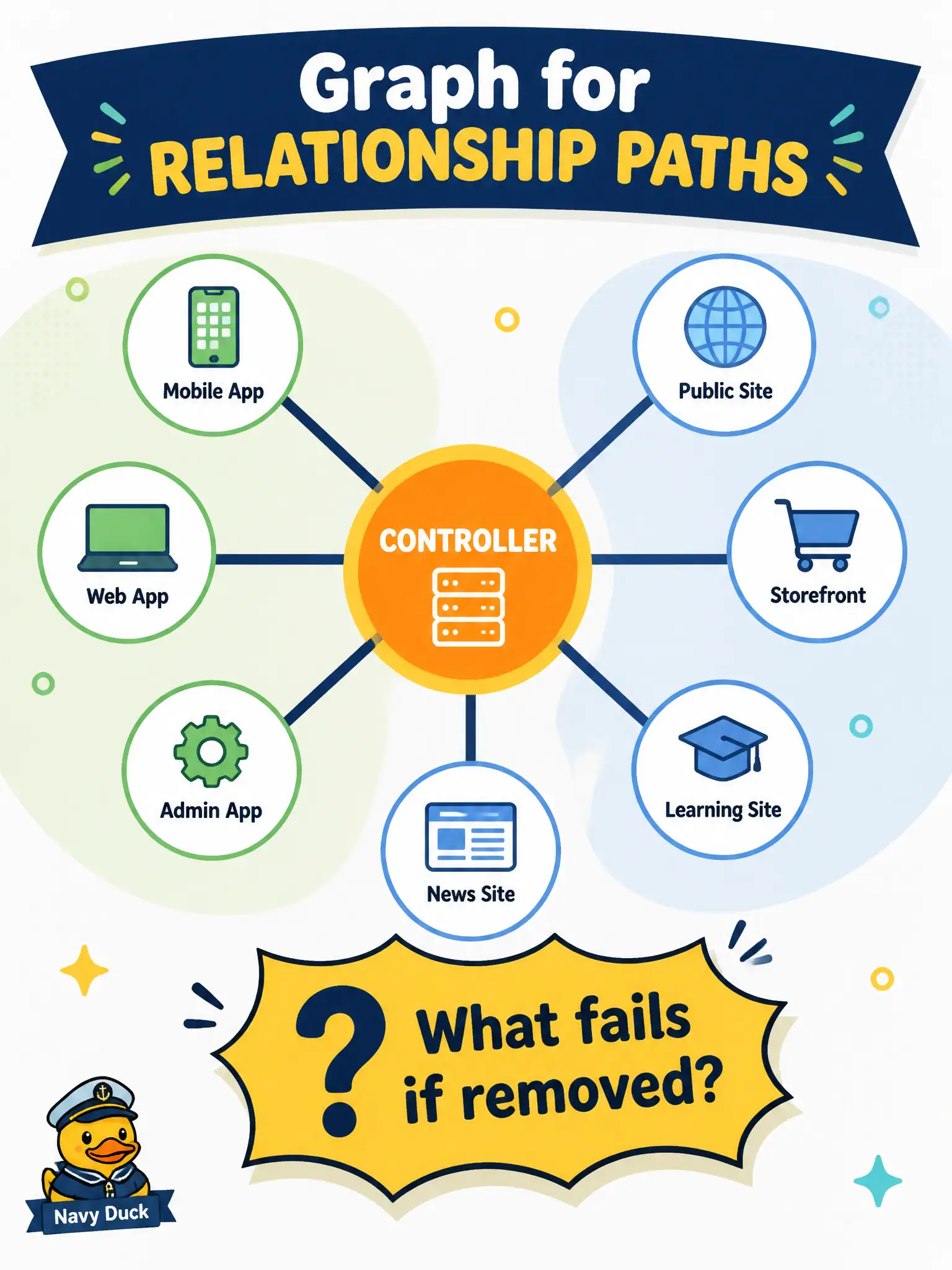
Operators ask: which applications and sites share this Catalyst Center controller, and what else fails if that node is removed? The dominant access pattern is walking relationships. Which database type best matches?
Select an answer to reveal the explanation.
Short Explanation
That question is a trail map—“who is connected to whom if we pull this peg?” Graph databases shine on paths and shared relationships. Row lookups or counter history answer different questions.
Full Explanation
A graph store suited to paths and relationship traversals best matches operators who ask which applications and sites share a Catalyst Center controller and what else fails if that node is removed. The dominant access pattern is walking relationships—who is connected to whom if we pull this peg. Graph databases model entities as nodes and dependencies as edges, making shared-controller and blast-radius queries natural. When the civic question is relational topology of dependencies rather than a single-row lookup or a counter history, graph is the fitting official type.
A time-series store of interface counters for that controller only answers rate and latency over time for one device; it does not enumerate applications and sites that share the controller or transitive failure impact. A columnar store that aggregates one KPI across all sites optimizes wide analytic scans of a few fields, not multi-hop relationship walks. A key-value cache that holds only the controller’s management IP answers a single attribute lookup and cannot express shared application or site relationships.
Exam caveat: graph shines when traversal is the workload—do not pick graph merely because someone said network topology while the real need is constrained inventory joins or time-window metrics. Operational check: load a small model of controllers, sites, and applications in a lab graph, remove one controller node or mark it failed, and confirm a traversal returns the dependent applications and sites you expect before relying on it for change planning.