
Many clerks opening the same health page would each trigger the same expensive DNA Center query. Which consumer design protects latency and the platform quota?
Select an answer to reveal the explanation.
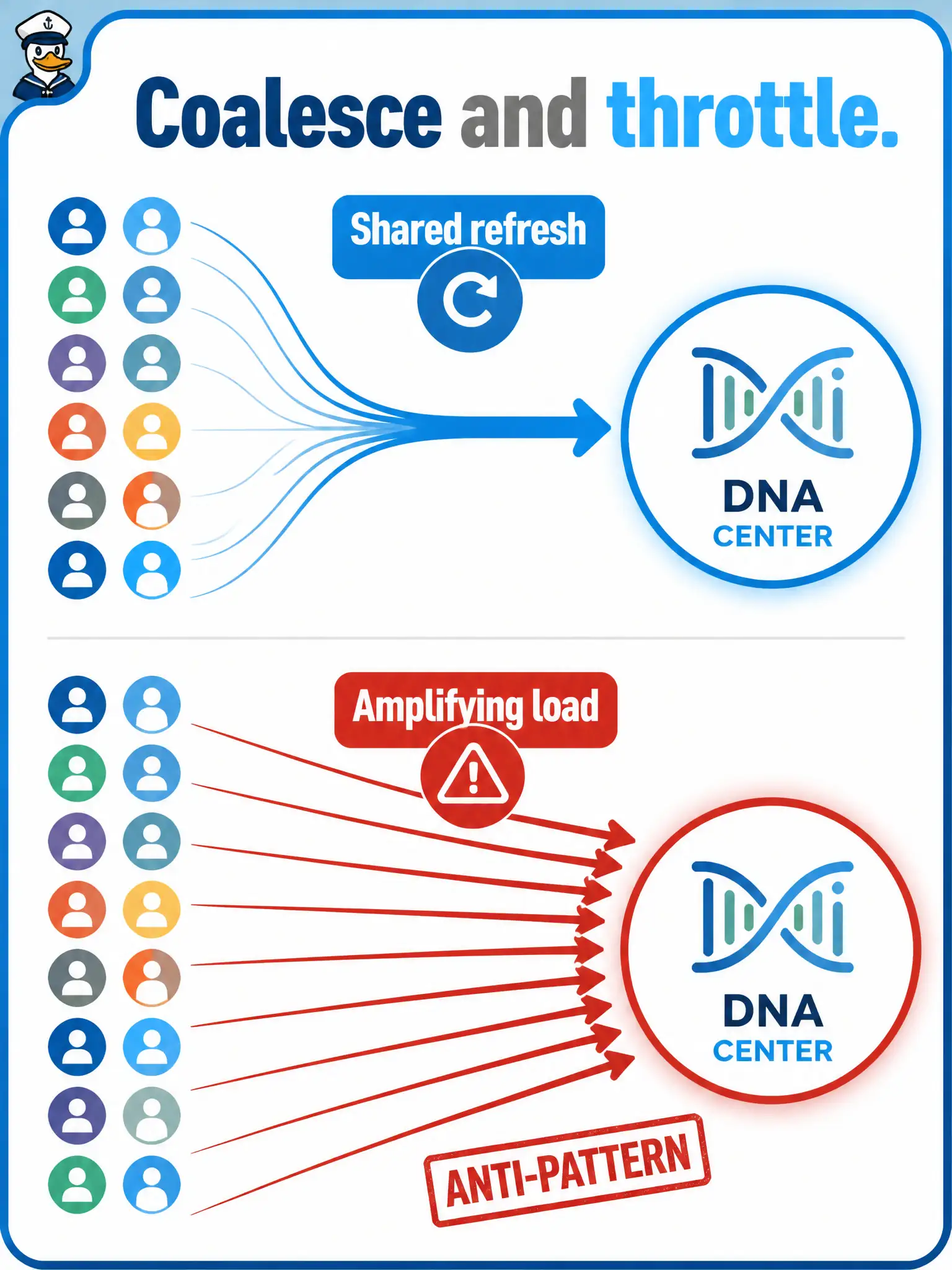
Short Explanation
If fifty people ask “is the bridge open?” you call the bridge once and share the answer—you do not dial fifty times. Back-end coalesce and throttle beat “retry harder from every tab.” Amplifying load hurts latency and quota.
Full Explanation
Many clerks opening the same health page must not amplify one expensive DNA Center query into N controller loads. Back-end coalesce and throttle let concurrent UI users share one refresh: single-flight the in-flight request, cache briefly within freshness policy, and rate-limit outbound platform calls. That protects both portal latency and the platform quota.
Letting every browser tab retry harder and independently fails by creating a thundering herd. Disabling caching and coalescing so every click forces a fresh round-trip fails by maximizing load by design. Fanning one UI click into parallel identical controller queries fails by multiplying identical work without improving correctness.
Exam caveat: coalescing must respect authorization boundaries—do not serve one clerk's filtered health view to another without equivalent rights.
Operational check: open many concurrent health-page sessions in staging and verify DNA Center receives roughly one refresh per coalesce window, not one per tab.
Coalescing is especially valuable for identical DNA Center health queries that do not vary by clerk. Combine single-flight with a short shared TTL cache and a maximum refresh rate so a shift change cannot stampede the controller. The back-end becomes the amplifier brake that browsers alone will not apply.