
A downtown wayfinding service must retrieve Meraki Wi-Fi and BLE location observations in near real time. How does that location data typically arrive?
Select an answer to reveal the explanation.
Short Explanation
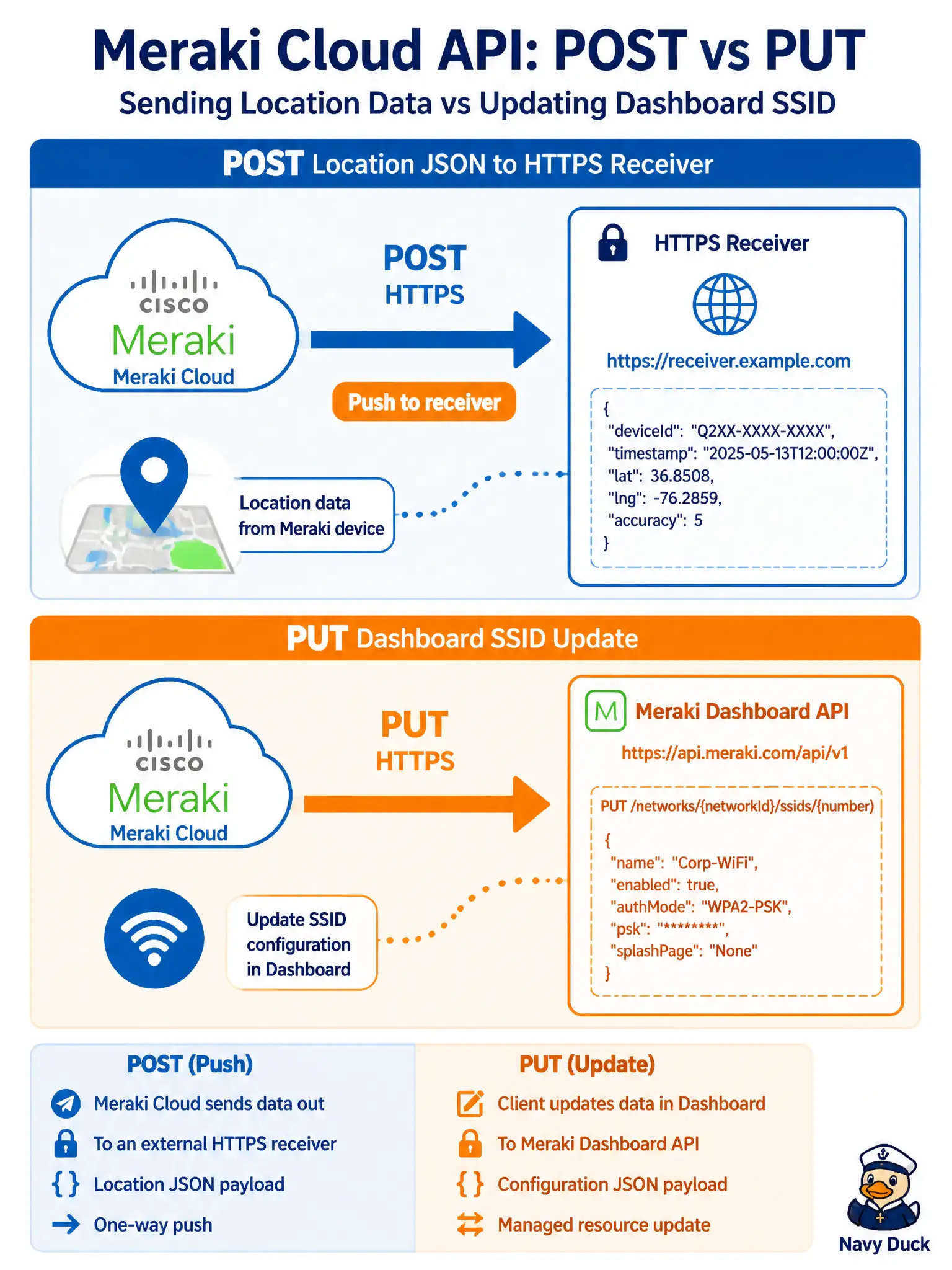
Location retrieve here is catching packages Meraki drops on your doorstep—an HTTPS POST to your receiver—not flipping SSIDs or GETting SSID config all day.
Full Explanation
Near-real-time Meraki Wi-Fi and BLE location for a downtown wayfinding service typically arrives as a push: the Meraki cloud POSTs JSON observations to the HTTPS receiver URL you configured for the network. Your application accepts those POSTs, validates them, and parses the observation payload. That push model is the classic “retrieve location” pattern for Scanning/location integrations, as opposed to polling configuration APIs for coordinates.
PUTting enabled true on each SSID slot every second fails both purpose and scale: SSID enable is configuration, not a location feed, and hammering enable does not yield client coordinates. Polling GET /networks/{networkId}/wireless/ssids in a tight loop fails because SSID resources describe WLAN settings, not live client lat/lng streams. Opening an FDM /object/networks websocket for Meraki locations fails by platform fiction—FDM network objects are firewall config, not a Meraki location transport.
Exam caveat: “retrieve” in this Meraki location sense often means receive the cloud’s POST, not actively GET the observation from Dashboard every second.
Operational check: configure the receiver URL in Dashboard, complete validator handshake, post a test walk past APs, and confirm your HTTPS endpoint logs observation POSTs with client and location fields.