
Several municipal microservices share one staging OKE cluster. What does that shared environment imply for each team’s test ownership?
Select an answer to reveal the explanation.
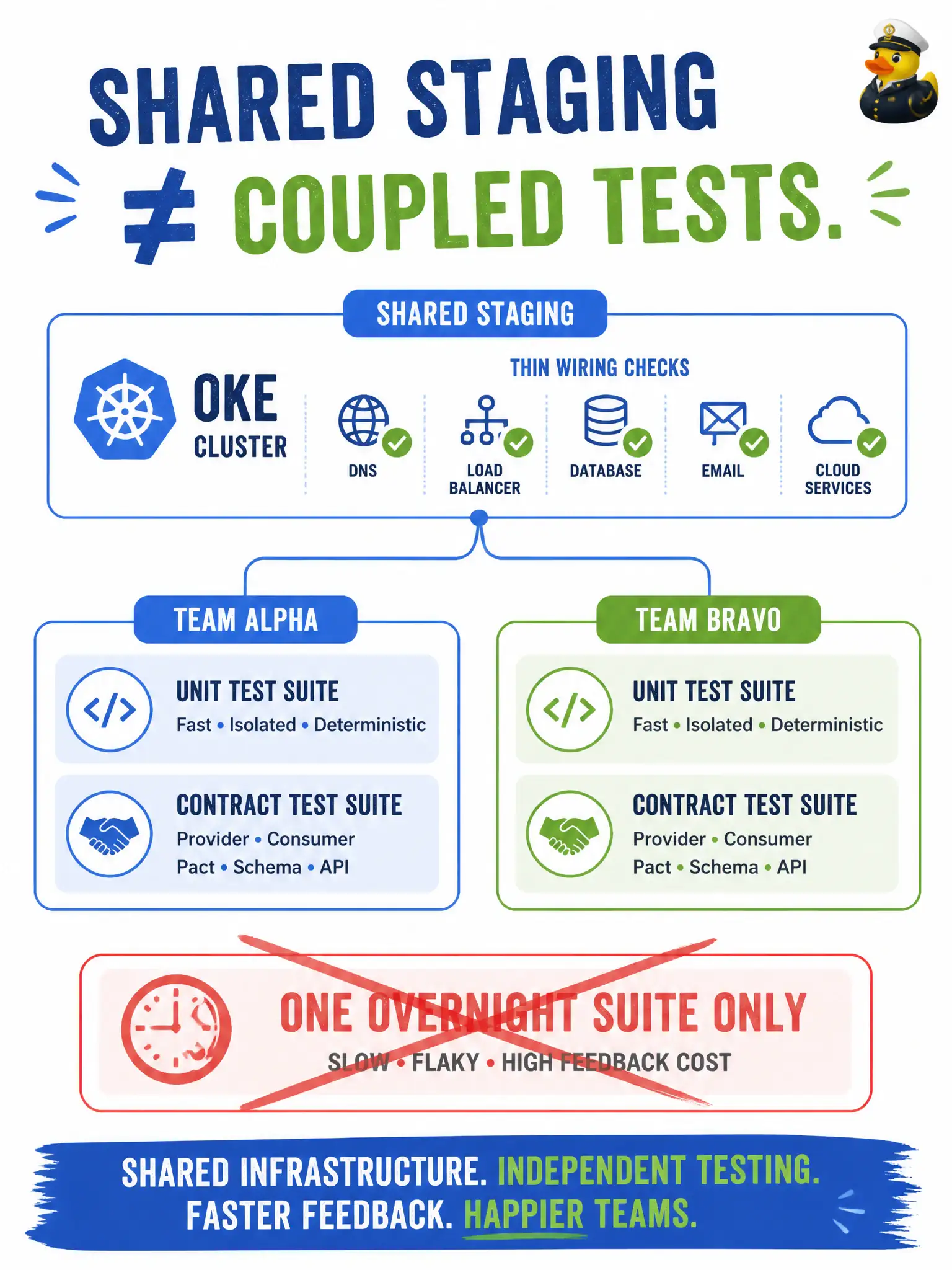
Short Explanation
Sharing a staging cluster doesn't mean you stop owning your service's tests. You still run your own unit and contract suites; the shared cluster is only for thin wiring checks.
Full Explanation
Sharing one staging OKE cluster among municipal microservices does not transfer ownership of unit and contract suites to a single coupled overnight run. The correct implication is that each team still runs its own unit and contract suite for the service it ships; the shared environment is for thin wiring checks across neighbors—not permission to delete local suites or to ship only when a giant multi-service job is green. Shared staging is a convenience gym floor, not a substitute for per-service confidence. Treating one shared overnight multi-service suite as enough so individual unit and contract suites can be deleted fails by concept: overnight feedback is slow and attributes failures poorly across teams. Making the central staging owner responsible for each team's service-level checks in OKE fails because it removes the owning team's fast, service-level feedback and blurs accountability. Blocking one service from shipping unless another service's fixtures always load first in the shared cluster fails because it re-couples independent deployability to neighbor fixture order. Claiming shared staging removes the need for any automated tests owned by individual services fails outright—environments do not replace suites. Exam caveat: shared staging complements, never replaces, per-service unit/contract ownership. Operational check: keep each service's PR gate on its own unit/contract jobs; use staging only for a thin service-to-service wiring smoke, and do not require another service's full fixture boot as a precondition for its unit green.