
Operations tags databases that need automated follow-up. Which Events capability aims a rule at only those labeled resources without listing every OCID?
Select an answer to reveal the explanation.
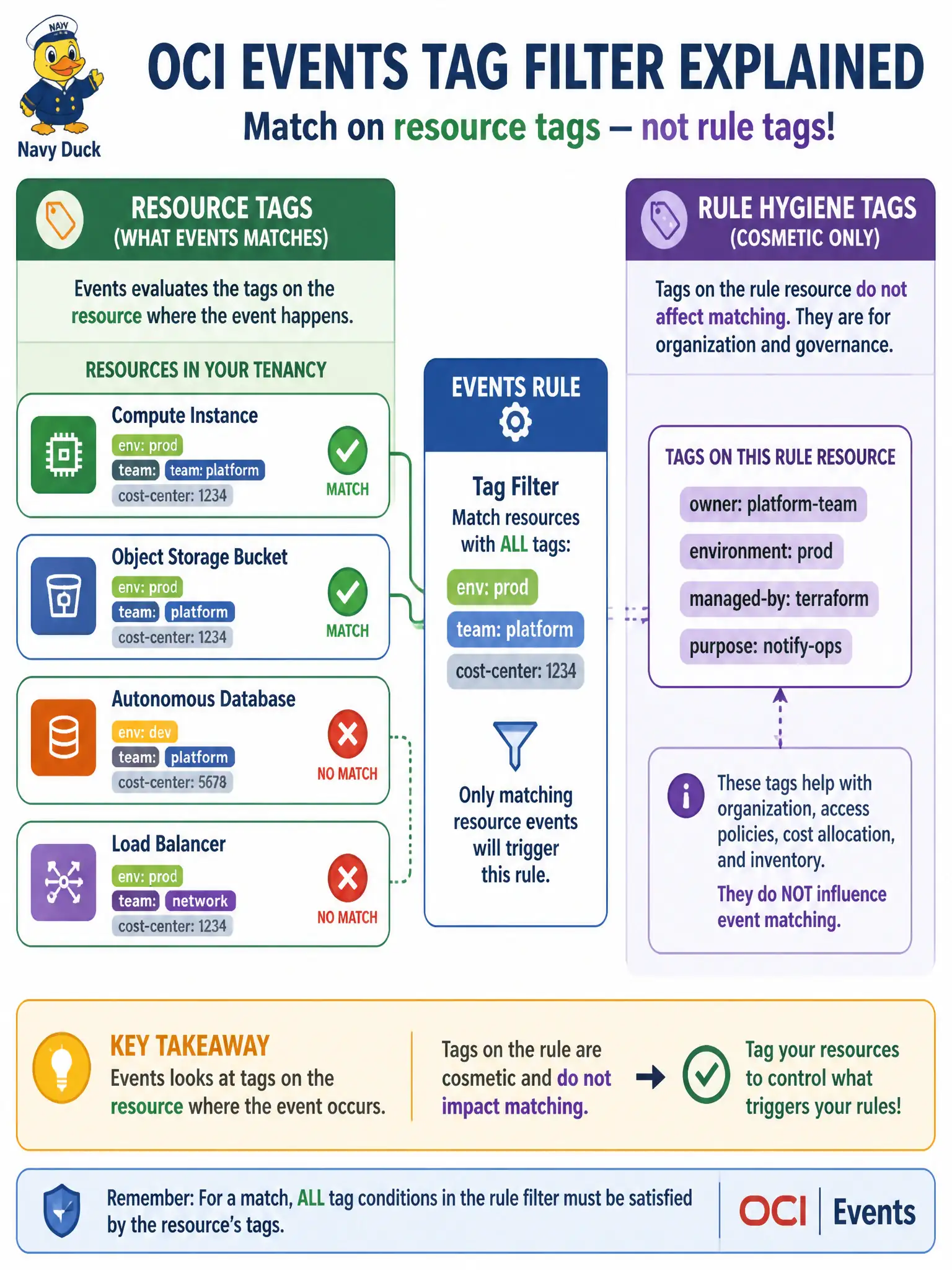
Short Explanation
Events can filter on tags that the emitting resources carry—for example only databases tagged for operations. That is different from tagging the rule object itself for inventory hygiene. Tags here aim automation without listing OCIDs.
Full Explanation
Operations tags databases that need automated follow-up, and Events can aim a rule at only those labeled resources with a tag filter. The filter matches free-form or defined tags carried by the emitting resources themselves, so databases tagged for operations fire the rule without enumerating every database OCID. Combined with Event Type (and optional attributes), tags become a scalable labeling plane for municipal automation. Tags applied only to the rule resource for tenancy hygiene do not select emitters: tagging the rule object helps inventory and IAM organization, but Events matching looks at tags on the resources that emit, not solely at tags decorating the rule. A Queue channel name equal to the tag key, used as an Events action, invents a bridge that is neither an Events filter nor a documented Events destination. A Vault secret whose name matches the tag so Events decrypts only tagged databases confuses secret storage with event matching—Vault does not act as an Events action or tag selector. Exam caveat: defined tags require the tag namespace and key to exist and be applied consistently; free-form tags are easier to mistype, and either form fails closed if the emitting resource never received the tag. Operational check: tag one test database with the operations key, leave a sibling untagged, emit a matching lifecycle event from both, and confirm only the tagged emitter reaches the rule’s Function or Notifications action.