
A parks department developer is designing subscriptions for bucket and database lifecycle changes. What envelope do OCI services use when they emit those resource-state messages through the Events service?
Select an answer to reveal the explanation.
Short Explanation
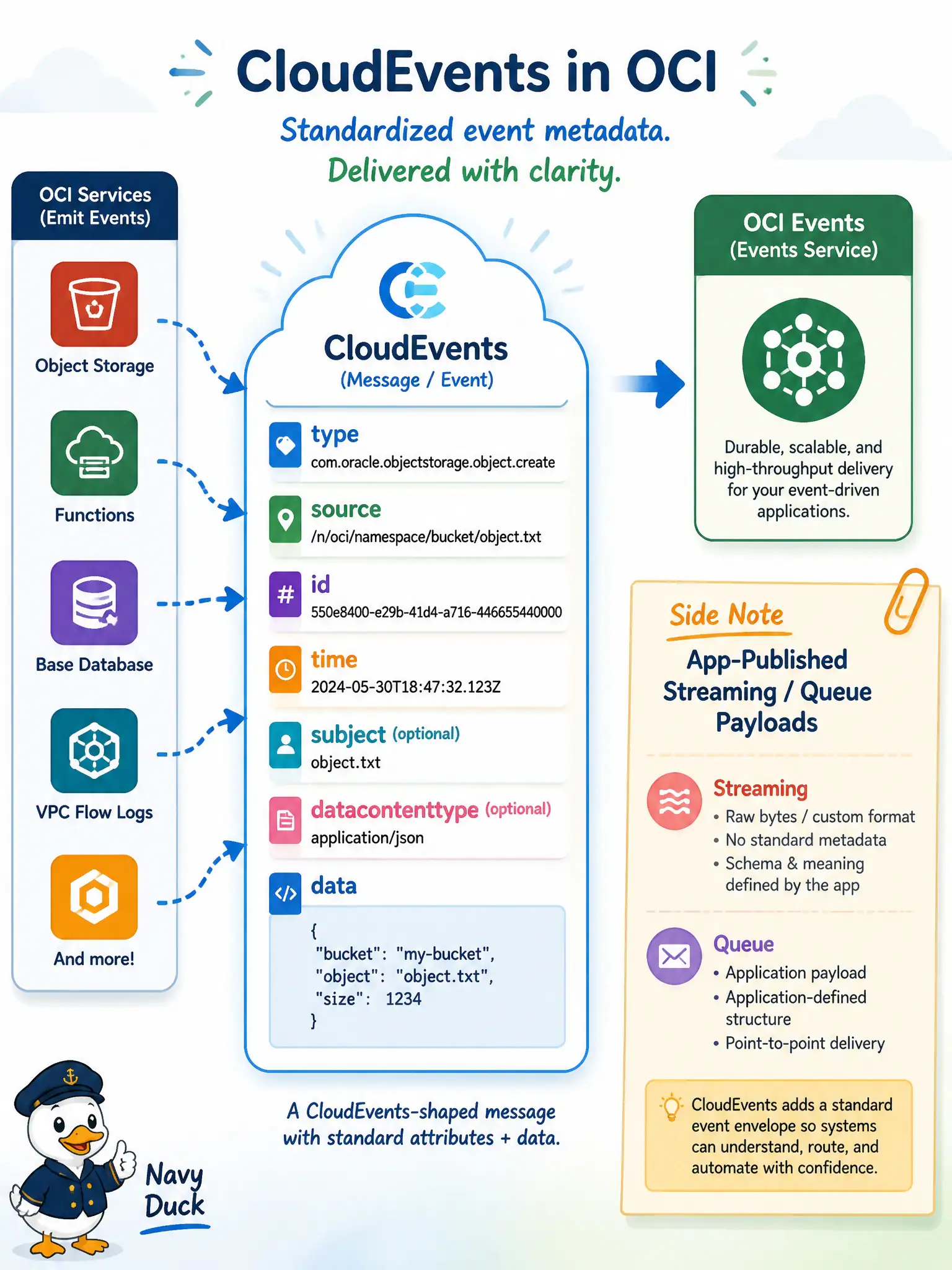
OCI’s Events service carries structured notices that look like CNCF CloudEvents when a resource changes. That is different from payloads you publish yourself on Streaming or Queue. The word “event” (the message) is not the same as the Events service that lets you subscribe.
Full Explanation
When the parks department designs subscriptions for bucket and database lifecycle changes, OCI Events emits those notices as structured messages that follow the CNCF CloudEvents format. Each emission carries typed fields such as event type, source, time, and a data payload describing the resource change—CRUD, lifecycle, and system events from participating OCI services. That shared envelope is what rules filter on and what Functions, Notifications, or Streaming actions receive. A proprietary Oracle-only binary envelope that replaces CloudEvents is incorrect: OCI aligns Events with the CloudEvents model rather than inventing an opaque proprietary wire format for all emissions. Raw Streaming record batches without event type or source fields describe application streams you publish yourself; they are not the Events service envelope for OCI resource-state notices. Queue message bodies whose format Events invents per compartment confuse Queue’s producer-defined string payloads with Events’ standardized CloudEvents-shaped resource emissions. Exam caveat: not every OCI resource emits by default in every scenario—Object Storage object-level changes require the bucket’s emit-events setting—so knowing the envelope does not guarantee a silent bucket will produce create-object events. Operational check: trigger a known change (for example create a test object in an emit-enabled bucket or perform a documented database lifecycle action), deliver to Streaming or a Function, and inspect the payload for CloudEvents-style type/source fields before building production filters.