
When creating OCI Functions for a utility billing notifier, where must network attachment and shared configuration be defined so every function in the group inherits them?
Select an answer to reveal the explanation.
Short Explanation
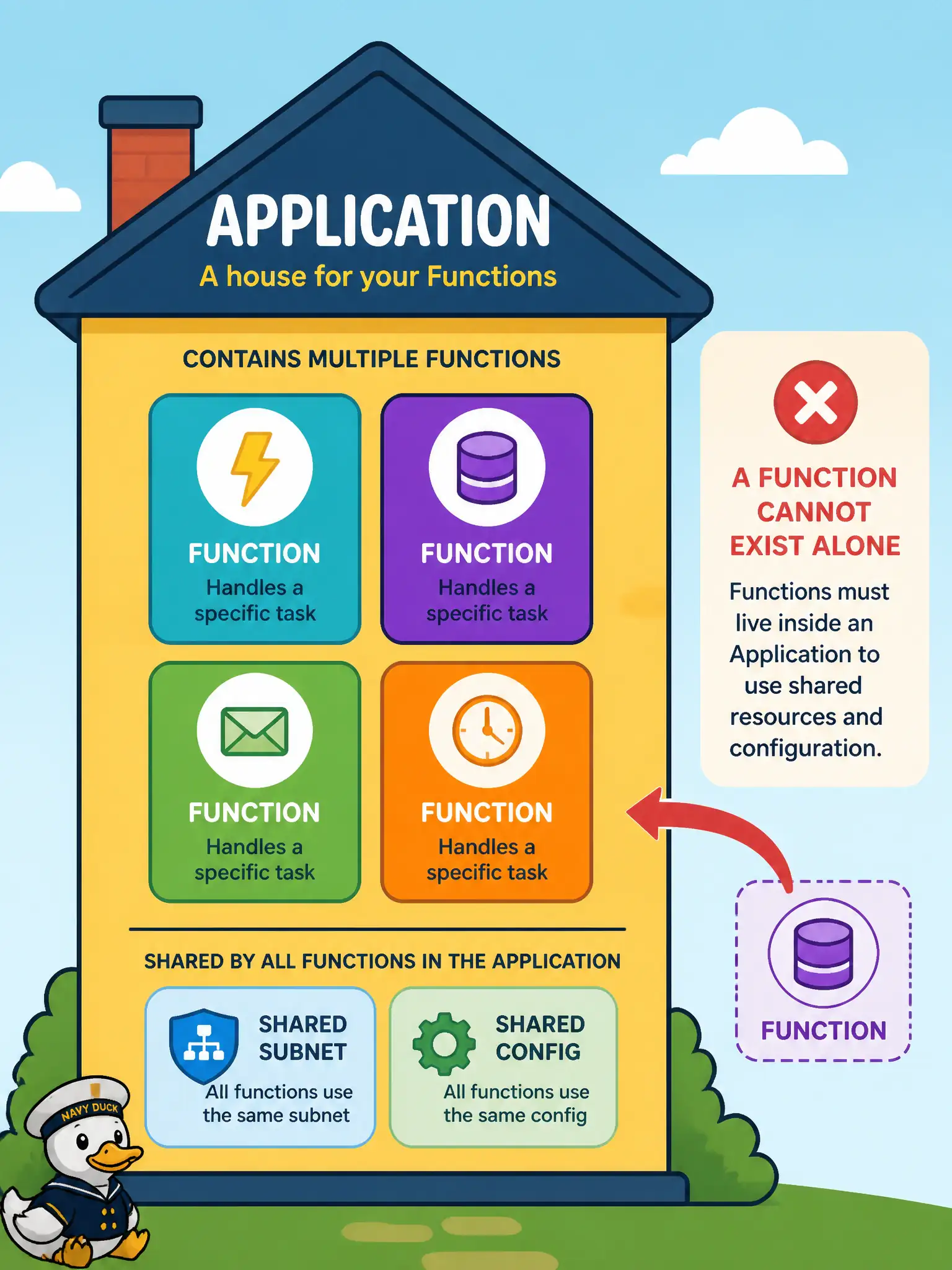
The application is the neighborhood: subnets and shared config on that parent apply to every function living there. You cannot hang a function in mid-air with no application.
Full Explanation
For a utility billing notifier, network attachment and shared configuration must be defined on the Functions application that parents those functions. In OCI Functions the application is the required logical grouping: compartment, subnets, and shared config set on the application apply to every function placed in it. You cannot hang a function in mid-air; inheritance of attachment and shared settings is an application-level concern so the whole notifier group shares one networking and config neighborhood.
Defining those only inside each function’s container ENTRYPOINT script fails by concept because ENTRYPOINT is process startup inside the image—it does not establish VCN subnet attachment or the application’s shared configuration model. Putting them on an unrelated Object Storage bucket in the same compartment fails because a bucket is an object store, not the Functions application networking/config parent. Storing them in a Kubernetes Namespace labeled for serverless workloads fails because OCI Functions applications are not Kubernetes namespaces; OKE constructs do not substitute for the Functions application object.
Exam caveat: function-specific memory and timeout still live on the function, while subnets and shared config live on the application—do not confuse those layers on the exam. Operational check: create the application with the intended subnets and shared keys first, deploy multiple billing functions into it, and confirm each execution uses the application’s network path and inherited config values.