
OCI Functions documentation names the open-source, container-native serverless engine that powers the service and shares the fn CLI and func.yaml model. Which engine is that?
Select an answer to reveal the explanation.
Short Explanation
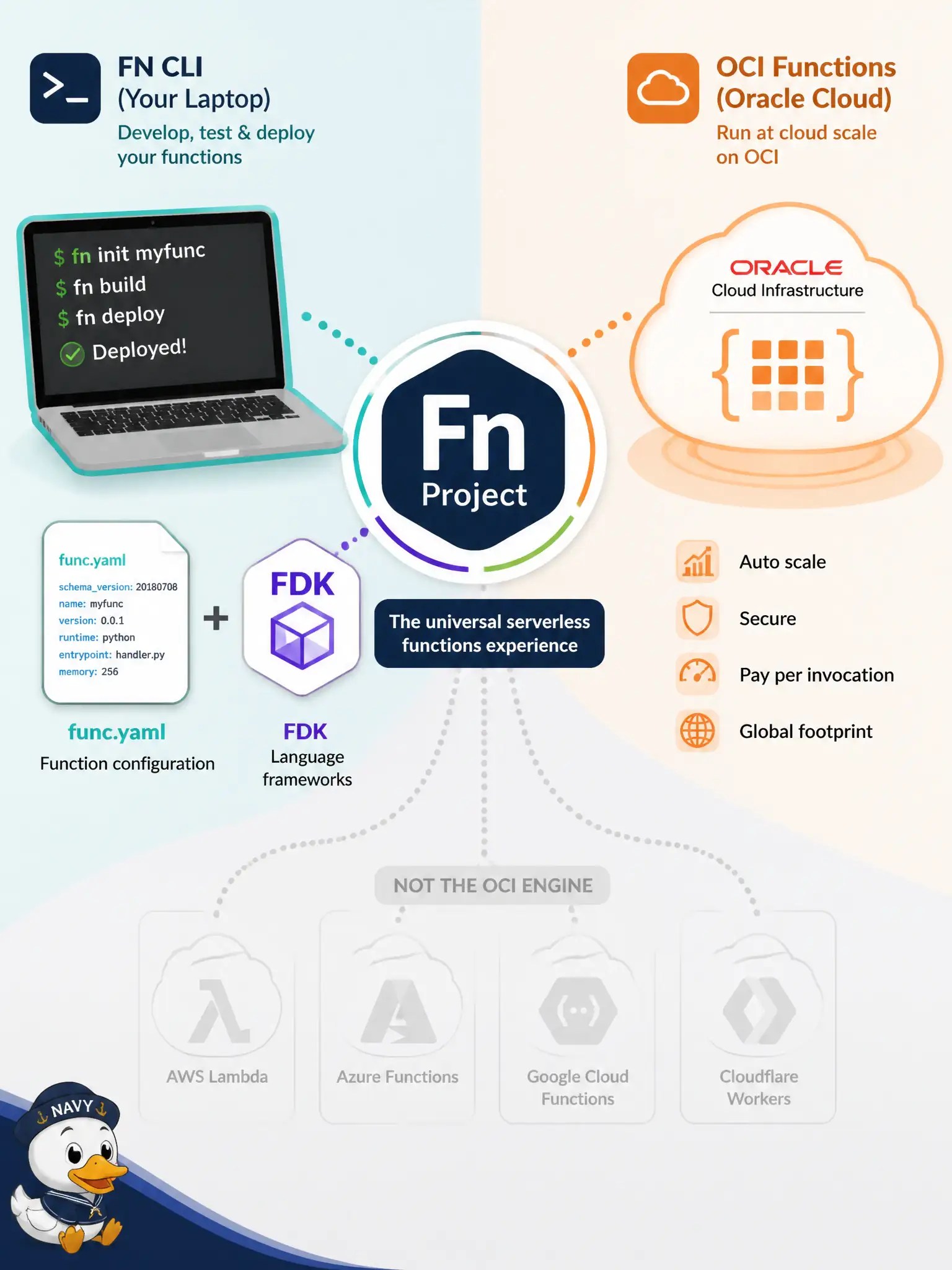
Fn Project is the shared engine under the hood—same CLI and func.yaml whether you are on a laptop or in OCI. It is not a catalog quiz comparing OpenWhisk or Knative as competing OCI products.
Full Explanation
OCI Functions documentation names the Fn Project open-source, container-native serverless engine as the technology that powers the service and shares the fn CLI and func.yaml model. That shared foundation is why the same developer workflow—init, local invoke, deploy with func.yaml—transfers from a laptop to OCI Functions without inventing a separate proprietary project format for municipal teams.
Apache OpenWhisk as the required OCI control plane fails by concept because OpenWhisk is a different serverless project and is not what OCI Functions documentation cites as its engine. Knative Serving installed on every OKE cluster by default fails because Knative is a Kubernetes-centric serverless layer and is not the documented power behind OCI Functions, nor is it silently installed on every OKE cluster as that product’s core. AWS Lambda runtime forks rebranded for Oracle Cloud fails because Functions is not presented as a rebranded Lambda fork; the documented lineage is Fn Project.
Exam caveat: knowing Fn Project as the engine does not mean every Fn feature on GitHub is identically exposed or supported as a managed OCI Functions capability—study OCI’s documented surface. Operational check: confirm official Functions docs reference Fn Project, then use the same fn/func.yaml artifacts locally and against an OCI context so the civic toolchain stays consistent.