
Emergency-alert microservices already push images to OCIR. Where should the matching Helm chart artifact live, and how is it applied to OKE?
Select an answer to reveal the explanation.
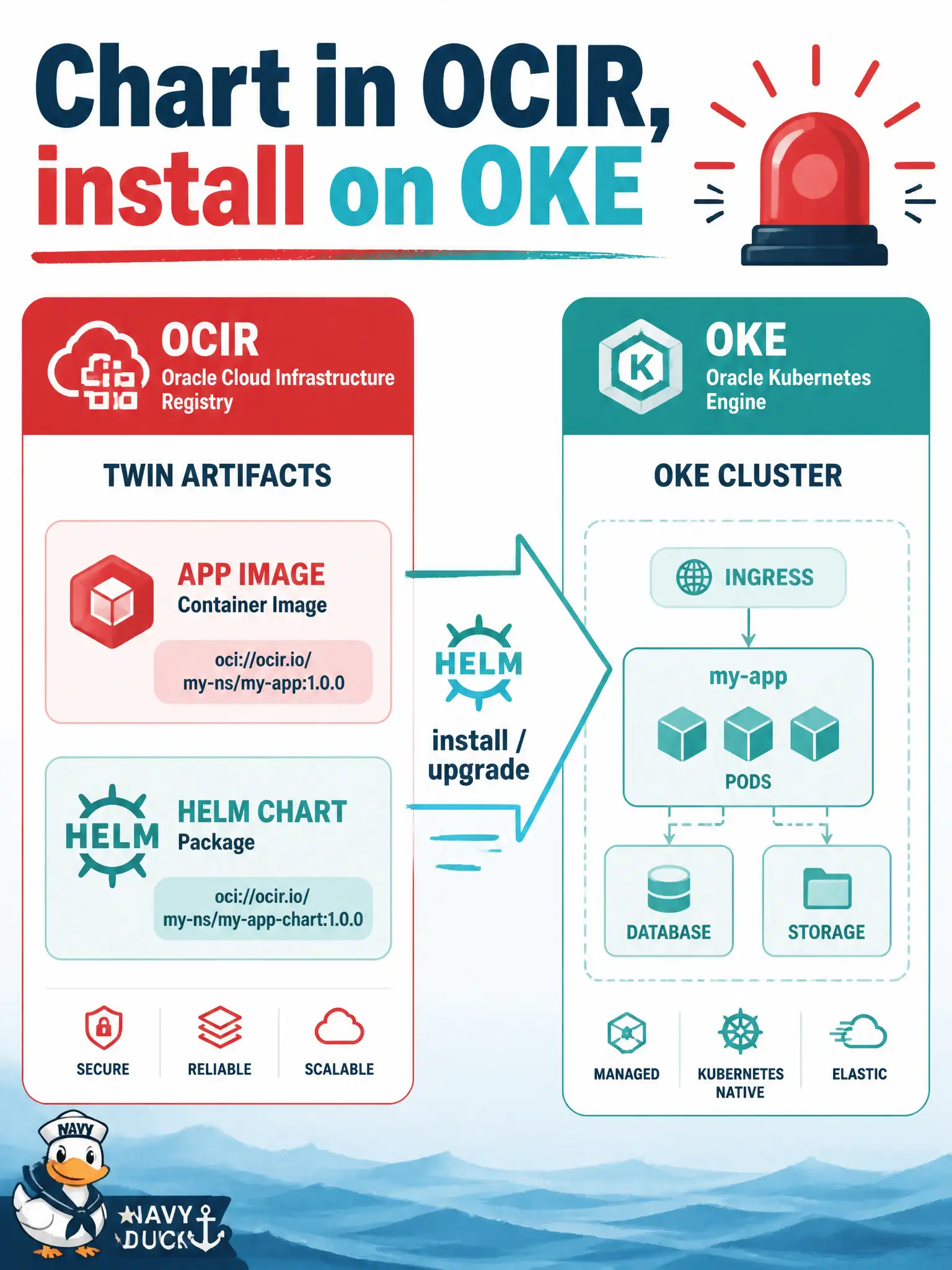
Short Explanation
OCIR speaks OCI artifacts, so the chart can sit next to the app image—two artifacts, one registry. helm install or helm upgrade (including documented native-ingress Helm installs) applies that chart to OKE. Keep packaging in the registry, not on a USB stick.
Full Explanation
OCIR stores OCI artifacts, so the Helm chart can live beside the emergency-alert application image as a versioned chart artifact in the same registry family. Operators then helm install or helm upgrade (including flows that pull the chart from the OCI registry) onto the OKE cluster. Packaging stays in the registry next to images rather than as a one-off laptop copy. Keeping the chart only on a laptop USB drive and kubectl-applying rendered YAML skips registry versioning and shared access. Disaster recovery and CI cannot reliably pull the same chart revision the team thinks they shipped. A public npm registry is the wrong artifact ecosystem for Helm charts in this OCI-centric workflow. Helm supports OCI-compliant registries—including OCIR—so claiming charts must not use OCI registries is false and steers away from the platform-aligned store. Embedding the chart inside the application container filesystem does not make kubelet install Helm releases. Kubelet runs containers; chart install is a Helm client/controller operation against the API server. Charts and runtime images are separate artifacts. Exam caveat: pushing a chart to OCIR still requires appropriate IAM/auth for helm push/pull, distinct from imagePullSecrets used by kubelet for container images. Operational check: push the chart to OCIR, pull it on an operator workstation or pipeline, helm upgrade onto OKE, and verify the release revision matches the chart version stored beside the alert service image.