
311 ticket workers on OKE must land on nodes with enough free capacity, yet noisy neighbors must not consume unbounded CPU. How should the Pod spec express that?
Select an answer to reveal the explanation.
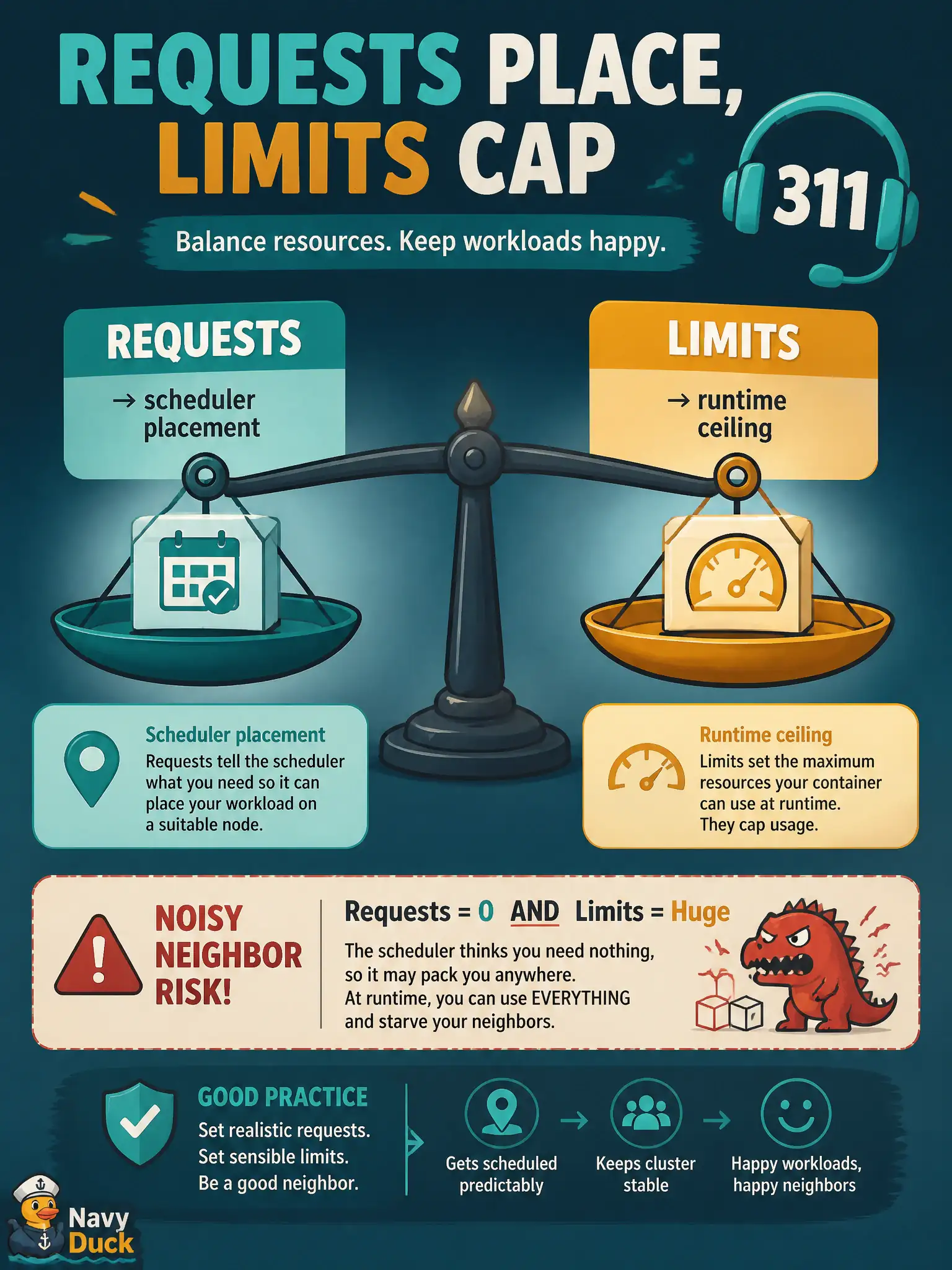
Short Explanation
Requests are the reservation card that gets the Pod a seat; limits are the "no second helpings" cap. Zero requests with huge limits invites noisy neighbors. On managed or virtual nodes, put CPU and memory in the Pod spec so placement and caps are explicit.
Full Explanation
CPU and memory requests tell the scheduler how much capacity to reserve so 311 ticket workers land on nodes with enough free resources. Limits cap what each container may consume so a noisy neighbor cannot unbounded-starve co-located Pods. Expressing both in the Pod spec is the standard way to combine placement guarantees with runtime caps on managed or virtual node environments. Huge limits with zero requests invite packing problems: the scheduler treats BestEffort or understated requests as needing little reserved capacity, then many Pods pile onto one node until limits and contention create latency or throttling. That pattern fails the 'land on nodes with enough free capacity' requirement. Omitting requests and limits entirely leaves placement and caps unspecified. Virtual nodes do not invent shapes from Deployment names; missing resources lead to unpredictable scheduling and weak isolation. Storing resource numbers only in a ConfigMap does not feed the kube-scheduler. The scheduler reads requests from the Pod spec containers; ConfigMap data is opaque application configuration unless something copies it into the Pod template—and even then the authoritative fields are still the container resources block. Exam caveat: requests affect scheduling and Guaranteed/Burstable QoS; limits without adequate requests still allow overcommit surprises—set requests from measured usage and limits as a safety ceiling. Operational check: after deploying, confirm Pods schedule without Pending insufficient-CPU events, inspect node allocatable versus requested totals, and load-test a noisy worker to verify limits throttle abuse without collapsing neighboring 311 Pods.