
During a rollout of the city’s code-enforcement API, which statement best describes the ReplicaSet relative to the Deployment authors use day to day?
Select an answer to reveal the explanation.
Short Explanation
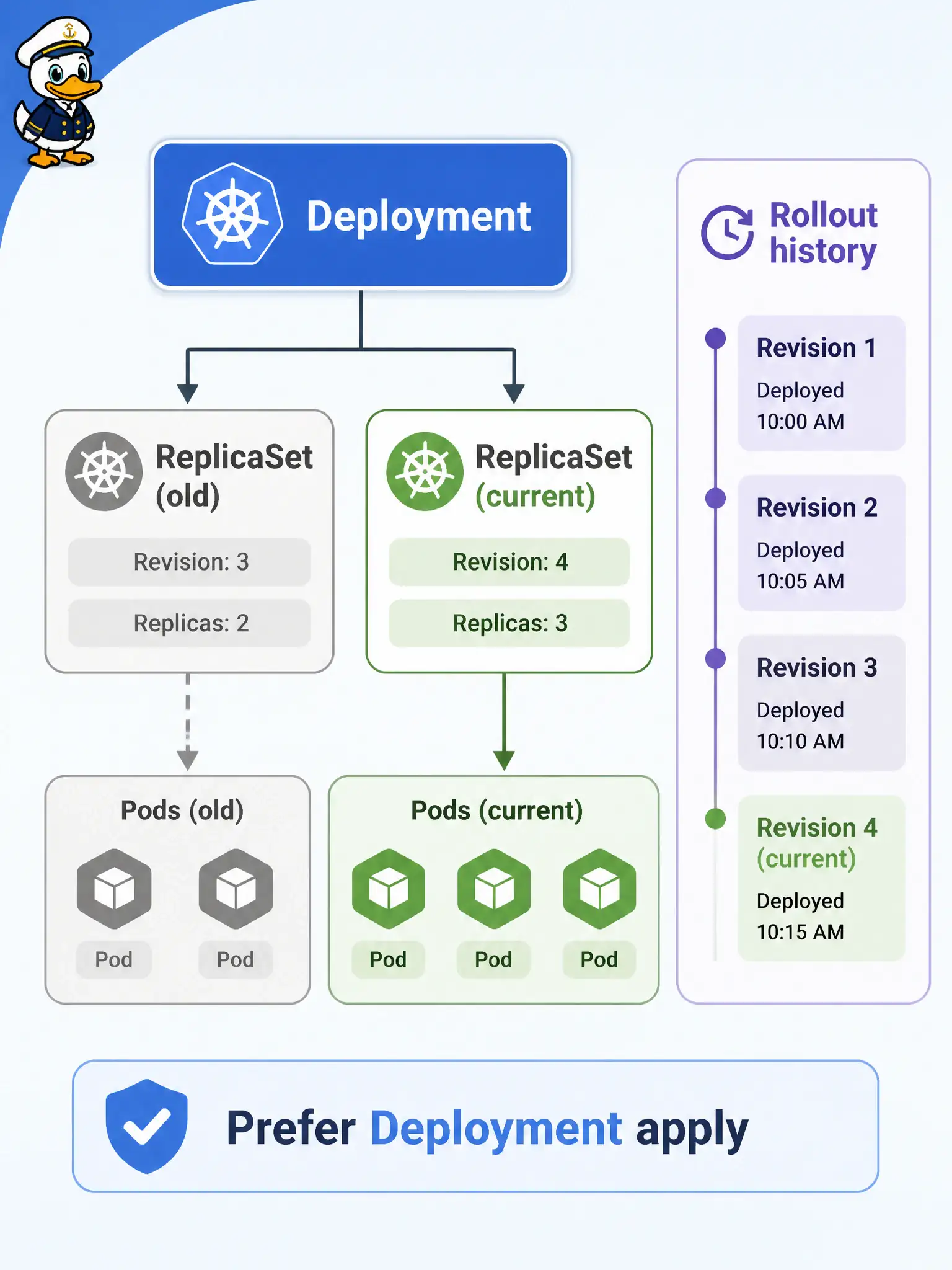
Think of the ReplicaSet as the current shift roster; the Deployment is the manager that opens and closes shifts during a rollout. You live in Deployment manifests—hand-authoring ReplicaSets skips rollout history.
Full Explanation
During a rollout of the city’s code-enforcement API, the ReplicaSet is the object that currently asserts “this many Pods matching this exact template.” The Deployment creates and retires ReplicaSets as the Pod template changes—scaling a new ReplicaSet up and the old one down—so day-to-day authors apply Deployments and rarely hand-author ReplicaSets. That layering is why rollouts are declarative, pauseable, and recoverable through the Deployment object. Requiring operators to kubectl apply a new ReplicaSet by hand for every image tag and skip Deployments throws away rollout history, surge controls, and the usual apply workflow teams standardize on. ReplicaSets do not replace Services for ClusterIP allocation; Services remain the discovery and in-cluster load-balancing objects. Claiming a ReplicaSet is only valid outside OKE is false—ReplicaSets are core Kubernetes and behave the same on OKE. Exam caveat: you may still kubectl get replicasets while debugging a stuck rollout, but fixing the Deployment Pod template is the durable change, not leaving orphan hand-managed ReplicaSets behind. Operational check: during an image change, list ReplicaSets—one new, one old—and confirm the Deployment owns both while Service traffic stays on Ready Pods.