
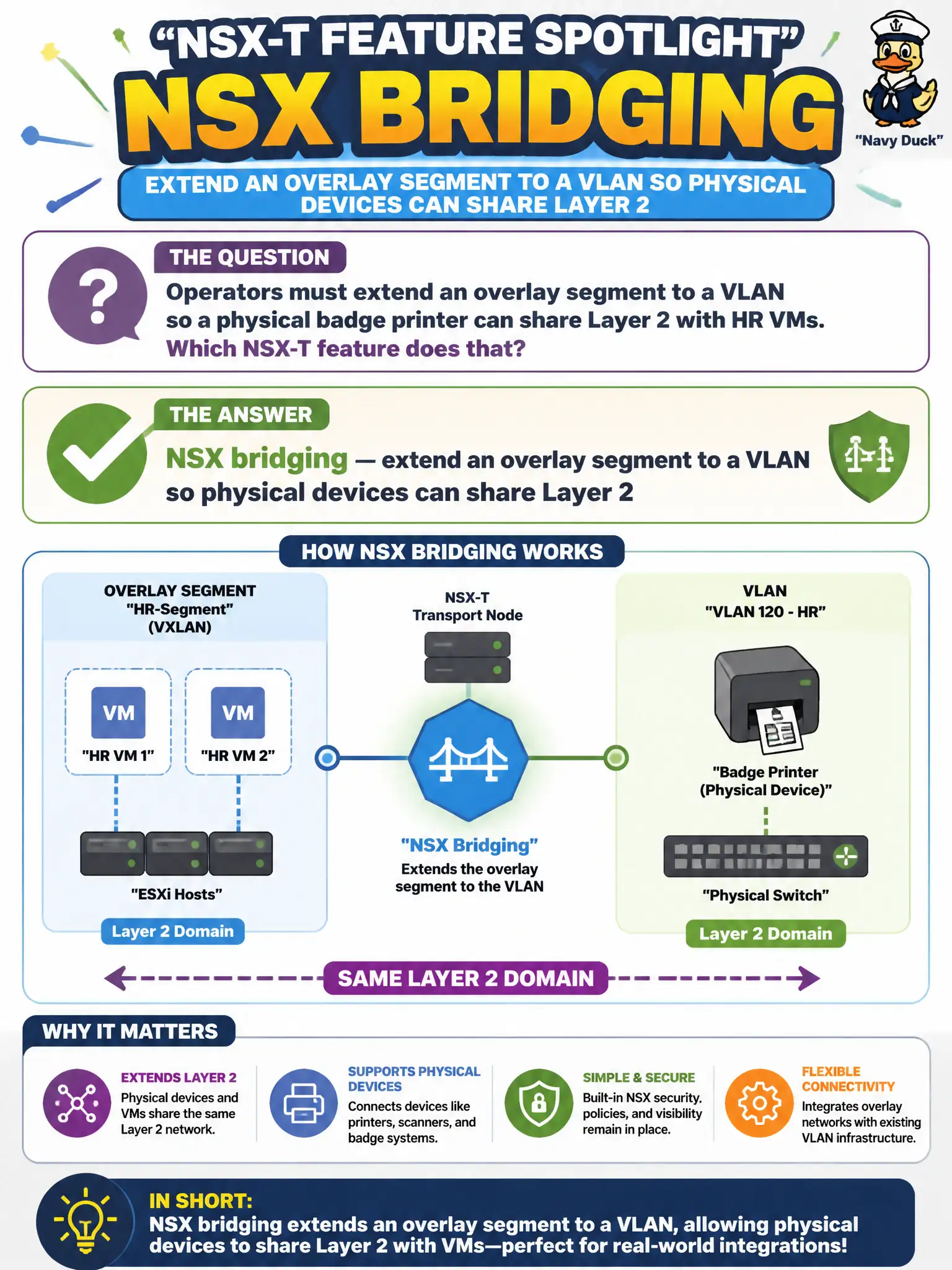
Operators must extend an overlay segment to a VLAN so a physical badge printer can share Layer 2 with HR VMs. Which NSX-T feature does that?
Select an answer to reveal the explanation.
Short Explanation
The badge printer still speaks VLAN, not Geneve. Bridging stitches that VLAN onto the HR overlay so they share L2. vMotion does not move a printer, and vSAN iSCSI is storage.
Full Explanation
NSX bridging extends an overlay segment to a VLAN so physical devices such as a badge printer can share a Layer 2 domain with HR VMs. The badge printer still speaks VLAN, not Geneve; bridging stitches that VLAN onto the HR overlay. Geneve is the overlay encapsulation; it is not itself the L2-to-VLAN stitch. vMotion migrates a running virtual machine, not a physical printer. vSAN iSCSI presents block storage and is not overlay bridging. Exam caveat: use bridging when true L2 adjacency to a physical device is required; use Tier-0/Edge routing when routed reachability is enough. Operational check: configure bridging between the HR overlay segment and the printer VLAN, verify L2 adjacency from an HR VM to the printer, and confirm vMotion, Geneve-alone, and vSAN iSCSI were not used as the stitch. Document the civic rationale in the change record so the next operator can restate why the correct control matches the agency outcome, why each distractor fails by concept, and which NSX Manager view confirms the result after publish. Document the civic rationale in the change record so the next operator can restate why the correct control matches the agency outcome, why each distractor fails by concept, and which NSX Manager view confirms the result after publish.