
County workforce agencies need their own logical routers, plus one ISP handoff at the civic edge. Which NSX-T feature provides that two-tier routing?
Select an answer to reveal the explanation.
Short Explanation
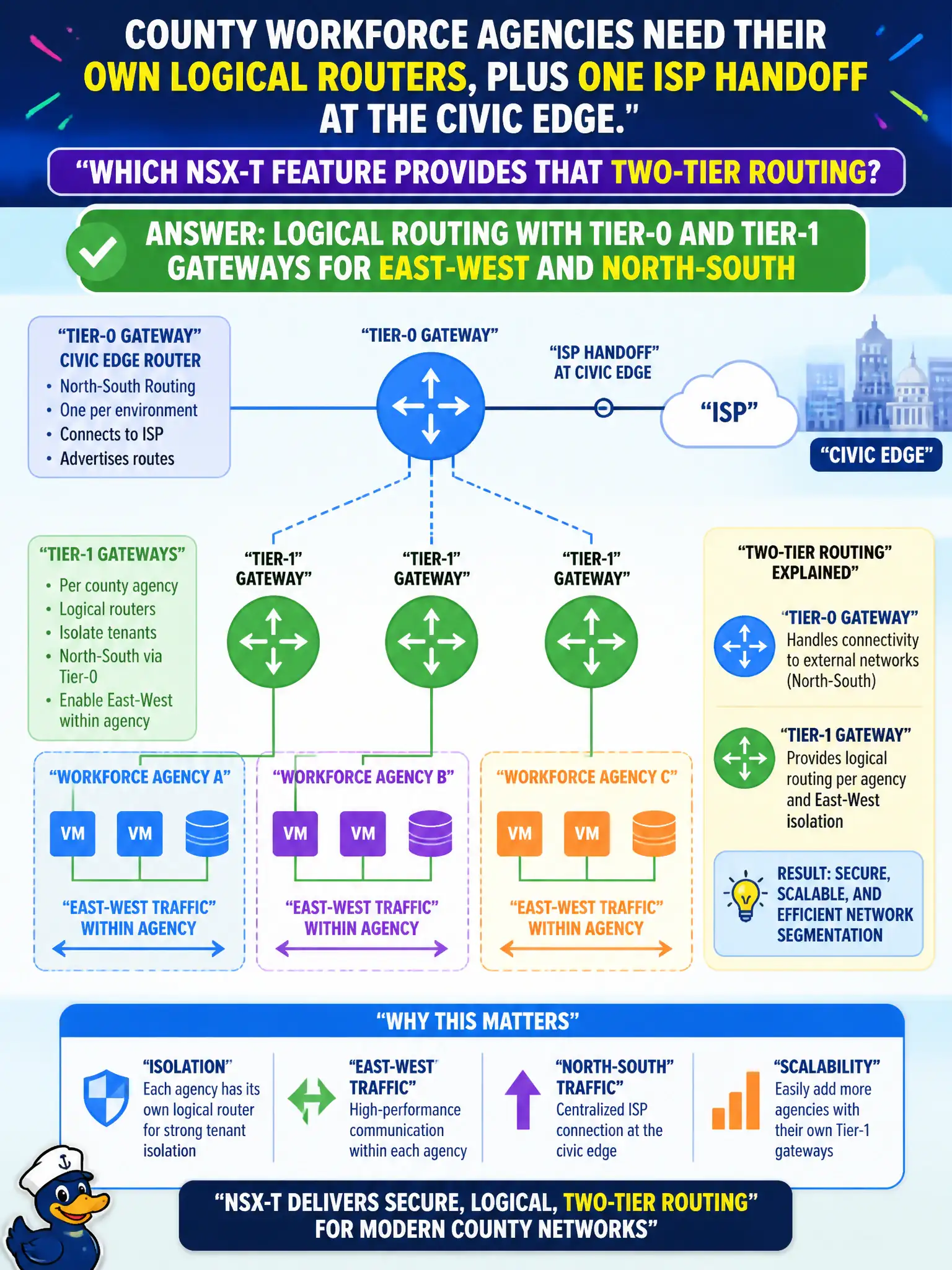
Two-tier routing is the county floor plan: each agency gets a Tier-1, and one Tier-0 meets the ISP. A lonely standard switch, a content library, and Horizon are not that floor plan.
Full Explanation
NSX-T logical routing uses distributed two-tier gateways: Tier-1 for tenant or agency networks and Tier-0 for the north-south ISP or core handoff. That feature covers east-west and north-south routing in software so county workforce agencies can have their own logical routers plus one ISP handoff at the civic edge. Two-tier routing is the county floor plan: each agency gets a Tier-1, and one Tier-0 meets the ISP. A single vSphere Standard Switch with no gateways cannot provide that two-tier fabric. vCenter content libraries store images; they are not routers. Horizon Connection Server is not the routing fabric. Exam caveat: Tier-1 handles departmental southbound routing and links north to Tier-0; ISP BGP belongs on Tier-0, not as a direct neighbor on every agency Tier-1. Operational check: create Tier-1s for pilot agencies, link them to a shared Tier-0, verify inter-agency and northbound paths, and reject Standard Switch, content libraries, and Horizon as the two-tier feature. Document the civic rationale in the change record so the next operator can restate why the correct control matches the agency outcome, why each distractor fails by concept, and which NSX Manager view confirms the result after publish.