
A permitting VM on an overlay segment must print to a VLAN-only physical printer that is not an NSX transport node. How do the high-level components interact?
Select an answer to reveal the explanation.
Short Explanation
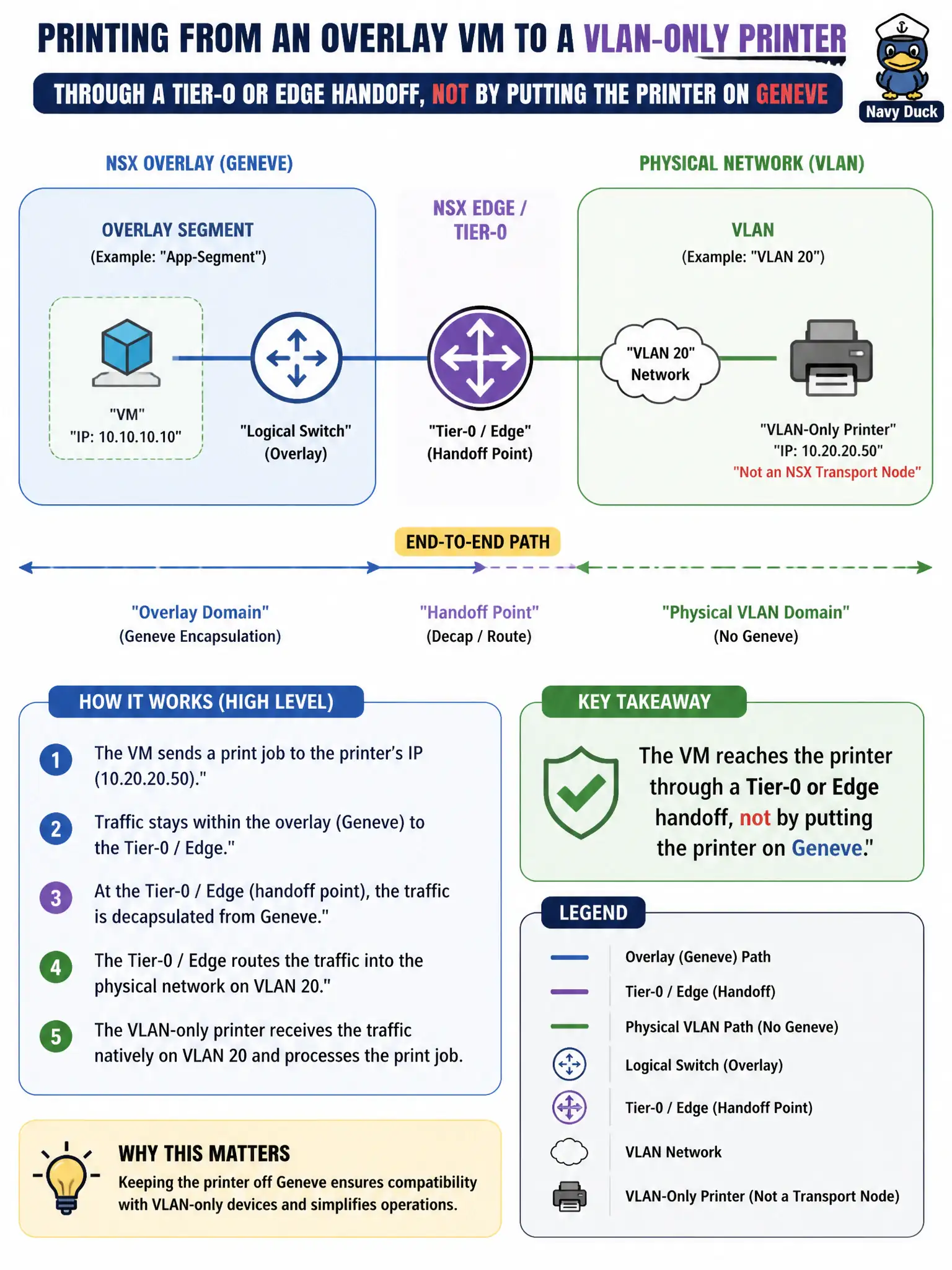
A hallway printer is not a tunnel endpoint. Overlay VMs reach that VLAN through a gateway handoff (Tier-0 or Edge), or a bridge, not by pretending the printer speaks Geneve. vMotion does not deliver print jobs.
Full Explanation
Overlay workloads reach non-NSX VLAN networks—such as a VLAN-only physical printer that is not a transport node—through a Tier-0 or Edge north-south handoff, or through bridging when true shared Layer 2 is required, rather than by placing the printer in the overlay transport zone. A hallway printer is not a tunnel endpoint and should not be forced to speak Geneve just to receive print jobs from a permitting VM. The printer does not join the overlay transport zone and become a VTEP in this design. The permitting VM and printer do not share Geneve without any gateway providing an external handoff toward the VLAN. vMotion moves running virtual machines between hosts; it does not carry a print job onto the printer's VLAN as a networking path. Exam caveat: choose bridging when the requirement is L2 adjacency to a physical device, and choose Tier-0/Edge routing when routed reachability is enough—either way, the printer is not an overlay transport node. Operational check: from the permitting VM, verify reachability to the printer network via the documented Tier-0/Edge path or bridge; confirm the printer is absent from transport-node inventory; reject vMotion as a print-delivery mechanism.