
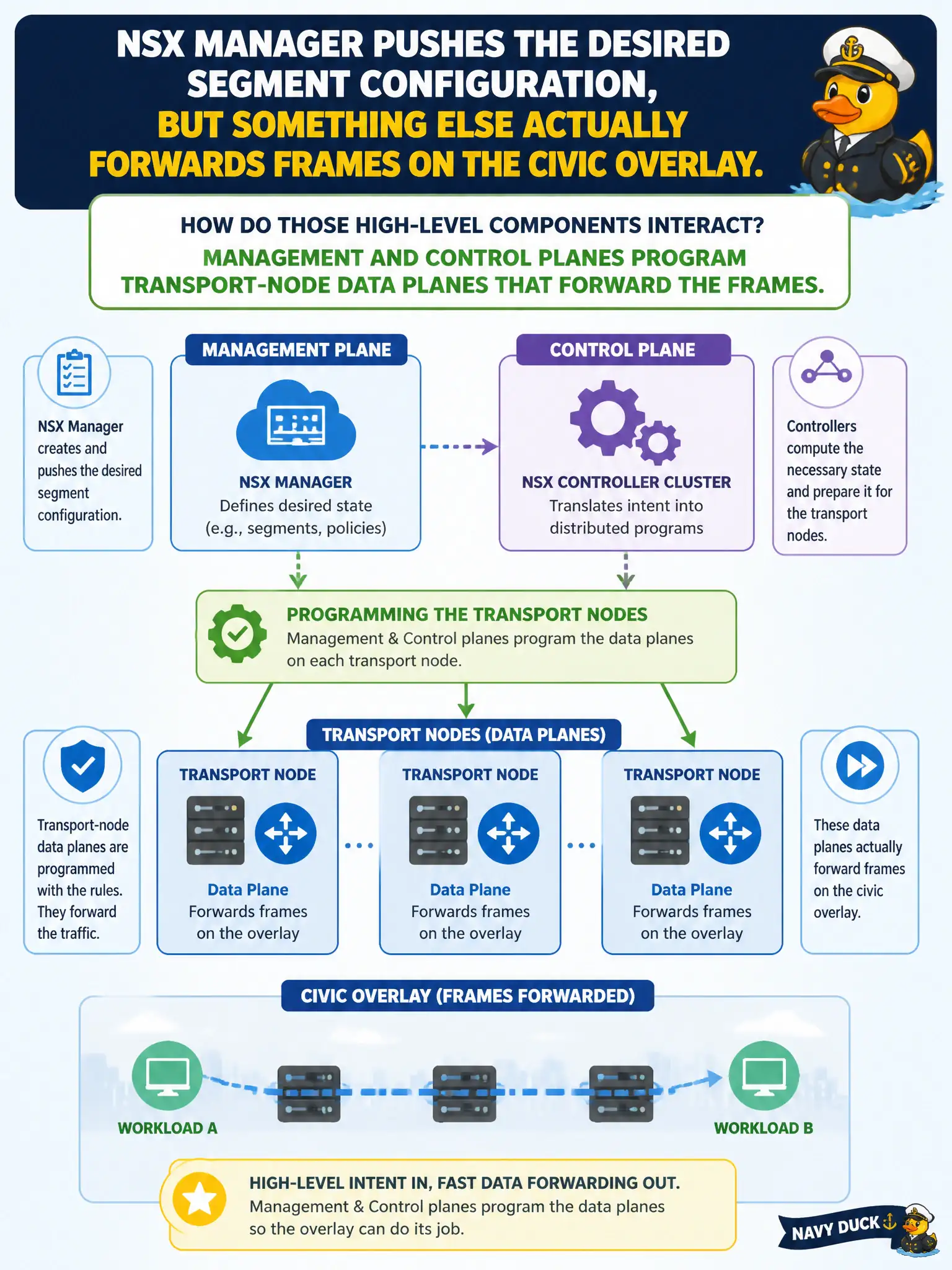
NSX Manager pushes the desired segment configuration, but something else actually forwards frames on the civic overlay. How do those high-level components interact?
Select an answer to reveal the explanation.
Short Explanation
Manager writes the recipe; the transport nodes cook the packets. Control tells the data plane what to do, and hosts or Edges forward frames. Manager is not the production switch fabric.
Full Explanation
NSX Manager holds desired state on the management plane and, together with the central control plane, programs transport nodes whose host and Edge data planes actually forward civic overlay frames. Management and control planes write the recipe; transport-node data planes cook the packets on the production path. That interaction answers how Manager can push segment configuration while something else forwards production frames on the overlay. NSX Manager itself does not switch every production frame for the civic overlay and must not be pictured as the data-center packet fabric. vCenter HA protects vCenter availability; it does not store or program the Geneve forwarding table for transport nodes during normal overlay forwarding. Horizon Connection Server does not program VTEPs if Manager is shut down and sits outside the NSX control-to-data path entirely. Exam caveat: associate-level items expect the management/control-versus-data-plane split, not a deep decode of every control-plane message format. Operational check: publish a segment or policy change in Manager, confirm transport nodes report realization success, and verify forwarding continues on hosts or Edges without treating Manager CPU as proof that Manager switches tenant packets.