
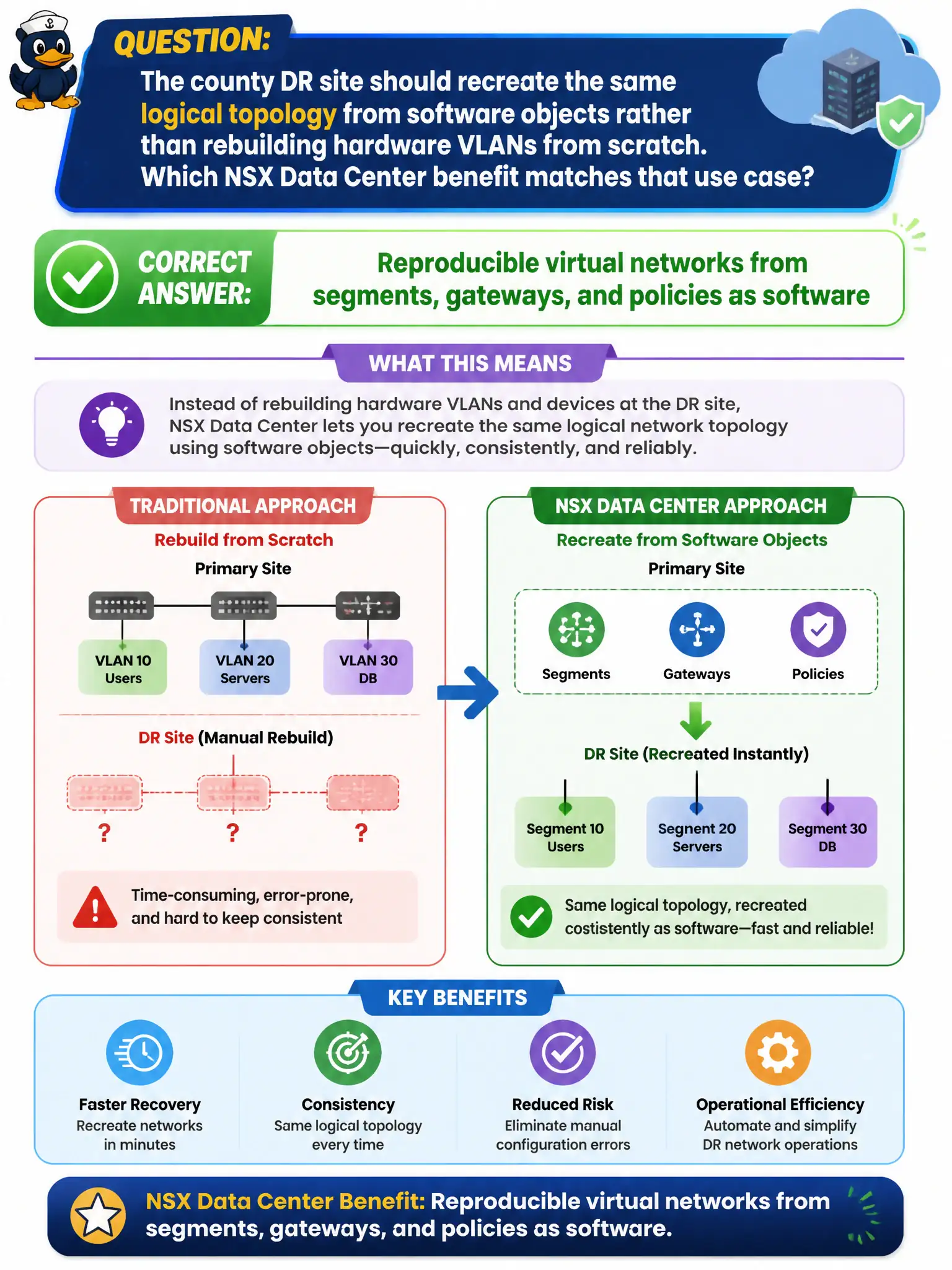
The county DR site should recreate the same logical topology from software objects rather than rebuilding hardware VLANs from scratch. Which NSX Data Center benefit matches that use case?
Select an answer to reveal the explanation.
Short Explanation
A DR site should reprint the same network blueprint, not recable the original switches. NSX objects are software, so segments, gateways, and policies can be reproduced. FT is a live secondary VM, not a topology clone.
Full Explanation
NSX Data Center represents switching, routing, and security as software objects—segments, gateways, groups, and policies—that a county can recreate at a DR site rather than rebuilding hardware VLANs from scratch on new switches. That reproducible virtual-network benefit lets the recovery hall reprint the same civic network blueprint instead of reverse-engineering cable maps and switch serial numbers from the primary site. Tying the DR copy to the exact same physical switch serial numbers couples recovery to hardware identity and misses the software-defined model. Documenting only the underlay cables while skipping logical objects fails to reproduce the topology agencies actually attach to. vSphere Fault Tolerance keeps a live secondary for a single protected VM; it is not a site-wide logical topology clone and does not recreate segments or gateways at DR. Exam caveat: reproducibility still requires a prepared NSX fabric, Managers, and transport nodes at the DR site—software objects do not appear without that platform. Underlay IP plans can differ, but the logical design should match. Operational check: recreate a pilot set of segments, Tier-1/Tier-0 relationships, and DFW groups at DR; attach a test agency VM; confirm forwarding and policy parity without depending on primary switch serials or Fault Tolerance.