
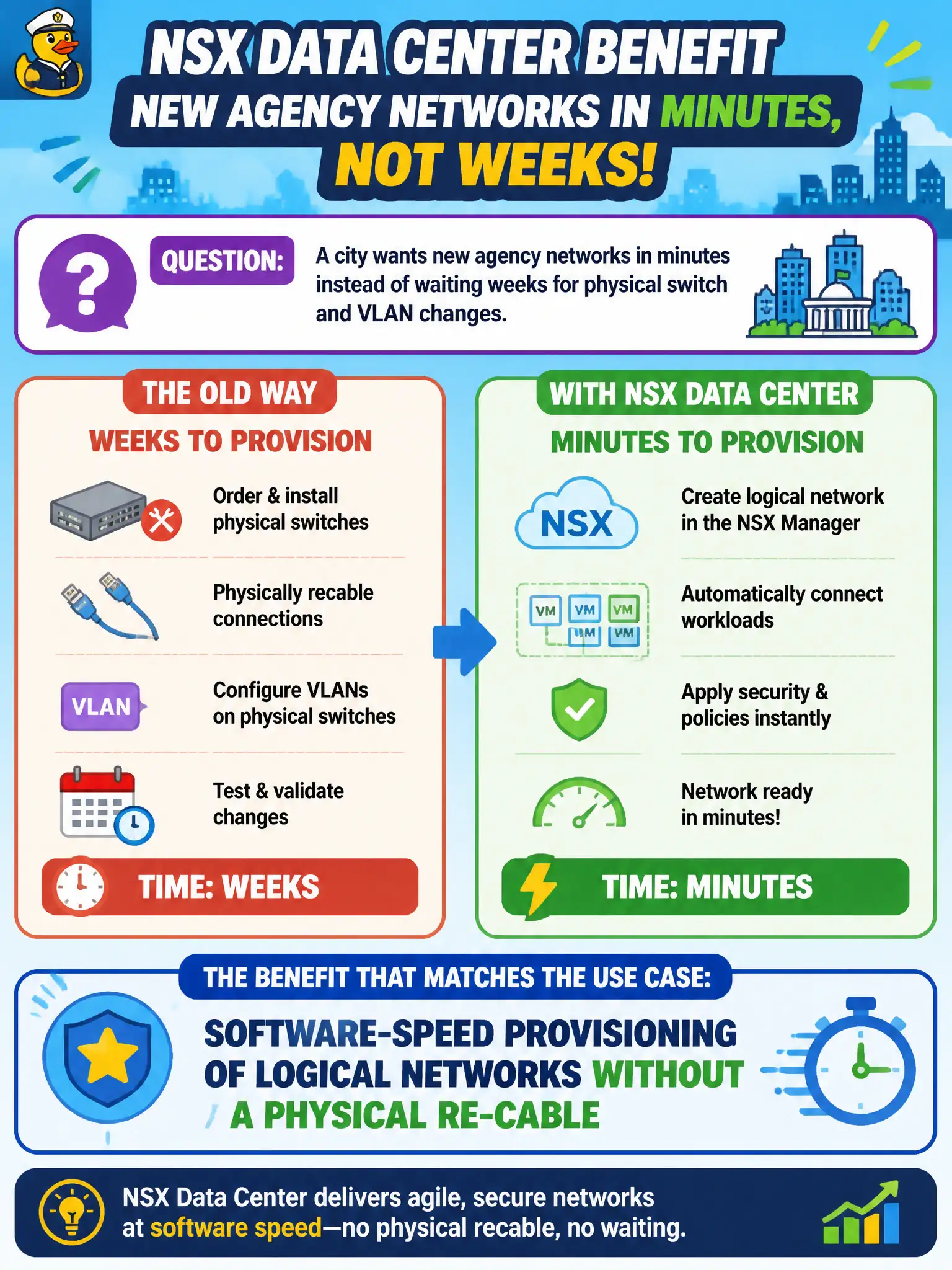
A city wants new agency networks in minutes instead of waiting weeks for physical switch and VLAN changes. Which NSX Data Center benefit matches that use case?
Select an answer to reveal the explanation.
Short Explanation
Picture ordering a new city street in software instead of pouring concrete for weeks. NSX lets operators publish logical networks at software speed. It does not delete the underlay or retire vCenter.
Full Explanation
Standing up new agency networks in minutes instead of waiting weeks for physical switch and VLAN changes is a core NSX Data Center benefit: logical networks are provisioned in software on an already-prepared underlay. Cities cite that software-speed model when physical recabling or weekend VLAN work previously dominated the ticket SLA. NSX does not replace vCenter or remove the need for compute virtualization; agencies still rely on vSphere for hosts and VMs. Hosts still require underlay IP connectivity for TEPs and management—NSX does not eliminate that requirement. Replacing every ESXi host with a hardware router per agency is the opposite of the software-defined benefit. Exam caveat: benefits questions expect agility or software-speed framing, not claims that NSX abolishes the underlay or compute stack. Operational check: time the creation of a new agency segment and Tier-1 attachment in NSX Manager on prepared transport nodes, and compare that change window to the city’s historical VLAN ticket SLA for the same outcome in the civic service catalog. In municipal operations, record the chosen control and the rejected distractors in the change ticket so future on-call staff understand which failure modes would affect city services. Re-validate after the next maintenance window that the same design still holds for the current NSX build and the agency workloads that depend on it.