
Wastewater operations wants shared storage for the municipal cluster from host disks so the county can skip buying a new SAN. Which VMware SDDC product is that storage pillar?
Select an answer to reveal the explanation.
Short Explanation
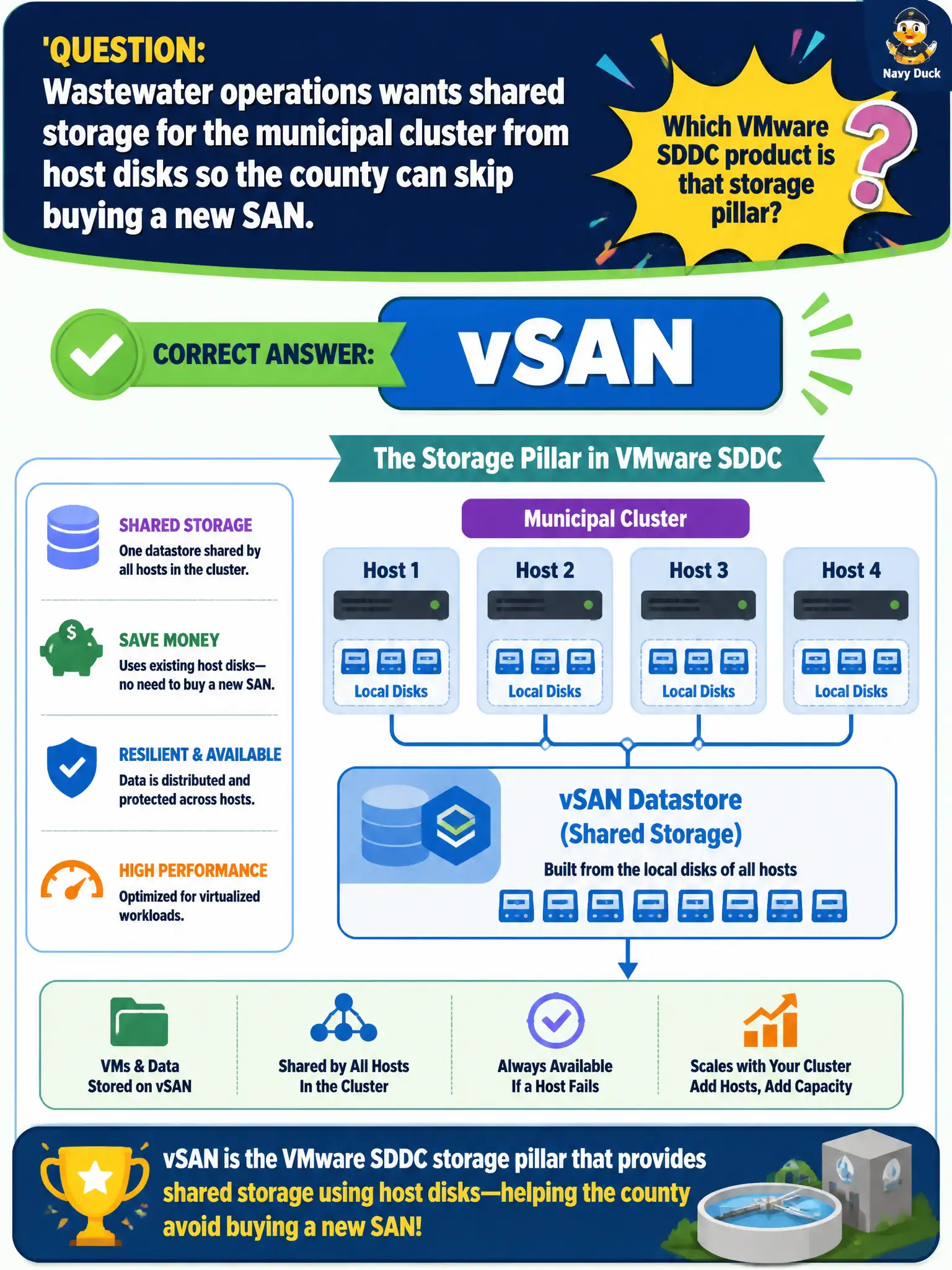
vSAN turns the disks already in the wastewater hosts into a shared software datastore, so the county does not have to buy a new SAN. NSX moves packets, Horizon publishes desktops, and Carbon Black watches endpoints.
Full Explanation
Wastewater operations that want shared storage for the municipal cluster from host disks—so the county can skip buying a new SAN—need vSAN, the software-defined storage pillar of the VMware SDDC. vSAN aggregates local disks in the wastewater hosts into a shared datastore that clusters can consume for VM disks, which is exactly the civic hyperconverged storage use case. NSX-T Data Center virtualizes networking with overlay, routing, and firewalling; it does not present a hyperconverged block datastore from host disks and cannot replace a SAN purchase with packet fabric alone. Horizon publishes virtual desktops and apps for end users; it is not the storage product that pools host disks. Carbon Black provides endpoint and workload protection analytics and prevention; it never becomes shared VM storage for wastewater historians or SCADA jump hosts. Exam caveat: vSAN still runs on vSphere hosts and uses networking for disk I/O between nodes; needing a VMkernel network for vSAN does not turn NSX into the storage pillar. Associate depth is naming vSAN as the storage product, not designing disk-group sizing or FTT policies on the exam. Operational check: confirm hosts have claimed disks in vSAN disk groups, a vSAN datastore is mounted to the cluster, and a wastewater VM can place VMDKs there without a traditional external SAN LUN for that use case; verify vSAN health is green before cutting over production disks. Keep that validation screenshot with the cluster design package so finance sees host-disk pooling—not a silent return to SAN procurement—for wastewater shared storage.