
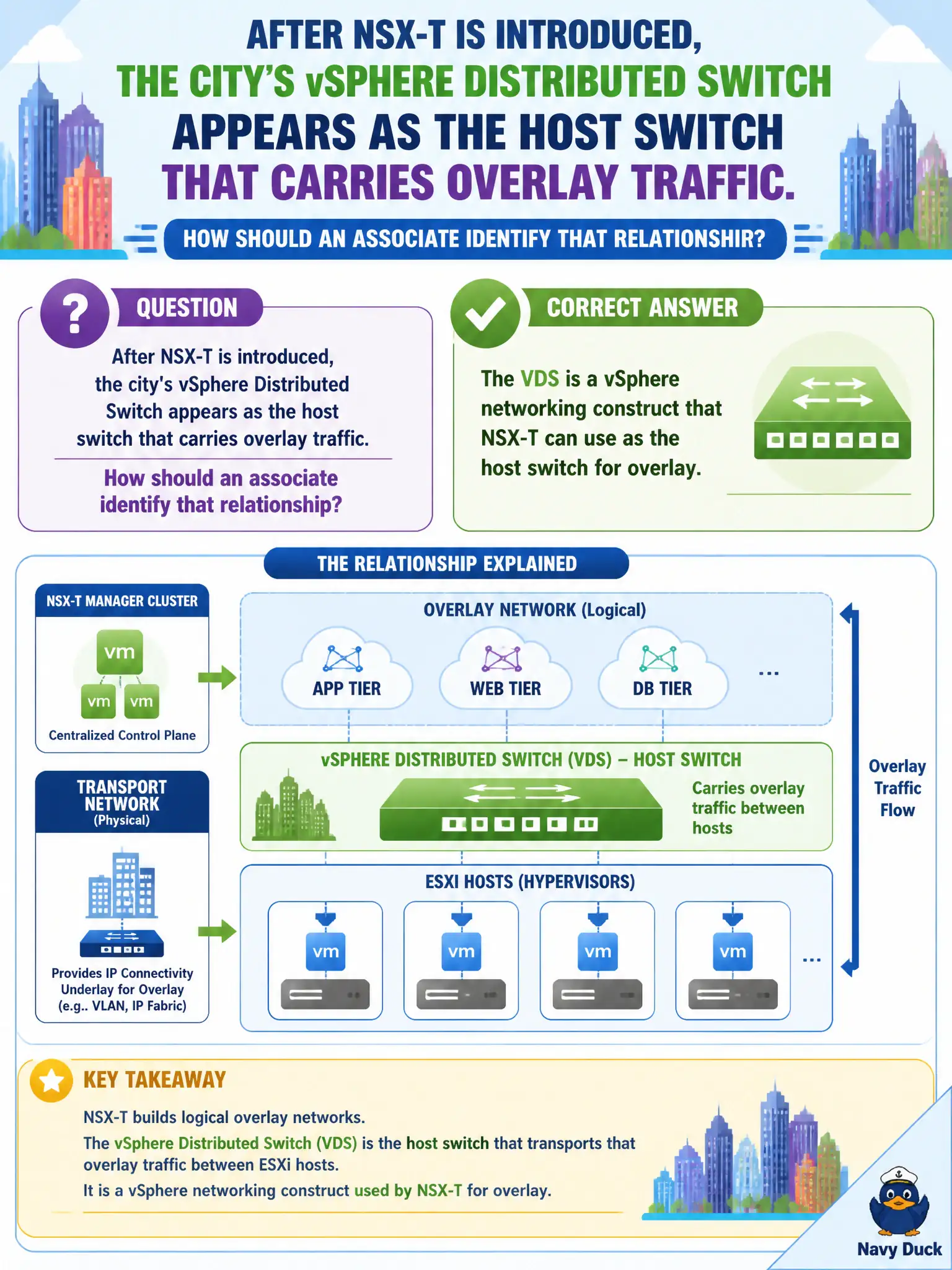
After NSX-T is introduced, the city's vSphere Distributed Switch appears as the host switch that carries overlay traffic. How should an associate identify that relationship?
Select an answer to reveal the explanation.
Short Explanation
The city street grid can stay in place while NSX adds tunnels on top of it. That street grid is the VDS, and NSX-T can use it as the host switch. Horizon is not a host switch, and the VDS does not turn into an NSX Manager.
Full Explanation
After NSX-T is introduced, the city’s vSphere Distributed Switch can appear as the host switch that carries overlay traffic. The correct identification is that the VDS is a vSphere networking construct that NSX-T can use as the host switch for overlay—historically alongside or instead of a dedicated N-VDS naming in older materials—so the civic street grid stays while NSX adds tunnels on top. Claiming the VDS is replaced by Horizon Connection Server as the overlay fabric confuses EUC brokering with the hypervisor host switch. Stating that NSX-T can overlay only on vSphere Standard Switches and never on a VDS is false for this exam era; prepared VDS is a supported host-switch path. Saying the VDS becomes an NSX Manager cluster node confuses a host virtual switch with the management-plane appliances. Exam caveat: associate questions often test that NSX prepares and programs a host switch rather than inventing a brand-new product category that erases vSphere networking. Know that VDS (or N-VDS, depending on release language) participates as the data-plane switch on ESXi transport nodes. Operational check: after transport-node preparation, confirm the cluster VDS shows NSX-backed segments or overlay readiness, TEPs are present, and a test VM on an overlay segment communicates host-to-host without converting the VDS into an NSX Manager.