
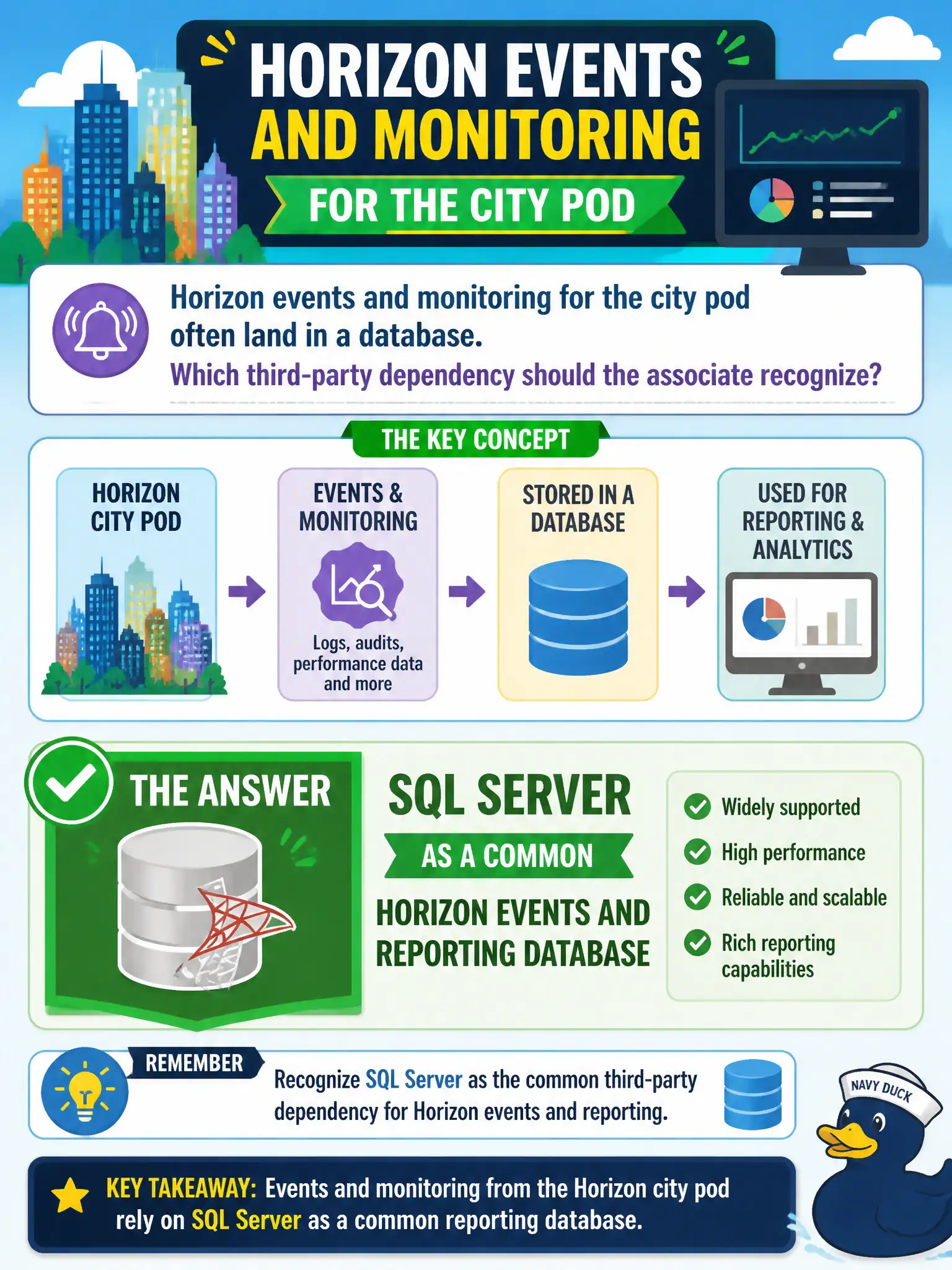
Horizon events and monitoring for the city pod often land in a database. Which third-party dependency should the associate recognize?
Select an answer to reveal the explanation.
Short Explanation
Think of SQL Server as the city's event logbook for Horizon — who connected, what failed, what the dashboard graphs. App Volumes shares, NSX syslog, and Boxer mailboxes are other products' storage, not the Horizon events database.
Full Explanation
Horizon events and monitoring for the city pod often land in SQL Server as a common events and reporting database dependency. In municipal EUC terms, treat the endpoint as a window into city systems when the architecture says so, not as the system of record for the files or apps in the stem. Distractor concept: App Volumes packaging file shares are not the Horizon events database. Distractor concept: NSX Manager syslog is not the only or primary Horizon events store in this framing. Distractor concept: Boxer mailbox databases are mail storage, not Horizon events. Exam caveat: Associate-level dependency: SQL Server for Horizon events/reporting. Operational check: Confirm the events DB connection in Horizon configuration and that dashboards/reports read from that SQL dependency. Record the chosen control and the rejected failure modes in the civic change ticket or runbook so on-call staff and auditors share the same rationale after the next maintenance window. Re-validate after personnel or image changes that the same control still meets the city's continuity, security, and support expectations for this service. Helpdesk coaching tip aligned to the conversational brief: Think of SQL Server as the city's event logbook for Horizon — who connected, what failed, what the dashboard graphs. App Volumes shares, NSX syslog, and Boxer mailboxes are other products' storage, not the Horizon events database.