
City communications posts a large training video for bus operators at every depot. Why use a content delivery network?
Select an answer to reveal the explanation.
Short Explanation
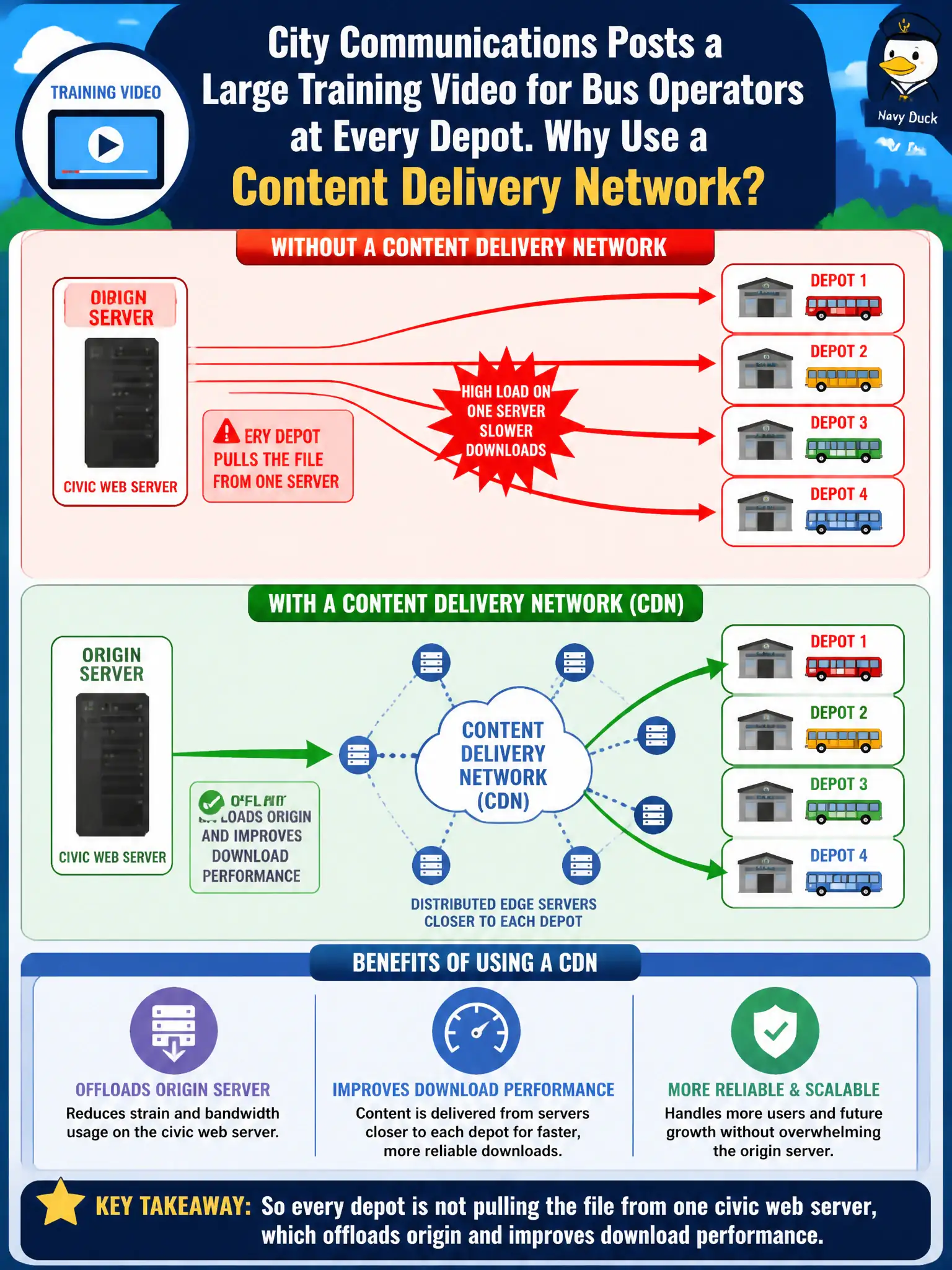
One giant video on one civic server is a stampede at every depot. A CDN copies the file to nearby caches so the origin survives and downloads stay snappy. Blast, UAG, and DEM are VDI and profile tools, not a video-distribution network.
Full Explanation
City communications uses a CDN for a large bus-operator training video so every depot is not pulling from one civic web server—offloading origin and improving download performance. In municipal EUC terms, treat the endpoint as a window into city systems when the architecture says so, not as the system of record for the files or apps in the stem. Distractor concept: Horizon Client Blast is not how the training video file is delivered as a CDN substitute. Distractor concept: UAG TLS termination is not the reason to use a CDN for the video file. Distractor concept: DEM roaming the video into each operator profile is not CDN origin offload. Exam caveat: Large shared media to many sites → CDN; not Blast, UAG, or DEM. Operational check: Publish the video via CDN endpoints at depots and compare origin bandwidth versus direct civic web-server pulls. Record the chosen control and the rejected failure modes in the civic change ticket or runbook so on-call staff and auditors share the same rationale after the next maintenance window. Re-validate after personnel or image changes that the same control still meets the city's continuity, security, and support expectations for this service. Helpdesk coaching tip aligned to the conversational brief: One giant video on one civic server is a stampede at every depot. A CDN copies the file to nearby caches so the origin survives and downloads stay snappy. Blast, UAG, and DEM are VDI and profile tools, not a video-distribution network.