
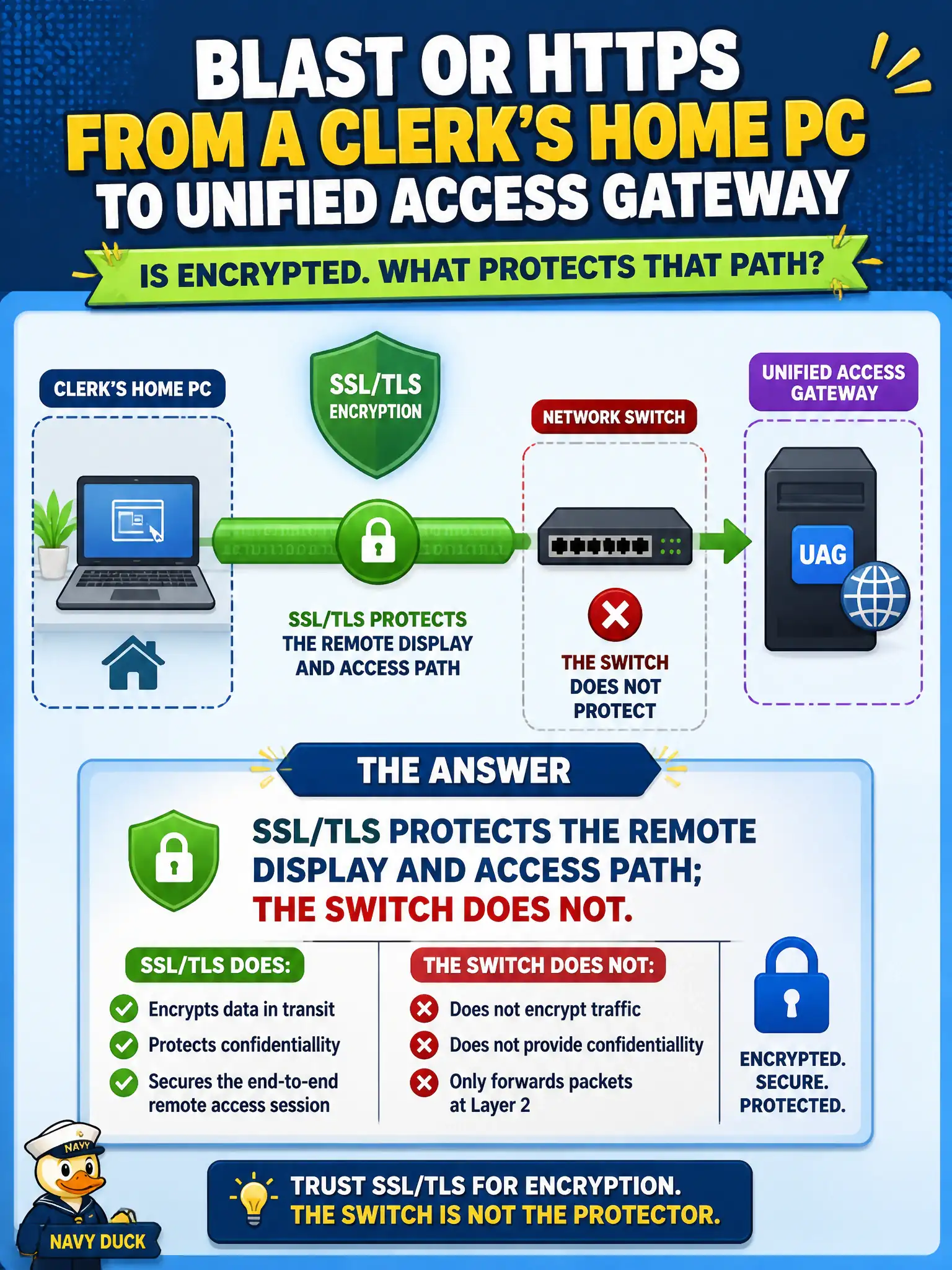
Blast or HTTPS from a clerk's home PC to Unified Access Gateway is encrypted. What protects that path?
Select an answer to reveal the explanation.
Short Explanation
The home-to-UAG path is a sealed envelope, not a magic switch port. SSL/TLS is what encrypts Blast or HTTPS. VLANs and DHCP get packets to a place; they do not wrap the session.
Full Explanation
Blast or HTTPS from a clerk's home PC to UAG is protected by SSL/TLS on the remote display and access path—not by the access closet switch. In municipal EUC terms, treat the endpoint as a window into city systems when the architecture says so, not as the system of record for the files or apps in the stem. Distractor concept: Layer-2 switching does not encrypt the Blast session. Distractor concept: DHCP assignment does not encrypt the remote display path. Distractor concept: A VLAN tag is not a TLS tunnel for the session. Exam caveat: Encryption of remote Horizon paths is TLS; switching/DHCP/VLAN are not substitutes. Operational check: Verify certificates and TLS on the UAG/Blast path and show that VLAN/DHCP alone do not provide confidentiality. Record the chosen control and the rejected failure modes in the civic change ticket or runbook so on-call staff and auditors share the same rationale after the next maintenance window. Re-validate after personnel or image changes that the same control still meets the city's continuity, security, and support expectations for this service. Helpdesk coaching tip aligned to the conversational brief: The home-to-UAG path is a sealed envelope, not a magic switch port. SSL/TLS is what encrypts Blast or HTTPS. VLANs and DHCP get packets to a place; they do not wrap the session.