
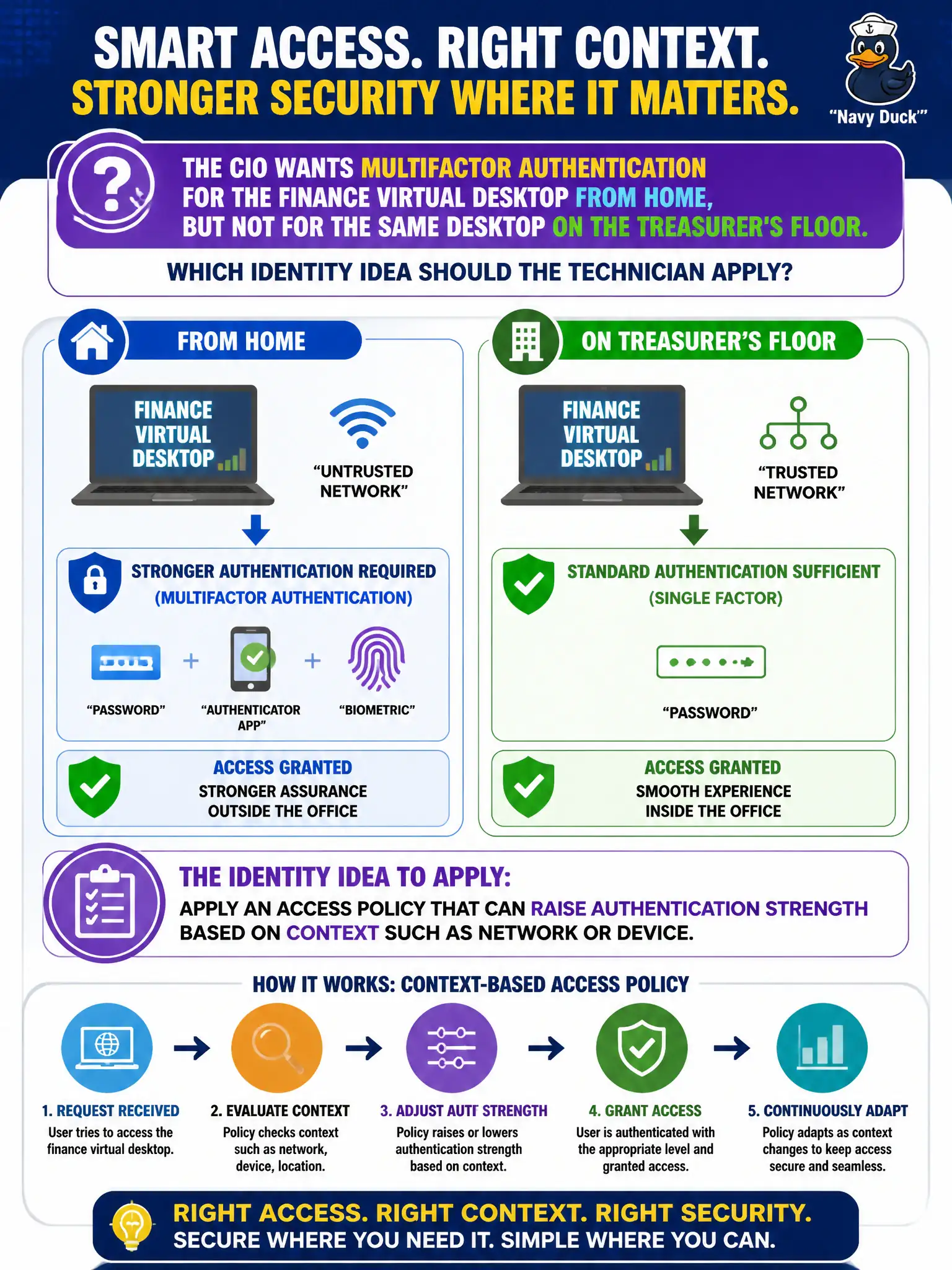
The CIO wants multifactor authentication for the finance virtual desktop from home, but not for the same desktop on the treasurer's floor. Which identity idea should the technician apply?
Select an answer to reveal the explanation.
Short Explanation
Home versus the treasurer's floor is like using a deadbolt on the street door and a simple latch inside the office. IAM can ask for a stronger proof when the network looks untrusted. Blast versus PCoIP is a display-protocol choice, not an MFA policy.
Full Explanation
Multifactor for finance VDI from home but not on the treasurer's floor is an access policy that raises authentication strength based on context such as network or device. In municipal EUC terms, treat the endpoint as a window into city systems when the architecture says so, not as the system of record for the files or apps in the stem. Distractor concept: Switching Blast to PCoIP off-site changes display protocol, not authentication strength. Distractor concept: Disabling vSphere HA does not implement contextual MFA. Distractor concept: Assignable writable volumes by home IP are packaging rules, not MFA policy. Exam caveat: Contextual auth strength is IAM/access policy—not protocol swaps, HA toggles, or App Volumes conditions. Operational check: Configure a policy that requires stronger auth off-network, test from home versus floor, and confirm finance pool access matches the CIO intent. Record the chosen control and the rejected failure modes in the civic change ticket or runbook so on-call staff and auditors share the same rationale after the next maintenance window. Re-validate after personnel or image changes that the same control still meets the city's continuity, security, and support expectations for this service.