
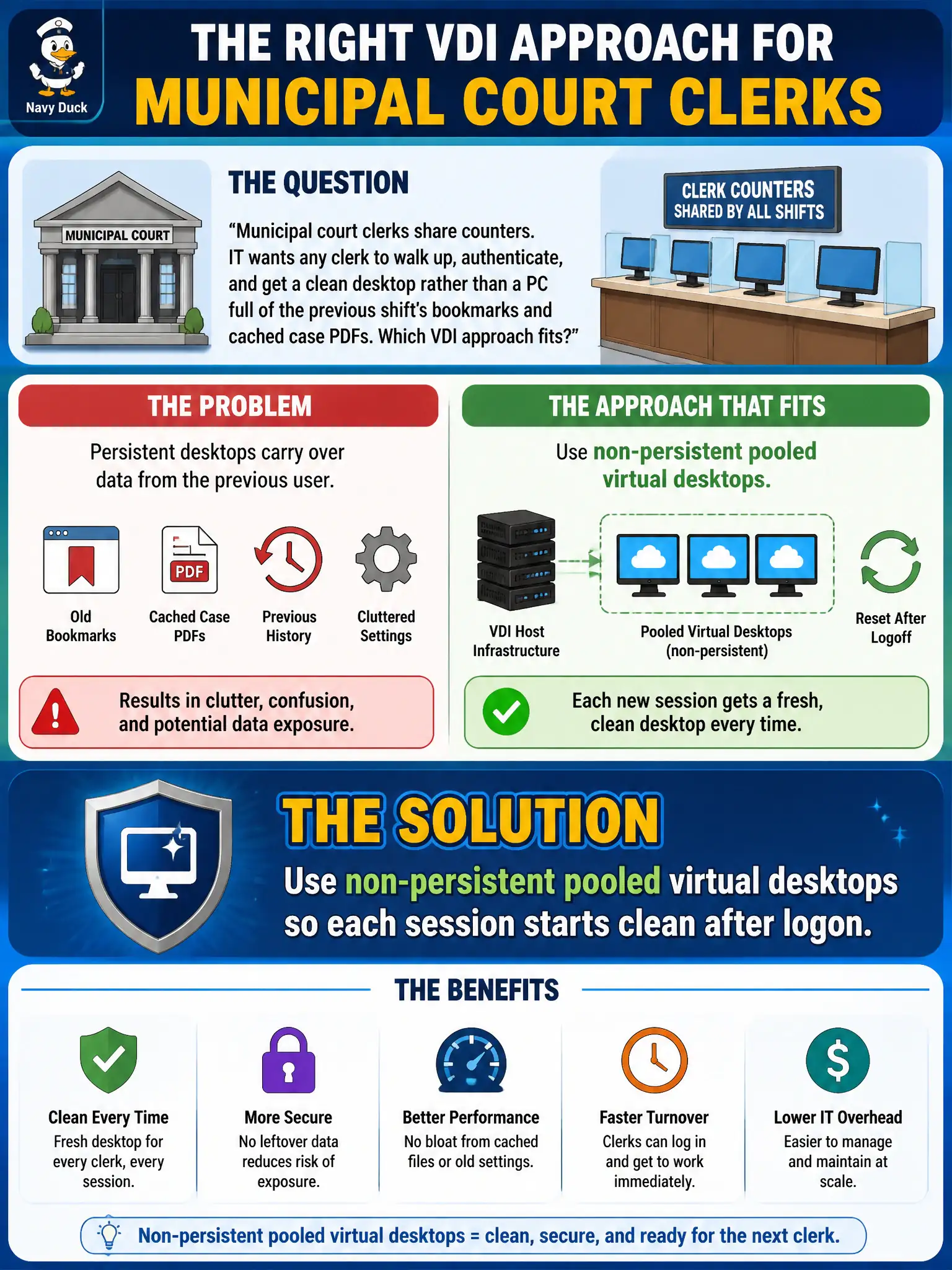
Municipal court clerks share counters. IT wants any clerk to walk up, authenticate, and get a clean desktop rather than a PC full of the previous shift's bookmarks and cached case PDFs. Which VDI approach fits?
Select an answer to reveal the explanation.
Short Explanation
A shared court counter should feel like a freshly wiped chalkboard at the start of each shift. Non-persistent pooled VDI hands every clerk a clean desktop and leaves yesterday's bookmarks behind.
Full Explanation
Non-persistent pooled virtual desktops give any court clerk a clean desktop after logon so shared counters do not keep the prior shift's bookmarks and cached case PDFs. In municipal EUC terms, treat the endpoint as a window into city systems when the architecture says so, not as the system of record for the files or apps in the stem. Distractor concept: Dedicated fat PCs left logged in between shifts retain prior-user residue and break walk-up sharing. Distractor concept: Leaving case PDFs in local browser cache for the next clerk intentionally leaks case material across shifts. Distractor concept: Pushing the previous shift's writable volume to every counter preserves personalization across users, which contradicts a clean session. Exam caveat: Shared kiosk/counter scenarios map to non-persistent pooled desktops, not writable volumes that follow the last user. Operational check: Log on as clerk A with bookmarks and a case PDF, log off, log on as clerk B, and confirm a clean session without A's cache. Record the chosen control and the rejected failure modes in the civic change ticket or runbook so on-call staff and auditors share the same rationale after the next maintenance window. Re-validate after personnel or image changes that the same control still meets the city's continuity, security, and support expectations for this service.